
Spanish Man Buys Philippines Home for €7,000: A Lifestyle Shift
A Spanish man's €7,000 home purchase in the Philippines sparks debate about affordability, lifestyle, and breaking away from Spain. Explore the costs and realities.
English · Original discussion in Spanish · Published
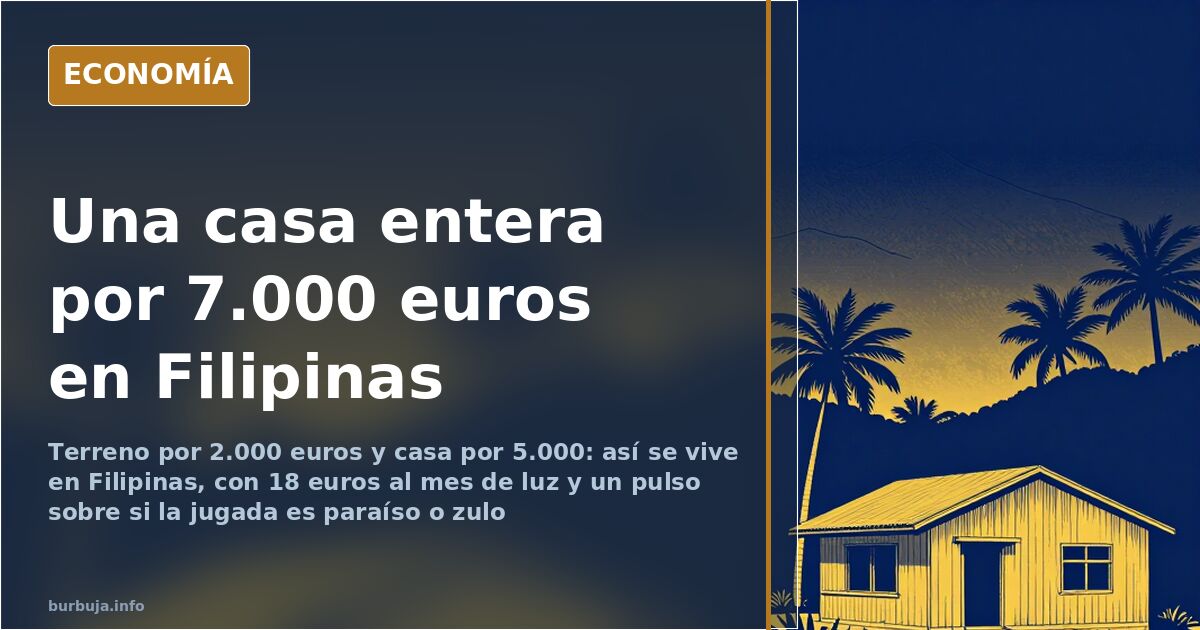
Philippines: €2,000 for Land, €5,000 for House
The budget fits on a napkin. Two thousand euros for the plot. Five thousand for the dwelling. Seven thousand in total for a single-story concrete house, built in a wind-protected valley and designed to withstand typhoons and earthquakes on the other side of the world. The figure, shared by a Spaniard who travels back and forth from Mallorca, has turned a home video into a debate about something bigger: the true cost of breaking away from Spain and what one pays for it in comfort, rights, and safety nets.
There's a second part that almost no one discusses. It's not just the bricks and mortar that are cheap. The owner boasts that the air conditioning, running 24/7, costs him €18 a month in electricity. In Spain, that same unit running at full power during an entire August would barely cover the family's dinner. With such a difference, the narrative of a tropical paradise begins to hold up under scrutiny.
What the €7,000 House Includes
The video's author, from Mallorca, insists he didn't build a shack. He constructed it in a valley to shelter it from extreme winds, with a reinforced structure and quality fixings, admitting that skipping these reinforcements would have halved the cost. Proof against typhoons, earthquakes, and landslides, he says. He also clarifies that the house is registered in his partner's name, giving her a place to live when he returns to Spain, and that when they are together, they usually stay on other islands with better beaches. His plan, on paper, is to stay there for one or two decades before old age sets in and then return.
Not everyone takes the roof's durability for granted. The most optimistic calculation assumes the structure can withstand anything; the most cautious warns that winds of 80 or 100 kilometers per hour could rip off the roof, no matter how much concrete is underneath. And there's the question of water: how to divert the mountain rain when it pours.
Foreigners Cannot Own Land
Here's the point that changes the entire transaction. The Philippines restricts land ownership for foreigners. The usual solution is to register the house in the name of a local partner, and the protagonist explains it plainly: when a foreigner marries a Filipina, she cannot divorce him if he doesn't want to, and if she intends to move on, she'd better negotiate amicably. This is not a minor detail when the property, according to his account, is now worth several times its purchase price: an investment he claims has tripled.
This same mechanism fuels the warnings. Some argue that renting is the only sensible option: if the relationship breaks down or the environment becomes toxic, you can just leave. Others counter that the risk is manageable with a stable cohabitation and roots. In any case, the land isn't bought like in Spain from a notary: without a deed in your name, ownership is an emotional loan, not an asset.
How Much Does it Cost to Rent a House in the Philippines?
Between €150 and €200 per month for a decent home on the same street where the partner's family lives, according to one of the circulating estimates. The fine print: many houses in the area are made of wood and sheet metal shacks, not air-conditioned villas. Renting is cheaper than buying, but buying ties you down more, which is precisely what some seek and others antiestéticar.
The total cost of settling in, for those considering it realistically, is around $600 to $800 per month without too much belt-tightening. With a modest Spanish pension, that's enough to live better than in many provincial capitals. The important nuance: we're talking about a local standard of living, not a mansion with a pool.
The Debate: Concrete Yard Shack or Cheap Paradise?
Rejection can be summarized with a phrase: why move 10,000 kilometers away to live in a concrete-yard shack. Added to this is the discomfort of seeing someone flaunt what others consider outright poverty on video, to the point of focusing on the most domestic details of the recording. And some recall that if the goal was to tighten the belt, staying in Spain and collecting public assistance would yield a similar result.
The defense comes from another angle. For a man with a small income, the alternative isn't a life of luxury in Spain: it's barely scraping by alone, between the TV and the village bar. In Southeast Asia, with the same pension, you can have a partner, warm weather, cheap food, and a house with mountain views. Others ground the case: in countries in the region, many foreigners live on this budget in towns and secondary cities. The calculation isn't just economic; it's also emotional. And that's where the numbers stop being decisive.
Ultimately, the figure that best illustrates the situation isn't the house price. It's the electricity bill: €18 a month with the air conditioning running non-stop. Anyone who has spent a summer in Spain knows how quickly such a bill arrives. The gap between that number and the one here explains, better than any speech, why the experiment continues to tempt people who, in their own country, no longer expect much.
The budget fits on a napkin. Two thousand euros for the plot. Five thousand for the dwelling. Seven thousand in total for a single-story concrete house, built in a wind-protected valley and designed to withstand typhoons and earthquakes on the other side of the world. The figure, shared by a Spaniard who travels back and forth from Mallorca, has turned a home video into a debate about something bigger: the true cost of breaking away from Spain and what one pays for it in comfort, rights, and safety nets.
There's a second part that almost no one discusses. It's not just the bricks and mortar that are cheap. The owner boasts that the air conditioning, running 24/7, costs him €18 a month in electricity. In Spain, that same unit running at full power during an entire August would barely cover the family's dinner. With such a difference, the narrative of a tropical paradise begins to hold up under scrutiny.
What the €7,000 House Includes
The video's author, from Mallorca, insists he didn't build a shack. He constructed it in a valley to shelter it from extreme winds, with a reinforced structure and quality fixings, admitting that skipping these reinforcements would have halved the cost. Proof against typhoons, earthquakes, and landslides, he says. He also clarifies that the house is registered in his partner's name, giving her a place to live when he returns to Spain, and that when they are together, they usually stay on other islands with better beaches. His plan, on paper, is to stay there for one or two decades before old age sets in and then return.
Not everyone takes the roof's durability for granted. The most optimistic calculation assumes the structure can withstand anything; the most cautious warns that winds of 80 or 100 kilometers per hour could rip off the roof, no matter how much concrete is underneath. And there's the question of water: how to divert the mountain rain when it pours.
Foreigners Cannot Own Land
Here's the point that changes the entire transaction. The Philippines restricts land ownership for foreigners. The usual solution is to register the house in the name of a local partner, and the protagonist explains it plainly: when a foreigner marries a Filipina, she cannot divorce him if he doesn't want to, and if she intends to move on, she'd better negotiate amicably. This is not a minor detail when the property, according to his account, is now worth several times its purchase price: an investment he claims has tripled.
This same mechanism fuels the warnings. Some argue that renting is the only sensible option: if the relationship breaks down or the environment becomes toxic, you can just leave. Others counter that the risk is manageable with a stable cohabitation and roots. In any case, the land isn't bought like in Spain from a notary: without a deed in your name, ownership is an emotional loan, not an asset.
How Much Does it Cost to Rent a House in the Philippines?
Between €150 and €200 per month for a decent home on the same street where the partner's family lives, according to one of the circulating estimates. The fine print: many houses in the area are made of wood and sheet metal shacks, not air-conditioned villas. Renting is cheaper than buying, but buying ties you down more, which is precisely what some seek and others antiestéticar.
The total cost of settling in, for those considering it realistically, is around $600 to $800 per month without too much belt-tightening. With a modest Spanish pension, that's enough to live better than in many provincial capitals. The important nuance: we're talking about a local standard of living, not a mansion with a pool.
The Debate: Concrete Yard Shack or Cheap Paradise?
Rejection can be summarized with a phrase: why move 10,000 kilometers away to live in a concrete-yard shack. Added to this is the discomfort of seeing someone flaunt what others consider outright poverty on video, to the point of focusing on the most domestic details of the recording. And some recall that if the goal was to tighten the belt, staying in Spain and collecting public assistance would yield a similar result.
The defense comes from another angle. For a man with a small income, the alternative isn't a life of luxury in Spain: it's barely scraping by alone, between the TV and the village bar. In Southeast Asia, with the same pension, you can have a partner, warm weather, cheap food, and a house with mountain views. Others ground the case: in countries in the region, many foreigners live on this budget in towns and secondary cities. The calculation isn't just economic; it's also emotional. And that's where the numbers stop being decisive.
Ultimately, the figure that best illustrates the situation isn't the house price. It's the electricity bill: €18 a month with the air conditioning running non-stop. Anyone who has spent a summer in Spain knows how quickly such a bill arrives. The gap between that number and the one here explains, better than any speech, why the experiment continues to tempt people who, in their own country, no longer expect much.
Summary of a discussion on Burbuja.info - Foro de economía, actualidad y política., translated from Spanish and reviewed before publication. Read the full discussion (201 replies).
More summaries
-
Euthanasia in Old Age: Autonomy vs. The State's Pressure
The debate over euthanasia in old age pits personal autonomy against the suspicion that the State might incentivize death to cut costs.
-
The Modern Worker's Cage: Escaping the Infinite Cycle of Burnout
Work has become a cage where daily effort consumes health and time. Discover why we push ourselves so hard and how to break the cycle.
-
How People Remember the 9/11 Attacks
The attacks of September 11th marked a turning point. Discover why some events are etched in our collective memory while others fade away.
-
Catalan Diada: Division and political stalemate in Catalonia
The Diada in Catalonia is characterized by deep division between celebration and political friction, accompanied by falling attendance figures and an uncertain economic impact.
-
Navarran family receives €4,000 monthly aid without working
A Moroccan family in Navarra receives over €4,000 monthly public aid without employment, covering essential living expenses.
-
Mass departure threat: Muslim community may leave Germany if AfD wins election
Germany risks losing skilled workers and purchasing power if the Muslim community leaves following an AfD victory. We analyze the economic implications.