
Spanish Local Police Warn: Placing Chairs on Public Sidewalks is Regulated
Local police in Spain warn that placing chairs or tables on public sidewalks is regulated and may require removal, clashing with local traditions.
English · Original discussion in Spanish · Published
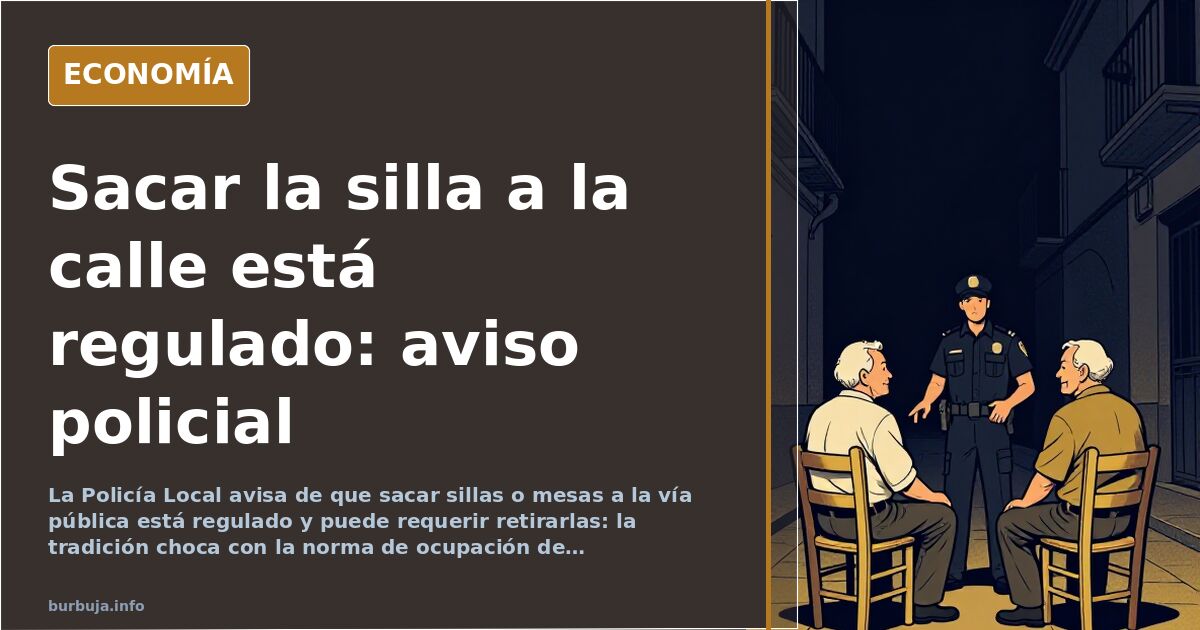
Police Warn: The Chair at the Doorway is Regulated
Can you still place a chair outside your door to enjoy the fresh air? According to a message from a Spanish Local Police force, public spaces are regulated. "We know that putting chairs or tables outside is a tradition in many towns, but the public space is regulated," the text states, asking residents to remove them if an officer requests it "out of respect and coexistence." This friendly warning has fallen like a cold shower for those who see this habit as more than furniture: a way of life fading due to administrative rules.
The reaction was immediate. Some recall that grandmothers sitting outside is a staple of rural Spain, while others defend that public space is regulated and cannot be occupied arbitrarily. Between these extremes, the police notice has peine a recurring debate: what can and cannot be done on the street, and why some occupations are pursued while others seem invisible to the administration.
What Exactly Does the Local Police Notice Say?
The message is brief and leaves no room for doubt: public space is regulated, and placing chairs or tables outside constitutes an occupation of public property. The Local Police do not mention specific fines or sanctions in that text, but they warn that if an agent asks for their removal, it is correct to comply. The argument is coexistence: with civility and common sense, they say, there are no disturbances.
The problem is that tradition clashes head-on with the rule. In many municipalities, occupying sidewalks or roads with personal furniture requires authorization and, where applicable, a fee. It is the same principle that forces a bar to pay for its terrace or request permission to install scaffolding or debris containers. Under this criterion, the chair at the doorway is not an endearing exception: it is an occupation without legal title.
This is where the conflict begins. What is a minor infraction for some is the last frontier of daily life for others. And the notice, framed as a civic recommendation, is read in many towns as an announcement that the street belongs to no one anymore.
The Tradition of the Chair at the Door: From Custom to Infraction
The image is familiar: folding chairs, a couple of neighbors, the shade of a building entrance, and a card game or after-dinner conversation. In many municipalities, this custom has persisted for decades without question. Some even remember painting a section of the sidewalk to reserve shade for games so no one would park there.
The clash arrives when the rule is applied strictly. Public space does not belong to the neighbor; it belongs to the community, and occupying it requires permission. Those who support the notice argue: if you pay for a terrace, there is no reason for a private chair to be exempt. Those who reject it respond that comparing a bar table to a grandmother's chair takes regulations beyond their intent.
Ultimately, the discussion is not about chairs. It is about who decides which uses of the street are legitimate and which become infractions. And whether the administrative response is proportionate or simply the easiest to apply.
The Double Standard Residents Denounce
The most repeated complaint is not against the rule itself, but against its selective application. Critics argue that while neighbors are warned for placing a chair, other occupations of public space—unauthorized sales stalls, goods on seaside promenades—remain untouched without similar diligence. The comparison highlights perceived injustice: harmless acts are pursued while truly annoying ones are tolerated.
This perception is hard to quantify but politically powerful. The feeling of unequal treatment turns a municipal notice into a matter of general indignation. It matters less about the fine than the criteria: why some are asked for civility while others are asked for nothing.
In this context, the police notice acts as a trigger. The chair is the symbol; the anger relates to authority and the sense that regulations are always applied in the same direction.
What Can and Cannot Be Done in Public Space
The general rule is simple: the street is public domain, and its occupation requires authorization. This includes hospitality terraces, scaffolding, construction containers, and any installation that reduces transit space. The fee is not a punishment; it is the price for using space that is not yours.
Applied to the chair at the doorway, the criterion is the same. Another issue is proportionality: if the occupation is minimal, temporary, and non-disruptive, does it make sense to mobilize an officer? Here, the notice becomes debatable even for those who accept the rule. The institutional response is usually that the law does not distinguish by size, and coexistence relies on compliance, not exceptions.
The result is an uncomfortable balance: the administration has legal right but loses the battle of common sense. And in towns, where everyone knows each other, this translates into a dull discomfort that neither side of the debate can dissolve.
In the end, the conclusion remains the same: public space is regulated, tradition has no market value, and the officer knocking on the door is administratively correct. The only thing left to decide is whether the chair is removed before or after the neighbor finishes their game.
Can you still place a chair outside your door to enjoy the fresh air? According to a message from a Spanish Local Police force, public spaces are regulated. "We know that putting chairs or tables outside is a tradition in many towns, but the public space is regulated," the text states, asking residents to remove them if an officer requests it "out of respect and coexistence." This friendly warning has fallen like a cold shower for those who see this habit as more than furniture: a way of life fading due to administrative rules.
The reaction was immediate. Some recall that grandmothers sitting outside is a staple of rural Spain, while others defend that public space is regulated and cannot be occupied arbitrarily. Between these extremes, the police notice has peine a recurring debate: what can and cannot be done on the street, and why some occupations are pursued while others seem invisible to the administration.
What Exactly Does the Local Police Notice Say?
The message is brief and leaves no room for doubt: public space is regulated, and placing chairs or tables outside constitutes an occupation of public property. The Local Police do not mention specific fines or sanctions in that text, but they warn that if an agent asks for their removal, it is correct to comply. The argument is coexistence: with civility and common sense, they say, there are no disturbances.
The problem is that tradition clashes head-on with the rule. In many municipalities, occupying sidewalks or roads with personal furniture requires authorization and, where applicable, a fee. It is the same principle that forces a bar to pay for its terrace or request permission to install scaffolding or debris containers. Under this criterion, the chair at the doorway is not an endearing exception: it is an occupation without legal title.
This is where the conflict begins. What is a minor infraction for some is the last frontier of daily life for others. And the notice, framed as a civic recommendation, is read in many towns as an announcement that the street belongs to no one anymore.
The Tradition of the Chair at the Door: From Custom to Infraction
The image is familiar: folding chairs, a couple of neighbors, the shade of a building entrance, and a card game or after-dinner conversation. In many municipalities, this custom has persisted for decades without question. Some even remember painting a section of the sidewalk to reserve shade for games so no one would park there.
The clash arrives when the rule is applied strictly. Public space does not belong to the neighbor; it belongs to the community, and occupying it requires permission. Those who support the notice argue: if you pay for a terrace, there is no reason for a private chair to be exempt. Those who reject it respond that comparing a bar table to a grandmother's chair takes regulations beyond their intent.
Ultimately, the discussion is not about chairs. It is about who decides which uses of the street are legitimate and which become infractions. And whether the administrative response is proportionate or simply the easiest to apply.
The Double Standard Residents Denounce
The most repeated complaint is not against the rule itself, but against its selective application. Critics argue that while neighbors are warned for placing a chair, other occupations of public space—unauthorized sales stalls, goods on seaside promenades—remain untouched without similar diligence. The comparison highlights perceived injustice: harmless acts are pursued while truly annoying ones are tolerated.
This perception is hard to quantify but politically powerful. The feeling of unequal treatment turns a municipal notice into a matter of general indignation. It matters less about the fine than the criteria: why some are asked for civility while others are asked for nothing.
In this context, the police notice acts as a trigger. The chair is the symbol; the anger relates to authority and the sense that regulations are always applied in the same direction.
What Can and Cannot Be Done in Public Space
The general rule is simple: the street is public domain, and its occupation requires authorization. This includes hospitality terraces, scaffolding, construction containers, and any installation that reduces transit space. The fee is not a punishment; it is the price for using space that is not yours.
Applied to the chair at the doorway, the criterion is the same. Another issue is proportionality: if the occupation is minimal, temporary, and non-disruptive, does it make sense to mobilize an officer? Here, the notice becomes debatable even for those who accept the rule. The institutional response is usually that the law does not distinguish by size, and coexistence relies on compliance, not exceptions.
The result is an uncomfortable balance: the administration has legal right but loses the battle of common sense. And in towns, where everyone knows each other, this translates into a dull discomfort that neither side of the debate can dissolve.
In the end, the conclusion remains the same: public space is regulated, tradition has no market value, and the officer knocking on the door is administratively correct. The only thing left to decide is whether the chair is removed before or after the neighbor finishes their game.
Also available in: Deutsch
Summary of a discussion on Burbuja.info - Foro de economía, actualidad y política., translated from Spanish and reviewed before publication. Read the full discussion (120 replies).
More summaries
-
Emergency services warned Santander police about footbridge a day before collapse
The 112 emergency service passed on a warning about the poor condition of the Santander footbridge to local police 24 hours before it collapsed. The officer who took the call did not...
-
Eight Police Pistols Stolen From Spanish Rural Station
Thieves stole eight service pistols and ammunition from a local police station in els Poblets, Spain. The Civil Guard investigates the breach.
-
Police restraint sparks debate in Spain
Video shows police restraining a man amid neighbor applause. Debate on proportionality and citizen security law reopens.
-
Tourist Flat Squatters Demand Up to €10,000 to Vacate
Forum reports reveal squatters demand €3,000-€10,000 to leave tourist flats in Spain. Overburdened courts and organized gangs worsen the crisis.
-
Forum debate predicts wealth gap between native and immigrant youth in Spain
Online discussions suggest native Spanish youth will inherit assets while immigrants won't, warning of potential social unrest in two decades.
-
US 10-Year Yield Tops 5.30% After Inflation Data
US 10-year Treasury yield breached 5.30% following higher-than-expected inflation data, while UK 30-year gilts hit 6%, raising refinancing costs.