
Spanish housing prices rise 18% in three years amid heated debate
A forum user claims Spanish housing prices rose 18% in three years and predicts an 11% further increase, sparking debate over supply imbalances.
English · Original discussion in Spanish · Published
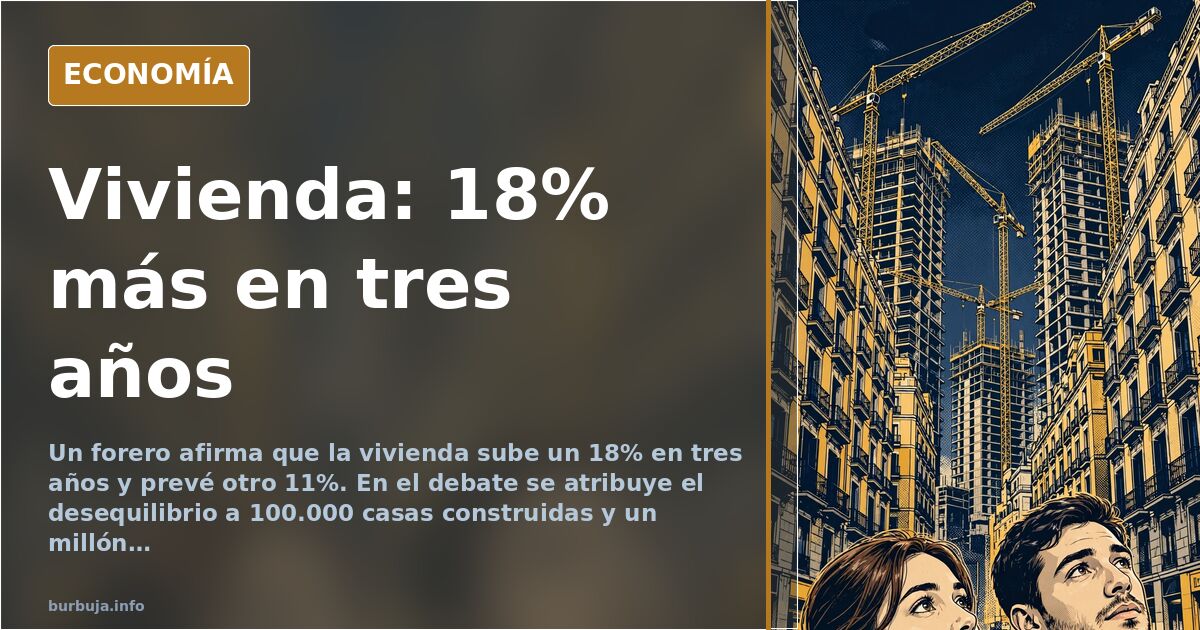
Housing prices up 18% in three years as consensus on causes collapses
The conversation opens with a stark figure: property prices have accumulated an 18% increase over the last three years, with forecasts predicting another 11% rise in the coming period, according to the post that started the discussion. This statistic, thrown out as a provocation, ignites a debate that has been simmering for years: is real estate rising, or is money losing value? The answer depends on who you ask, and almost no one agrees.
What the data says versus what skeptics claim
The first sustancia ilegal appears when questioning the source. Some argue that the reported 11% year-on-year rental increase is simply false, pointing to a shift in statistical control: the acquisition of a real estate portal by a valuation firm allegedly served to inflate the narrative and justify a public housing plan. Suspicion doesn't stop there. The CNMC (Spain's National Markets and Competition Commission) has fined several portals and agencies for colluding on commissions, fueling the theory that prices are not a natural phenomenon but a choreographed act.
Against this interpretation, the most repeated explanation remains the classic one: it is not that housing is getting more expensive, but that the value of money is falling. With central bank printers running at full capacity, any real asset appreciates by default. The underlying debate is whether we are facing a bubble or a flight to tangible assets.
Supply, demand, and a million new residents per year
The argument gaining the most traction toward the end of the conversation concerns the imbalance between construction and population growth. If a country builds 100,000 homes annually while incorporating one million new inhabitants each year, it would be strange if prices didn't rise significantly, according to calculations circulating in the debate. The conclusion is uncomfortable: there is no room for prices to drop as long as the equation remains unbalanced.
The other side of the coin is purchasing power. Many people can no longer access a mortgage, and without financing, 95% of potential buyers are left out of the market, according to one user. Pessimists argue this should cool prices due to a lack of solvent buyers. Skeptics see the opposite: investment funds filling this void by buying without credit needs, turning renting into the only viable option for the majority.
Rent strikes and the limits of civil disobedience
In this context emerges the most radical proposal: tenant pickets and rent strikes promoted by the Madrid Tenants' Union, a campaign of civil disobedience aimed at forcing price reductions. The idea immediately divides opinion. Some view it as the only remaining tool when political channels are blocked; others remind us that courts are slow but eventually catch up, and non-payment leads to convictions, seizures, and legal costs.
The fundamental problem is that such a strike can only be sustained by those with nothing to lose. Anyone with a salary, guarantor, or assets is unlikely to take the risk. And those who don't likely won't find anyone willing to rent to them anyway.
Building cheaper: the path nobody wants to discuss
The latest angle involves technology. Lowering construction costs is presented as the only realistic solution: prefabricated housing, concrete modules, 3D printing. In Sweden, according to available data, around 60% of housing is built this way. In Spain, however, buyers remain distrustful: if plasterboard is already perceived as a scam, prefabricated houses are directly associated with refugee camps.
The underlying calculation is simple: either raise bricklayers' wages indefinitely to attract labor, or industrialize the sector. The former makes housing more expensive; the latter lowers costs but concentrates business in fewer hands and destroys traditional jobs. No one has yet found a way to make this politically sellable.
Ultimately, the question hovering over the entire discussion isn't how much prices will rise, but how long a country can sustain building 100,000 homes a year for a million newcomers. For now, the answer mirrors the price trend: upward.
Summary of a discussion on Burbuja.info - Foro de economía, actualidad y política., translated from Spanish and reviewed before publication. Read the full discussion (155 replies).
More summaries
-
Madrid housing prices jump 7.4%, reigniting bubble fears
Madrid capital saw a 7.4% year-on-year price rise in April 2024, while towns like Coslada remain below 2008 levels. The debate over a property bubble intensifies.
-
Spain's housing prices fall for the first time, forum data show
Forum participants celebrate a 2.6% national drop, with Navarra seeing a 35% plunge, signaling a shift in Spain's property market.
-
Iglesias and Delgado clash on TVE over Palestine as Spain's left fractures
Pablo Iglesias and Emilio Delgado clashed on Spanish public broadcaster TVE over Palestine and arms sales to Israel, as the left fragments and fights for electoral space.
-
Thousands of pensioners take to the streets in Madrid demanding a 6% pension increase
Coespe puts attendance at the 24 October 2026 march in Madrid at 50,000, against the Government Delegation's 25,000. They were demanding a 6% rise.
-
Why does Spain innovate so little?
Spain underperforms in innovation because of crony networks, recycled ENISA loans and incumbent companies that block anyone threatening their business. Here is why.
-
Sánchez on La Revuelta: promises to renew Broncano if he wins
Spain's PM Sánchez promised on TVE's La Revuelta to renew Broncano's show if he wins. The interview, with pre-agreed questions and applause, fuels controversy over the use of public television.