
Spanish healthcare complaints: 'Doctors miss a thousand things'
Forum testimonials cite five-minute visits, steroid prescriptions, and six ophthalmologists without diagnosis. Growing dissatisfaction with medical care.
English · Original discussion in Spanish · Published
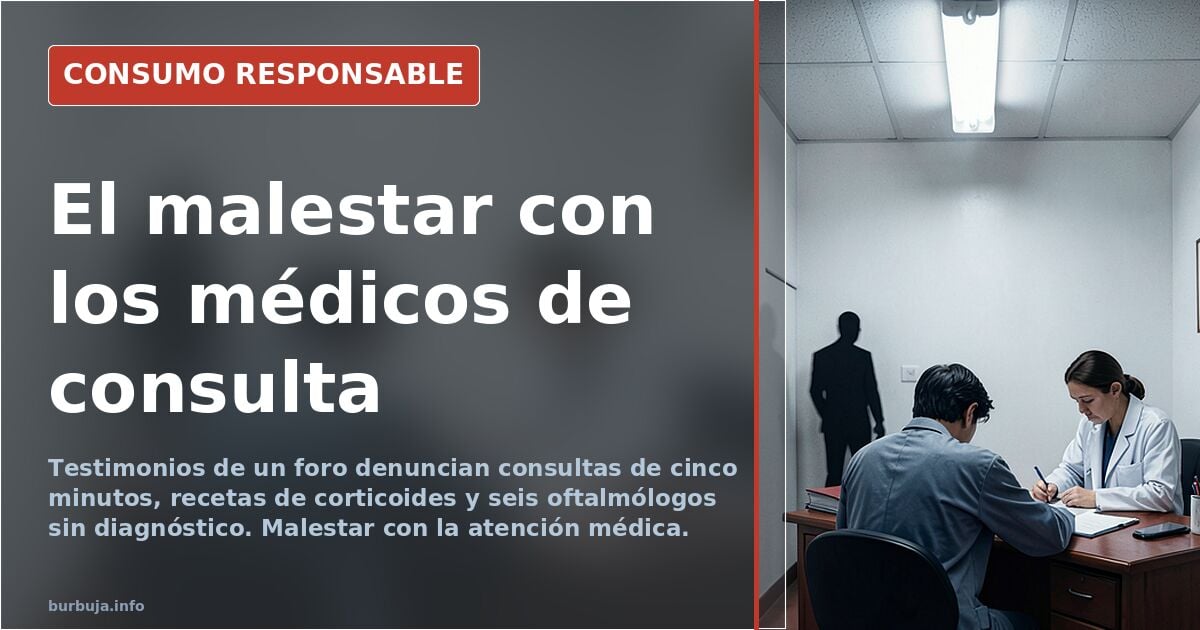
Growing complaints against healthcare in Spain
One patient sees six ophthalmologists without anyone solving the problem. Another leaves Madrid, crosses half of Spain, and has perfect skin the next day. Yet another accumulates steroid prescriptions that only mask symptoms until the next visit. The scene repeats: five-minute consultations, incomplete diagnoses, and a growing sense that the general practitioner no longer acts as a filter, but as a dispenser of paracetamol.
The discontent does not distinguish between public and private healthcare. This is the thesis supported by most testimonials: **80% of doctors who see patients overlook things**, write prescriptions incorrectly, or send patients from one specialist to another. The minority who get it right, they say, "sustain civilization." And the generational diagnosis is devastating: young people aged 25 to 40, including men, fare worse than veterans, whose presence has been missed since 2020.
Specialties under suspicion: ophthalmology and dermatology in the crosshairs
The most repeated hypothesis points not to the individual, but to the **specialty**. Ophthalmology that only knows how to prescribe artificial tears. Dermatology that only prescribes steroids. The pattern repeats until it becomes a caricature: the specialist applies their protocol and sends the patient back to square one. When treatment ends, the problem remains, and it’s time to start over.
The second hypothesis is structural. **Private healthcare** operates like a poorly managed company that mistreats its doctors, and those burned-out doctors perform less effectively. The mix of exhaustion and apathy—"a blend of burnout and lack of desire to be there"—explains why the service in the nineties and two-thousands bears no resemblance to today's.
Why do younger doctors provide worse care than veterans?
The dominant perception identifies professionals aged **25 to 40** as the weakest link, regardless of gender. In contrast, doctors aged 50 to 60 who practiced before 2020 have become rare, as if they had all retired en masse. Nostalgia for old-style care is not just longing; it confirms that the new generation has not maintained the standard.
Some go further, predicting a future of **quacks and underground doctors** if this trend continues. They argue that life expectancy figures are manipulated by mixing them with the average population age to appear higher than they are. Nursing is also included: finding a vein is becoming increasingly difficult.
Pills as the universal solution
The pharmacological pattern repeats with an insistence bordering on scriptwriting: **pills for diabetes, cholesterol, and blood pressure** prescribed "no matter what." Patients leave with a prescription but no diagnosis. The complaint is not against medication, but against replacing analysis with leaflets.
The anecdote that best summarizes the phenomenon is dermatitis: steroids in Madrid, perfect skin the day after leaving the capital. Something fails in treatment, management, or both. Neither fame nor money buys better care: those visiting the same luxury hospitals as royalty complain about the same cold treatment as public hospital patients.
AI as an exit and the disorienting data
The technological proposal appears early: **image-based diagnosis** without stress, without five-minute consultations, and with access to global results. The obstacle is not technical but political: if the sector has the power of notaries, AI will take time to enter. Meanwhile, patients remain at the mercy of whichever specialist is on duty.
And the disorienting data: in a system where complaints are general, the most repeated solution is not more doctors or budget, but **algorithms**. When users trust a machine more than whoever takes their blood pressure, the problem is no longer about scheduling.
Also available in: Deutsch
Summary of a discussion on Burbuja.info - Foro de economía, actualidad y política., translated from Spanish and reviewed before publication. Read the full discussion (26 replies).
More summaries
-
Gluten intolerance: most self-diagnoses don't hold up
A double-blind study shows that most people who believe they are gluten intolerant experience no real symptoms when consuming it. The myth of…
-
Spaniards’ Unfiltered Medical Histories: From Circumcision to Stage IV Lymphoma
114 forum responses reveal Spain’s surgical reality: from fimosis to lymphoma, covering medical errors and domestic accidents.
-
Most Celiacs Lack Digestive Symptoms, Delaying Diagnosis in Spain
Isabel Polanco warns that celiac disease often presents without digestive symptoms, delaying diagnosis and increasing undetected cases.
-
Spanish 1970s Cookies: The Lost Taste of Childhood
Iconic Spanish brands like Cuétara and Fontaneda have changed. Palm oil, mergers, and quality cuts explain the decline of a national staple.
-
Radical Fruitarian Diet Claims Only Sugar Is Human Food
A radical thesis argues fruit is the only human food and starch is toxic. Protein calculations and cellulose roles challenge this view.
-
Spain's Neighbor Noise: Legal Limits and Retaliation
Legal recourse against noisy neighbors in Spain is limited. Reporting creates records but rarely solves issues, leading to informal retaliation tactics.