
Spanish Forum User Plans Rural Escape to Switzerland
A Spanish forum user plans to work in Switzerland to fund a rural property, sparking debate on country life.
English · Original discussion in Spanish · Published
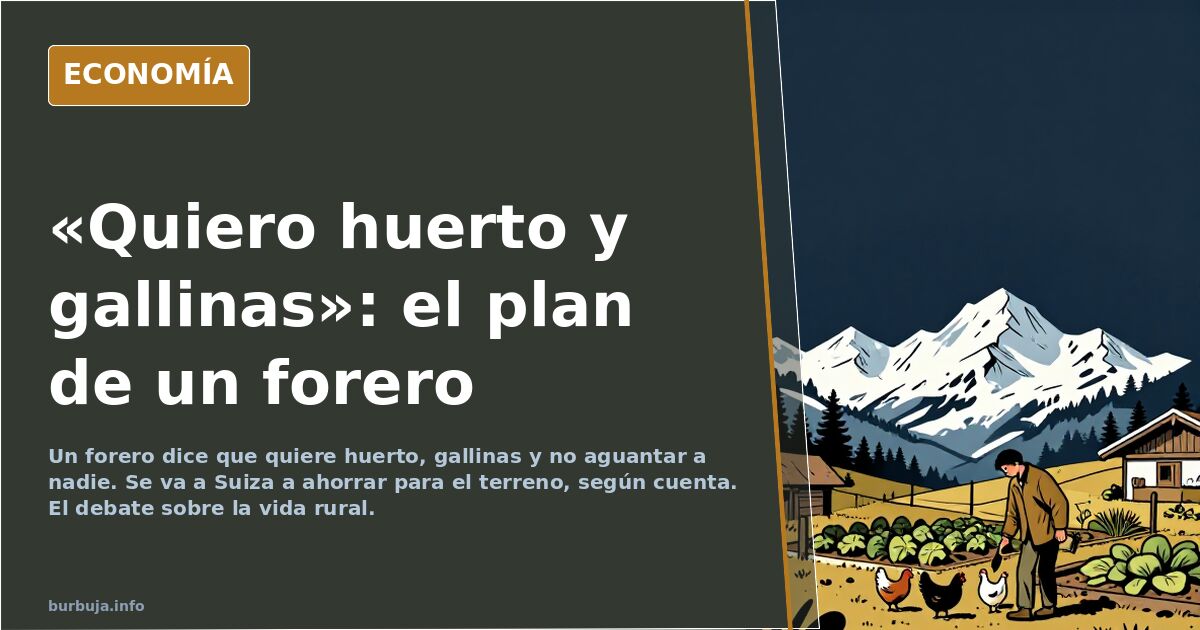
Trading the Office for a Garden and Chickens
There is a generation that has stopped arguing about salaries and started debating the meaning of everything else. A forum user summarized it this way: his only interest is having some hectares, animals, a vegetable garden, fruit trees, and above all, not having to put up with anyone. He is not an isolated exception. The conversation generated by his post, with more than a hundred accumulated replies, reveals a pattern that goes far beyond the typical Monday morning venting.
The diagnosis shared by those who join the approach is that the urban lifestyle model has become a machine extracting time and energy in exchange for very little. Eight hours locked inside daily, two real weeks of vacation per year, and a weekend to recover from the week. The city, they say, no longer sells pogre: it sells proximity to services and concentration of wealth, with everything that entails.
The countryside as an economic refuge, not just emotional
The first reaction of many is the usual one: if the countryside makes you so happy, go there. But the author himself has a concrete plan. He says he is moving to Switzerland to save money to buy land. It is not a romantic escape: it is an accumulation strategy. Working abroad to finance the purchase of land in Spain is a pattern that appears repeatedly in the conversation.
Some argue that the birth rate is historically higher in rural areas than in cities, and that this is not a coincidence. More potential partners in a city, yes, but also more chances of personal failure. The city, they argue, does not exist for people to form families: it exists to concentrate services and wealth.
How much does a village house really cost?
Here comes one of the most uncomfortable data points of the matter. One participant puts a farm up for sale antiestéticaturing 14,000 square meters with a well, pool, deed-registered house, 100 olive trees, fruit trees, and nearly a thousand pines in the dry plains of La Mancha. The price does not appear in the message, but the description gives an idea of what can be bought outside major hubs for a fraction of the cost of an apartment in any capital city.
Another participant has already bought a plot, although he admits he can only visit during holidays because he cannot leave his job. This is the dominant pattern: people who buy land but cannot live off it. The gap between desire and execution is enormous.
The problem is not the countryside, it is the partner
The initial message includes a confession that disconcerts: he would love to have a vvife and five children, but sees it as impossible in the era he lives in. The response from others is relentless. He is told that with such a closed mindset he has very few options to find a partner, and that this is statistics, not opinion.
The contradiction is evident. He wants a large family, but rejects the environment where statistically it is more likely to find one. He wants to live isolated, but complains of loneliness. This is the Gordian knot of the entire proposal: total autonomy and family life are objectives that clash with each other.
The Swiss trap: workaholics in the country of workaholics
One of the sharpest blows in the debate arrives when his move to Switzerland is pointed out as contradictory. If you find it abnormal that people are workaholics, why are you going to the country with the most workaholics in the world, along with the United States? You are not going to meditate in the Alps: you are going to work more than here.
The author himself assumes this: that is why he is going, to save. But the warning is clear. The first years in Switzerland, without a top salary, are lived in a shared room with Eastern European migrants, not in a chalet in Gstaad. The reality of Switzerland for a newcomer without a support network is much harsher than the collective imagination suggests.
The experience of those who already tried
Against theory, there is practice. Someone who lives in a small village has it clear: he would have it easy. Another participant says he knows city people who have been saying for 25 years that they would move to the countryside, and none have done it. One has a perfectly equipped country house an hour from Madrid and gets overwhelmed if he stays more than a week. Another has a farmhouse and cannot stand it either.
The conclusion drawn from these experiences is that the countryside is not for everyone, no matter how idealized it is. Loneliness, lack of services, and dependence on a car for everything weigh more than the fantasy suggested by Idealista (a popular Spanish real estate portal).
The calculation nobody makes: €10,000 doesn't fix a house
One of the most useful pieces of data in the exchange is the warning that €10,000 is a ridiculous figure to renovate a house. Those who say this have experience: they know many people who fantasize about rural life but never take the step. The real cost of renovating a rustic house, with its installations, insulation, and permits, devours any optimistic budget.
The complete calculation, broken down item by item, yields a difference that surprises those who have only looked at the plot price. Cheap land is just the beginning. The habitable house is where the money goes.
The question left hanging
Is it possible to live outside the system without ending up dependent on it? The author of the message says he is leaving for Switzerland in January. If he returns with the money for the land, he will have to face everything the rest warned him about: loneliness, hidden costs, the difficulty of finding a partner in a rural environment, and the temptation to return to the city when winter drags on. No one in the entire conversation has managed to resolve that contradiction.
There is a generation that has stopped arguing about salaries and started debating the meaning of everything else. A forum user summarized it this way: his only interest is having some hectares, animals, a vegetable garden, fruit trees, and above all, not having to put up with anyone. He is not an isolated exception. The conversation generated by his post, with more than a hundred accumulated replies, reveals a pattern that goes far beyond the typical Monday morning venting.
The diagnosis shared by those who join the approach is that the urban lifestyle model has become a machine extracting time and energy in exchange for very little. Eight hours locked inside daily, two real weeks of vacation per year, and a weekend to recover from the week. The city, they say, no longer sells pogre: it sells proximity to services and concentration of wealth, with everything that entails.
The countryside as an economic refuge, not just emotional
The first reaction of many is the usual one: if the countryside makes you so happy, go there. But the author himself has a concrete plan. He says he is moving to Switzerland to save money to buy land. It is not a romantic escape: it is an accumulation strategy. Working abroad to finance the purchase of land in Spain is a pattern that appears repeatedly in the conversation.
Some argue that the birth rate is historically higher in rural areas than in cities, and that this is not a coincidence. More potential partners in a city, yes, but also more chances of personal failure. The city, they argue, does not exist for people to form families: it exists to concentrate services and wealth.
How much does a village house really cost?
Here comes one of the most uncomfortable data points of the matter. One participant puts a farm up for sale antiestéticaturing 14,000 square meters with a well, pool, deed-registered house, 100 olive trees, fruit trees, and nearly a thousand pines in the dry plains of La Mancha. The price does not appear in the message, but the description gives an idea of what can be bought outside major hubs for a fraction of the cost of an apartment in any capital city.
Another participant has already bought a plot, although he admits he can only visit during holidays because he cannot leave his job. This is the dominant pattern: people who buy land but cannot live off it. The gap between desire and execution is enormous.
The problem is not the countryside, it is the partner
The initial message includes a confession that disconcerts: he would love to have a vvife and five children, but sees it as impossible in the era he lives in. The response from others is relentless. He is told that with such a closed mindset he has very few options to find a partner, and that this is statistics, not opinion.
The contradiction is evident. He wants a large family, but rejects the environment where statistically it is more likely to find one. He wants to live isolated, but complains of loneliness. This is the Gordian knot of the entire proposal: total autonomy and family life are objectives that clash with each other.
The Swiss trap: workaholics in the country of workaholics
One of the sharpest blows in the debate arrives when his move to Switzerland is pointed out as contradictory. If you find it abnormal that people are workaholics, why are you going to the country with the most workaholics in the world, along with the United States? You are not going to meditate in the Alps: you are going to work more than here.
The author himself assumes this: that is why he is going, to save. But the warning is clear. The first years in Switzerland, without a top salary, are lived in a shared room with Eastern European migrants, not in a chalet in Gstaad. The reality of Switzerland for a newcomer without a support network is much harsher than the collective imagination suggests.
The experience of those who already tried
Against theory, there is practice. Someone who lives in a small village has it clear: he would have it easy. Another participant says he knows city people who have been saying for 25 years that they would move to the countryside, and none have done it. One has a perfectly equipped country house an hour from Madrid and gets overwhelmed if he stays more than a week. Another has a farmhouse and cannot stand it either.
The conclusion drawn from these experiences is that the countryside is not for everyone, no matter how idealized it is. Loneliness, lack of services, and dependence on a car for everything weigh more than the fantasy suggested by Idealista (a popular Spanish real estate portal).
The calculation nobody makes: €10,000 doesn't fix a house
One of the most useful pieces of data in the exchange is the warning that €10,000 is a ridiculous figure to renovate a house. Those who say this have experience: they know many people who fantasize about rural life but never take the step. The real cost of renovating a rustic house, with its installations, insulation, and permits, devours any optimistic budget.
The complete calculation, broken down item by item, yields a difference that surprises those who have only looked at the plot price. Cheap land is just the beginning. The habitable house is where the money goes.
The question left hanging
Is it possible to live outside the system without ending up dependent on it? The author of the message says he is leaving for Switzerland in January. If he returns with the money for the land, he will have to face everything the rest warned him about: loneliness, hidden costs, the difficulty of finding a partner in a rural environment, and the temptation to return to the city when winter drags on. No one in the entire conversation has managed to resolve that contradiction.
Also available in: Deutsch
Summary of a discussion on Burbuja.info - Foro de economía, actualidad y política., translated from Spanish and reviewed before publication. Read the full discussion (142 replies).
More summaries
-
Rental Stock Plummets Across Spain Amid Regulatory Shifts
A forum claims rental listings dropped 3% in a day, with Madrid losing over 8,000 ads since 2012, citing the 'Mari Carmen Decree'.
-
Madrid rental listings drop to 8,762 homes
Forum data shows only 8,762 apartments and 5,100 rooms available in Madrid, with the cheapest room starting at €550 plus utilities.
-
More housing won't lower prices if population keeps growing
A forum user argues that building more homes won't reduce prices if population growth continues, challenging Spain's expansion model.
-
Boston Dynamics to mass-produce 30,000 Atlas robots in 2026
Boston Dynamics plans to manufacture 30,000 Atlas humanoid robots in 2026, sparking global debate on job displacement and universal basic income.
-
Maduro hires Assange’s lawyer for US defense
Nicolás Maduro retains Barry Pollack, Julian Assange’s former attorney, to contest his detention in New York. Analysts debate whether this legal strategy offers a path to freedom or exposes Trump.
-
Patriotic Hypocrisy: Spanish Campers Fund French Owners
A family argument at a campsite exposes the contradiction of right-wing voters criticizing France while staying in French-owned facilities.