
Spanish Forum Claims Doctors Vacation Free at Retired In-Laws' Home
A Spanish forum user claims a doctor couple with a €1M Barcelona apartment stays free at their retired in-laws' home, sparking debate on intergenerational wealth transfer.
English · Original discussion in Spanish · Published
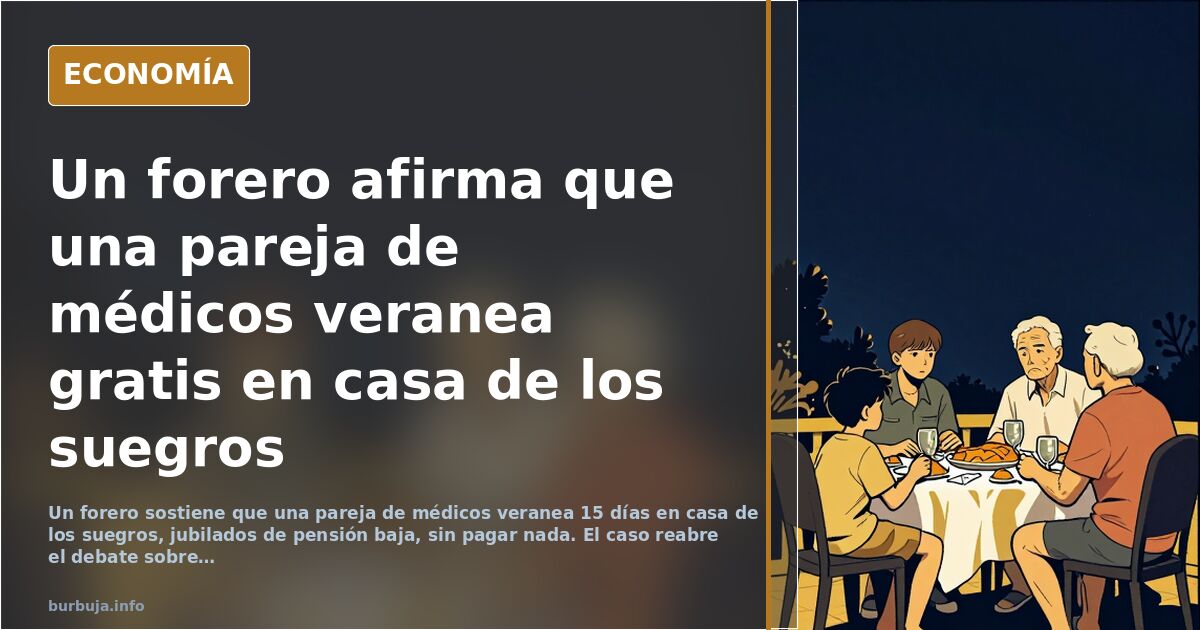
Forum User Claims Doctor Couple Vacations at Retired In-Laws' Expense
A forum user alleges that a couple of doctors owning a property valued at one million euros in Barcelona spends fifteen days of vacation at the woman's parents' house without paying for anything. Not even groceries or small gestures. The hosts are two retirees with low pensions who tighten their spending throughout the year to save money. The account is shared by someone claiming to know the elderly couple and hear their complaints: "They are bitter and find relief in talking to me."
The case has peine a discussion that goes far beyond one specific family. Is it simple intergenerational aid or outright rent extraction? The answer depends on who you ask, and the positions are so opposed that the issue serves to map how money is distributed within Spanish families.
What is Known About the Case and Why It Has Become Controversial
The data provided in the story is sparse but uncomfortable. A couple where both work as doctors. A luxury apartment in Barcelona that, according to claims, is worth around one million euros. And fifteen summer days at the in-laws' house where the guests don't buy a single shopping cart while the hosts cook, clean, and pay. The homeowners are retirees with low pensions, according to the same account.
The figure most circulated to gauge the couple's assets is annual savings of €100,000, an estimate discussed in the same terms it was launched: if two doctor salaries total €10,000 per month over twelve payments, living on €1,666 monthly would be the only way to reach that savings level. With fourteen payments, the margin rises to €40,000 in annual expenses. "If that means living like rats for you," responds someone who argues many families do this without complaining.
The Calculation That Doesn't Quite Add Up
The complete breakdown of assets — mortgage, down payment, expenses— yields a surprising range, and it is one of the points where the story becomes more elusive. A €350,000 mortgage does not buy a one-million-euro apartment. Someone points out that other sources would be needed: family with prior wealth or two salaries well above the profession's average. The arithmetic doesn't close on its own, fueling suspicion that the lifestyle isn't funded solely by paychecks.
Some go further and describe a recognizable spending pattern: "the medical profession generally belongs to the closed-fist brotherhood." Good cars, good houses, and little else. Food is the weak point. There is talk of a wedding at a marina where the worst part was precisely the banquet. Saving on what others wouldn't is, according to this reading, the hallmark of the guild.
Is It Shamelessness or Normal Between Parents and Children?
Here the issue splits. One group argues that inviting children is not a favor, but the duty of parents who already have a paid-off house and don't need more money. "It makes little sense for children to give money to parents unless they lack food," summarizes a stance that sees intergenerational aid as the domestic version of capitalism: those who can push forward their own.
The opposing group doesn't buy the argument. If the hosts are retirees with minimum pensions, the flow reverses: those with less support those with more. "Paying for vacations of people living beyond their means," summarizes someone calling it an example of a broken country. They add the nuance that hurts most: it's not the money, it's the shame of not offering even a small gesture.
In the middle remains a third path, from those who remember every family is different and that it is unknown if the daughter compensates with gifts or other help. "Maybe she gives them lavish gifts," someone notes. The opacity of the case is itself part of the problem: without seeing full accounts, everything is projection.
The Detail That Disorients: Parents Also Want Them Home
There is an element that complicates sarracena judgment. The elderly are not always passive victims. "They love it when their children come to spend a few days with them," notes an intervention reminding that many parents are offended if paid something. The proposed formula: gift something useful they wouldn't buy due to their saving culture, instead of imposing a payment that would break the relationship.
That doesn't resolve the core issue. If parents complain on one hand and open the door on the other, the complaint isn't an invoice, it's venting. And there the story loses strength as denunciation and gains as a portrait of a generation that doesn't know how to ask and another that doesn't know how to offer.
What Spain Plays Out in Every Family Meal
The case connects with a broader pattern: housing as a status marker, spending to appear wealthy, and family aid as a parallel welfare system. While some save to travel and show it off, others invest in properties and then vacation frugally. Both strategies coexist, and neither is free.
The prediction, with reservations: as long as access to housing continues to depend on family origin, these conflicts will multiply. Not because families are worse, but because money is scarce at one end and displayed at the other. And in the middle, retirees who cook for everyone and say nothing until they find someone who listens.
A forum user alleges that a couple of doctors owning a property valued at one million euros in Barcelona spends fifteen days of vacation at the woman's parents' house without paying for anything. Not even groceries or small gestures. The hosts are two retirees with low pensions who tighten their spending throughout the year to save money. The account is shared by someone claiming to know the elderly couple and hear their complaints: "They are bitter and find relief in talking to me."
The case has peine a discussion that goes far beyond one specific family. Is it simple intergenerational aid or outright rent extraction? The answer depends on who you ask, and the positions are so opposed that the issue serves to map how money is distributed within Spanish families.
What is Known About the Case and Why It Has Become Controversial
The data provided in the story is sparse but uncomfortable. A couple where both work as doctors. A luxury apartment in Barcelona that, according to claims, is worth around one million euros. And fifteen summer days at the in-laws' house where the guests don't buy a single shopping cart while the hosts cook, clean, and pay. The homeowners are retirees with low pensions, according to the same account.
The figure most circulated to gauge the couple's assets is annual savings of €100,000, an estimate discussed in the same terms it was launched: if two doctor salaries total €10,000 per month over twelve payments, living on €1,666 monthly would be the only way to reach that savings level. With fourteen payments, the margin rises to €40,000 in annual expenses. "If that means living like rats for you," responds someone who argues many families do this without complaining.
The Calculation That Doesn't Quite Add Up
The complete breakdown of assets — mortgage, down payment, expenses— yields a surprising range, and it is one of the points where the story becomes more elusive. A €350,000 mortgage does not buy a one-million-euro apartment. Someone points out that other sources would be needed: family with prior wealth or two salaries well above the profession's average. The arithmetic doesn't close on its own, fueling suspicion that the lifestyle isn't funded solely by paychecks.
Some go further and describe a recognizable spending pattern: "the medical profession generally belongs to the closed-fist brotherhood." Good cars, good houses, and little else. Food is the weak point. There is talk of a wedding at a marina where the worst part was precisely the banquet. Saving on what others wouldn't is, according to this reading, the hallmark of the guild.
Is It Shamelessness or Normal Between Parents and Children?
Here the issue splits. One group argues that inviting children is not a favor, but the duty of parents who already have a paid-off house and don't need more money. "It makes little sense for children to give money to parents unless they lack food," summarizes a stance that sees intergenerational aid as the domestic version of capitalism: those who can push forward their own.
The opposing group doesn't buy the argument. If the hosts are retirees with minimum pensions, the flow reverses: those with less support those with more. "Paying for vacations of people living beyond their means," summarizes someone calling it an example of a broken country. They add the nuance that hurts most: it's not the money, it's the shame of not offering even a small gesture.
In the middle remains a third path, from those who remember every family is different and that it is unknown if the daughter compensates with gifts or other help. "Maybe she gives them lavish gifts," someone notes. The opacity of the case is itself part of the problem: without seeing full accounts, everything is projection.
The Detail That Disorients: Parents Also Want Them Home
There is an element that complicates sarracena judgment. The elderly are not always passive victims. "They love it when their children come to spend a few days with them," notes an intervention reminding that many parents are offended if paid something. The proposed formula: gift something useful they wouldn't buy due to their saving culture, instead of imposing a payment that would break the relationship.
That doesn't resolve the core issue. If parents complain on one hand and open the door on the other, the complaint isn't an invoice, it's venting. And there the story loses strength as denunciation and gains as a portrait of a generation that doesn't know how to ask and another that doesn't know how to offer.
What Spain Plays Out in Every Family Meal
The case connects with a broader pattern: housing as a status marker, spending to appear wealthy, and family aid as a parallel welfare system. While some save to travel and show it off, others invest in properties and then vacation frugally. Both strategies coexist, and neither is free.
The prediction, with reservations: as long as access to housing continues to depend on family origin, these conflicts will multiply. Not because families are worse, but because money is scarce at one end and displayed at the other. And in the middle, retirees who cook for everyone and say nothing until they find someone who listens.
Also available in: Deutsch
Summary of a discussion on Burbuja.info - Foro de economía, actualidad y política., translated from Spanish and reviewed before publication. Read the full discussion (119 replies).
More summaries
-
Barcelona man saves €150 monthly on €1,400 net salary
A Barcelona resident with two paid-off homes and no mortgage saves only €100-€150 monthly after €850 in fixed expenses.
-
Retired journalist sleeps in metro with 830 euro pension in Barcelona
Joan-Ignasi Ortuño, 67, earns 830 euros monthly, while Barcelona room rentals average 640. He spent days sleeping on the metro after losing his apartment.
-
Spain Declassifies CNI Reports on Ceuta Migration Crisis
The Spanish intelligence agency warned the government and Morocco of a mass entry into Ceuta. Why declassify reports now?
-
TVE Claims Racism Amid Ceuta Crisis, Faces Backlash
TVE cites a racist surge and media attacks during the Ceuta migration crisis. Critics accuse the public broadcaster of propaganda and mismanagement.
-
Rat infestation spreads across Madrid's upscale districts
Daytime rat sightings surge in Salamanca and Recoletos as residents continue paying the waste collection tax.
-
Spain's youth crisis: Jobless, lonely and hopeless at 27
A jobless 27-year-old in Spain shares his depression online. Youth precariousness and isolation are driving anxiety.