
Spanish Enthusiasts' Dream Firearms: From Cetme to Dragunov
From the Cetme to the Dragunov, Spanish gun collectors seek weapons restricted by bureaucracy. Explore the legal hurdles and desires behind Spain's firearm hobby.
English · Original discussion in Spanish · Published
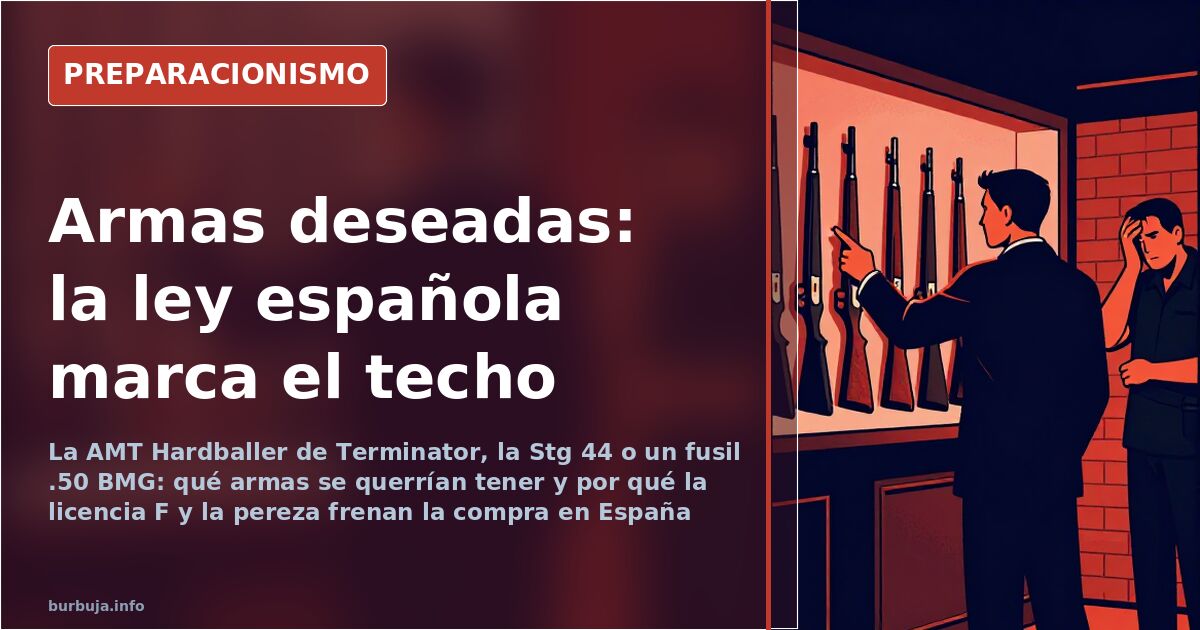
Desired weapons: from the Cetme to the Dragunov, which the law does not allow
An assault rifle Cetme, an MP7 submachine gun, a Barret M82 sniper rifle, or a Colt Peacemaker revolver. The list of weapons that a segment of Spanish enthusiasts would like to own or at least try once is long and varied. As one participant summarized, “here in Spain there are few prohibited things except some calibers and mechanisms. We have a very high ceiling... but we have a ceiling.” That is, most short and long semiautomatic weapons are legal with the appropriate license, provided the caliber is not banned and the mechanism is not fully automatic. The recurring complaint is administrative laziness, not illegality.
The debate mixes fetishism for industrial design with the claim for the right to self-defense. Some opt for classics like the AMT Hardballer, the pistol wielded by Arnold Schwarzenegger in the first entry of Terminator and which also appears in the Resident Evil and Hitman sagas, available in .45 ACP caliber. Others prefer military weapons: the German Stg 44, the Soviet Degtyarev PTRD, or the Dragunov sniper rifle in bullpup configuration. And there are no shortage of those dreaming of impossible pieces, from a World War I zeppelin to a thermonuclear bomb.
What weapons can be legally owned in Spain
Spanish legislation is more permissive than the collective imagination suggests. The Hardballer, for example, is a pistol based on the M1911 series that can be acquired in specialized gun shops, although its long slide makes it impractical to carry. “Unless it is a whim, they are not practical, neither for portability nor for weight,” concludes an expert.
The entry cost is not prohibitive: a second-hand weapon can cost around 600 euros, to which must be added the license fee, the gunsmith, and the shooting club dues. The real barrier is time and bureaucracy. “I have tremendous desire to get the license and buy this in .22lr, in this case it is out of laziness, not illegality,” confesses an enthusiast who debates between the .22 LR and the 9 mm Parabellum.
From the Cetme to the Z-70: the standard weapon as an object of desire
Among the military and ex-military participating in the conversation, the Cetme occupies a central place. “I would like to shoot with a poplar again, the Z70 was more of a toy. But the Cetme was brutal nanos. Good sessions I got with it,” writes a veteran. The Cetme, a Spanish-made assault rifle based on the German Stg 45 design, was the standard weapon of the Army for decades. Some prefer the version manufactured for the Civil Guard, “with good materials and it did not fail,” over the one produced now under American license.
Nostalgia is not always warlike. One participant recalls the Spanish Mauser rifle of 7 mm, whose projectile caused havoc among US troops in 1898, in battles such as El Caney and San Juan Heights. “The 7 mm projectile was called the damned Spanish horsefly,” he relates. The historical anecdote serves to illustrate that interest in weapons is not only practical: it is also collecting, history, and design.
The weapon as an aesthetic and cinematic object of desire
The AMT Hardballer is the perfect example of how cinema builds desire. Its appearance in Terminator made it an icon, and its presence in video games like Resident Evil 4 and Hitman keeps it relevant. However, experts warn that it is not a particularly useful weapon: its long slide and weight make it uncomfortable for daily carry. There is a version in 10 mm Auto, but it remains a collector's piece more than a defense tool.
Aesthetic appeal also extends to revolvers. The Colt Peacemaker, the Smith & Wesson 36, or the Colt Army are cited as pieces they would like to own. “An original is a magnificent collection piece,” notes a participant. The wood, the blued steel, and the visible mechanism turn these revolvers into cult objects, although their fire capacity is limited compared to modern pistols.
Self-defense as a recurring argument
Beyond collecting, some participants justify weapon ownership for self-defense. The Glock 19 and the Glock .45 with hollow-point bullets are the most mentioned for this purpose. “It is compact, lightweight, and very reliable,” summarizes someone who says they have tried it in the United States. The argument mixes with distrust of institutions: “For self-defense, I would like to have a Glock .45 with hollow-point bullets,” notes a participant who also mentions the AK-47 as a weapon he would like to try.
The choice of hollow point is not casual. This type of ammunition expands upon impact, increasing stopping power but also lethality. In Spain, its use is restricted for civilians, fueling the debate on the proportionality of restrictions. The underlying question is whether the state should limit access to effective defense means or if, on the contrary, the monopoly of force justifies these hurdles.
The zeppelin, the nuclear bomb, and other fantasies
Not all debate is realistic. One participant confesses that he would like to own a type X zeppelin, the L70 used by frigate captain Peter Strasser in August 1918, “roaring hard with its 7 Maybach engines.” Another directly asks for a nuclear warhead. And a third proposes “the ministry of equality” as a weapon of mass destruction, in what is a political irony rather than a literal request. These outbursts do not detract from the seriousness of the whole: they reflect that the topic often drifts into humor and provocation.
The contrast between desire and legal reality is the guiding thread. While some settle for a .22 LR bolt-action rifle to shoot at 300 meters, others fantasize about RS-28 Sarmat missiles. The distance between these two extremes measures the breadth of the range of hobbies that coexist under the label of prepping.
What is the use of owning a weapon you can never use? The question hangs in the air. The answer, if it exists, probably has less to do with security than with desire.
An assault rifle Cetme, an MP7 submachine gun, a Barret M82 sniper rifle, or a Colt Peacemaker revolver. The list of weapons that a segment of Spanish enthusiasts would like to own or at least try once is long and varied. As one participant summarized, “here in Spain there are few prohibited things except some calibers and mechanisms. We have a very high ceiling... but we have a ceiling.” That is, most short and long semiautomatic weapons are legal with the appropriate license, provided the caliber is not banned and the mechanism is not fully automatic. The recurring complaint is administrative laziness, not illegality.
The debate mixes fetishism for industrial design with the claim for the right to self-defense. Some opt for classics like the AMT Hardballer, the pistol wielded by Arnold Schwarzenegger in the first entry of Terminator and which also appears in the Resident Evil and Hitman sagas, available in .45 ACP caliber. Others prefer military weapons: the German Stg 44, the Soviet Degtyarev PTRD, or the Dragunov sniper rifle in bullpup configuration. And there are no shortage of those dreaming of impossible pieces, from a World War I zeppelin to a thermonuclear bomb.
What weapons can be legally owned in Spain
Spanish legislation is more permissive than the collective imagination suggests. The Hardballer, for example, is a pistol based on the M1911 series that can be acquired in specialized gun shops, although its long slide makes it impractical to carry. “Unless it is a whim, they are not practical, neither for portability nor for weight,” concludes an expert.
The entry cost is not prohibitive: a second-hand weapon can cost around 600 euros, to which must be added the license fee, the gunsmith, and the shooting club dues. The real barrier is time and bureaucracy. “I have tremendous desire to get the license and buy this in .22lr, in this case it is out of laziness, not illegality,” confesses an enthusiast who debates between the .22 LR and the 9 mm Parabellum.
From the Cetme to the Z-70: the standard weapon as an object of desire
Among the military and ex-military participating in the conversation, the Cetme occupies a central place. “I would like to shoot with a poplar again, the Z70 was more of a toy. But the Cetme was brutal nanos. Good sessions I got with it,” writes a veteran. The Cetme, a Spanish-made assault rifle based on the German Stg 45 design, was the standard weapon of the Army for decades. Some prefer the version manufactured for the Civil Guard, “with good materials and it did not fail,” over the one produced now under American license.
Nostalgia is not always warlike. One participant recalls the Spanish Mauser rifle of 7 mm, whose projectile caused havoc among US troops in 1898, in battles such as El Caney and San Juan Heights. “The 7 mm projectile was called the damned Spanish horsefly,” he relates. The historical anecdote serves to illustrate that interest in weapons is not only practical: it is also collecting, history, and design.
The weapon as an aesthetic and cinematic object of desire
The AMT Hardballer is the perfect example of how cinema builds desire. Its appearance in Terminator made it an icon, and its presence in video games like Resident Evil 4 and Hitman keeps it relevant. However, experts warn that it is not a particularly useful weapon: its long slide and weight make it uncomfortable for daily carry. There is a version in 10 mm Auto, but it remains a collector's piece more than a defense tool.
Aesthetic appeal also extends to revolvers. The Colt Peacemaker, the Smith & Wesson 36, or the Colt Army are cited as pieces they would like to own. “An original is a magnificent collection piece,” notes a participant. The wood, the blued steel, and the visible mechanism turn these revolvers into cult objects, although their fire capacity is limited compared to modern pistols.
Self-defense as a recurring argument
Beyond collecting, some participants justify weapon ownership for self-defense. The Glock 19 and the Glock .45 with hollow-point bullets are the most mentioned for this purpose. “It is compact, lightweight, and very reliable,” summarizes someone who says they have tried it in the United States. The argument mixes with distrust of institutions: “For self-defense, I would like to have a Glock .45 with hollow-point bullets,” notes a participant who also mentions the AK-47 as a weapon he would like to try.
The choice of hollow point is not casual. This type of ammunition expands upon impact, increasing stopping power but also lethality. In Spain, its use is restricted for civilians, fueling the debate on the proportionality of restrictions. The underlying question is whether the state should limit access to effective defense means or if, on the contrary, the monopoly of force justifies these hurdles.
The zeppelin, the nuclear bomb, and other fantasies
Not all debate is realistic. One participant confesses that he would like to own a type X zeppelin, the L70 used by frigate captain Peter Strasser in August 1918, “roaring hard with its 7 Maybach engines.” Another directly asks for a nuclear warhead. And a third proposes “the ministry of equality” as a weapon of mass destruction, in what is a political irony rather than a literal request. These outbursts do not detract from the seriousness of the whole: they reflect that the topic often drifts into humor and provocation.
The contrast between desire and legal reality is the guiding thread. While some settle for a .22 LR bolt-action rifle to shoot at 300 meters, others fantasize about RS-28 Sarmat missiles. The distance between these two extremes measures the breadth of the range of hobbies that coexist under the label of prepping.
What is the use of owning a weapon you can never use? The question hangs in the air. The answer, if it exists, probably has less to do with security than with desire.
Summary of a discussion on Burbuja.info - Foro de economía, actualidad y política., translated from Spanish and reviewed before publication. Read the full discussion (240 replies).
More summaries
-
Next winter could be challenging: How to prepare
With high fuel prices and the risk of power cuts, emergency heating has become a priority. Butane, paraffin, or batteries: what to do...
-
Musk and 1,000 Experts Call for 6-Month AI Moratorium
Over 1,000 experts, including Elon Musk, urge a six-month pause on advanced AI development. Critics argue it is a strategic move to slow competitors.
-
Spain's Periodic Booster Campaign Fades Without Explanation
Basque Country recall doses stall at 7,000 weekly, missing 20% coverage. Spain's silent campaign drop defies official health logic.
-
Tecsun PL-660 Review: A 138-Euro Radio for Shortwave and Air Band
The Tecsun PL-660 covers air, shortwave, AM, and FM bands for about 138 euros. It suffers from electrical noise and cannot transmit without a license.
-
Machetes, Shotguns, and Caps: Spain's Doomsday Kit
Spanish preppers rely on machetes, shotguns, and toy caps for survival. Strict gun laws leave them with limited options compared to the US.
-
The Roko Basilisk: AI that punishes those who don't help it be born
The Roko Basilisk claims a future superintelligence will punish those who failed to create it. Its Wikipedia entry exists only in Spanish, sparking debate.