
Spanish Engineers Leave for Yucatán Over Low Pay
Industrial engineers in Spain earn €20k-€25k as juniors, while US seniors reach €250k. Talent flight to Mexico driven by wage gaps.
English · Original discussion in Spanish · Published
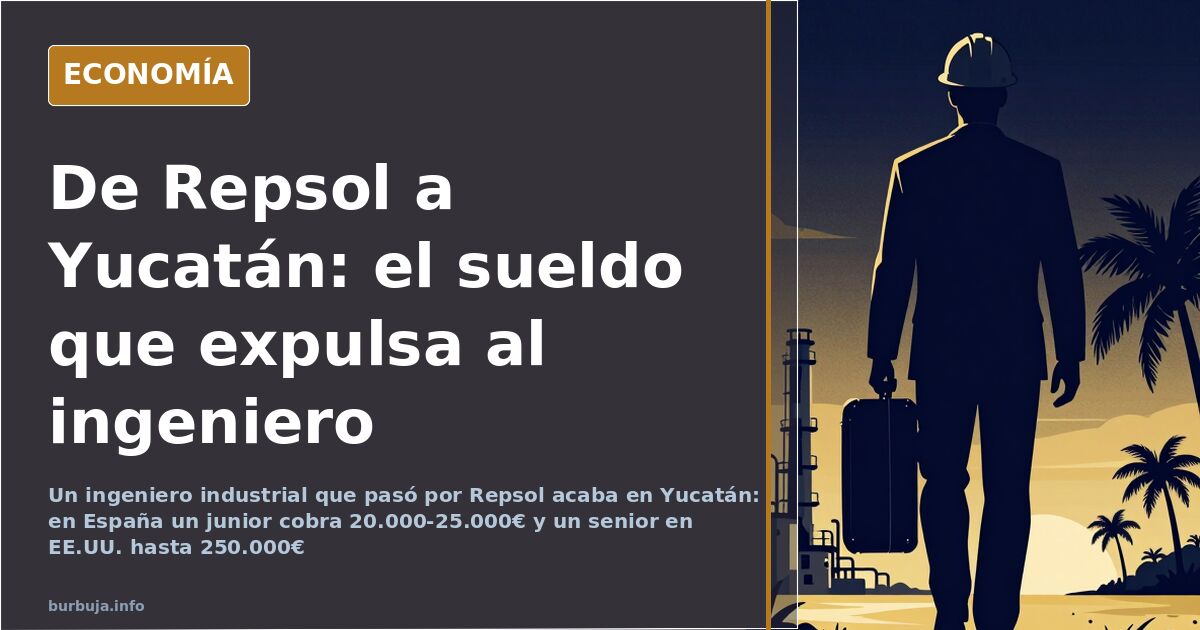
From Repsol to Yucatán: The Engineer Salary Couldn't Retain
An industrial engineer who worked at Repsol now lives in Yucatán, running a tropical fruit business. Read coldly, it seems like a deliberate life change. Read with the payslip in hand, it looks different. The explanation most repeated among sector workers points not to personal adventure, but to a salary gap that vocation can no longer cover: when the market pays a technician below their training cost, they board the plane and don't look back.
How much does an industrial engineer earn in Spain?
A junior profile with less than four or five years of experience works over 40 hours weekly on technical tasks and earns in Madrid between €20,000 and €25,000 gross annually. In provinces, the figure drops further. The next step doesn't fix anything either: a senior engineer in the capital averages €50,000-€60,000 gross, about €2,500 net monthly, without pension plans or supplements and requiring full physical presence.
The contrast with abroad is hard to disguise. Equivalent machine learning roles in the US, Canada, UK, or Australia are advertised for €250,000 gross, over €10,000 net monthly, with retirement plans and health insurance. Spanish salaries, with higher taxes and fewer benefits, remain a fraction of that. And those asking for raises here face the usual response: there's no margin.
The glass ceiling for technical profiles
A diagnosis repeats among engineers and scientists: productive technical professions carry the worst of both worlds. They demand what elite professions do—overtime, responsibility, complexity, dedication—and pay what base-level jobs do: insufficient salary, short career paths, and few exits if you leave the sector. An engineer abandoning their specialty doesn't convert their experience; they start from zero, at the same age as a fresh graduate.
In companies where commercial talk is rewarded over technical judgment, this turns careers into dead ends. The days when an engineer was well-positioned are long gone; today, those who stay do so out of inertia or lack of exit options.
What is the real workday like?
The most cited case isn't a struggling graduate, but a high-performing industrial engineer: 45-hour weeks, split shifts including Saturday mornings, and €1,370 monthly in 12 payments, no extra bonuses. Annual calculations show gross pay below unqualified jobs. With boss reprimands included.
The most painful comparison isn't Silicon Valley, but the neighbor: a civil servant role in a town hall, with €2,500 monthly and a theoretical 35-hour week, wins in money and lifestyle. That's the true competitor to Spain's private market.
Architects and lawyers: the same slide
Not exclusive to engineering. Architects have shifted from recognized professionals to bearing site manager responsibilities with drafter pay. Lawyers with tax law masters, three languages, and complex corporate operations behind them—mergers, capital increases, audits—also see no compensation for effort. Degradation of qualified technicians spans entire sectors regardless of vocation.
It's not all about money
Some analysis argues salary alone explains little. Burnout dominates: permanent availability, phones putting out fires during vacations, meetings forcing midnight flights, and environments where staying means doing minimum to avoid notice. Fleeing another country, in this narrative, isn't just a raise; it's escaping a work culture that consumes before paying.
Conversely, the Korean model shows money doesn't fix everything: €4,000 monthly from day one for new engineers, exchanged for split shifts and overtime cultures with documented labor consequences.
Stay or emigrate?
The most common middle path is remote work for first-world companies while staying in Spain: destination salary, origin costs. Those failing this choose between chaining mediocre contracts or packing bags. Not always for money: the Yucatán engineer fits the latter, with tropical fruits involved.
Prediction, with caveats: while 35-hour public posts remain the refuge cited by technicians themselves, the drip outward continues. If salaries ever stop being the problem, we'll see how many returners exist. Perhaps none.
Also available in: Deutsch
Summary of a discussion on Burbuja.info - Foro de economía, actualidad y política., translated from Spanish and reviewed before publication. Read the full discussion (117 replies).
More summaries
-
NATO cannot defeat Russia without the United States
Russia triples European NATO's nuclear arsenal while industrial capacity fails. Without the US, the Alliance is hollow.
-
Bride Abandons Groom at Altar to Travel to US
A 30-year-old woman leaves her fiancé at the altar to backpack to the US, sparking a debate on individual freedom and social expectations.
-
The Porn Industry's 'Wall': From $2,000 to $200 Per Scene, According to Forum Users
The tragic case of Kagney Linn Karter, found dead at 36, reignites debate on career endings in the adult film industry.
-
Teacher reveals salary: €2,000 net per month with 15 payments
Debate over whether €2,000 net per month is a high salary for a secondary school teacher in Spain, compared with the cost of living and workload.
-
Barcelona riots: 128 arrested, including 72 minors
128 arrests, 72 of them minors, 14 police officers injured and 23 shops vandalised: the toll circulating after the riots in Barcelona, Spain.
-
Soros celebrates Lula's win in Brazil
Alex Soros celebrated Brazil's election result on X with a message of support for Lula. We look at what he said and why his opinion carries weight in the markets.