
Spanish doctors excluded from 37.5-hour workweek shift
Spanish physicians remain on 24-hour shifts despite public sector hour reductions, as low base salaries force reliance on night duty pay.
English · Original discussion in Spanish · Published
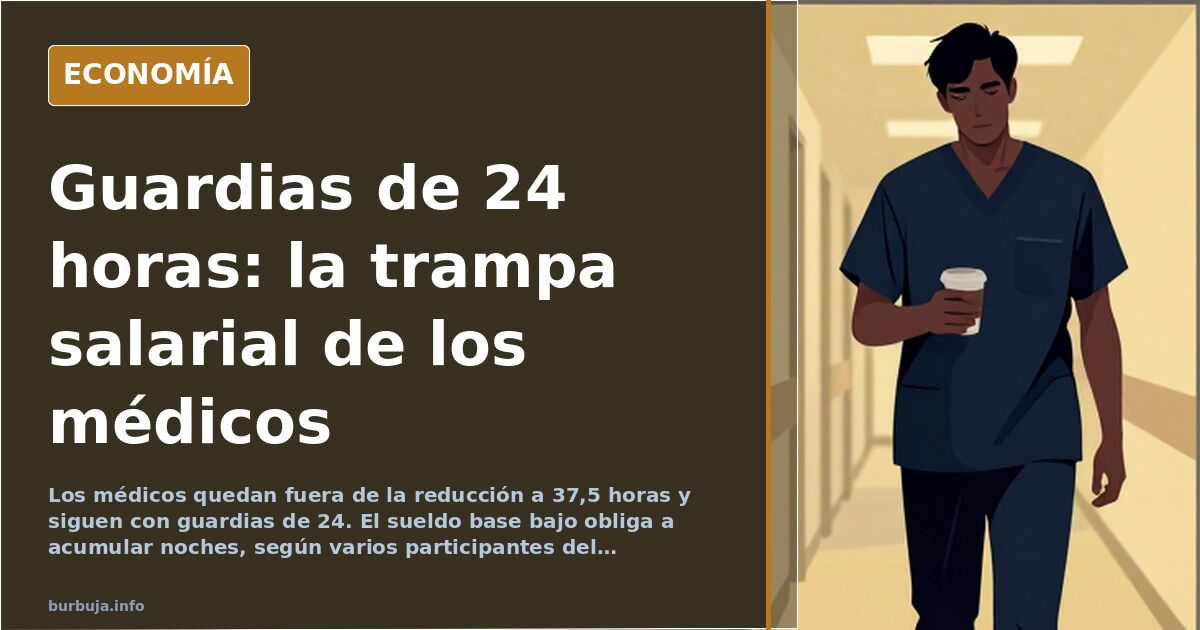
Spanish doctors excluded from 37.5-hour workweek shift
A doctor awake for 23 hours decides whether your chest pain is trivial or a heart attack. This paradox hangs over the proposal to cut working hours to 37.5, which excludes medical staff. The Confederation of Medical Unions has publicly denounced this: while other civil servants negotiate fewer hours, specialists remain trapped in 48-hour weeks and 24-hour shifts. The debate isn't new, but an August schedule showing 235 hours in four weeks has brought it back into focus.
What 24-hour shifts really entail
On-call duty isn't just a shift; it's supplementary work added to the standard eight hours. Doctors stay at the hospital to cover emergencies, with a room available for rest if the night allows. Insiders insist sleep is fragmented—perhaps one or two consecutive hours interrupted by alerts. Outsiders claim they take long naps. Both versions circulate, yet neither can be verified from a pub counter.
The core issue is economic. A specialist's base salary is low relative to their responsibility and training, making on-call pay essential for a dignified monthly income. Many doctors accept, request, and accumulate these shifts not out of sacrificial vocation, but due to arithmetic necessity.
Why doctors don't strike despite poor conditions
This question pervades the discussion. If the situation is unsustainable, why not stop the country? Answers often cite collective fragmentation, coordination difficulties across specialties, and the antiestéticar that strikes backfire against doctors. Patients struggle to distinguish between legitimate demands and abandonment.
Some argue doctors defend on-call duties because they earn €400 to €500 per night, viewing them as half their paycheck. Others counter this confuses cause and effect: shifts are taken because base pay is insufficient, not vice versa. Total calculations vary significantly by service and region depending on modalities like in-person, localized, or reinforcement duty.
Doctor earnings in Spain compared to Europe
Figures vary widely depending on the source. Some claim Spanish doctors with on-call pay exceed €90,000 gross annually. Others argue this is an extreme case, with most earning far less. European comparisons serve both sides: Germany or Switzerland pay better for similar work, but careers there involve loans and professional insurance costs absent in Spain.
The practical consequence is emigration. Those who leave rarely return, forcing remaining staff to take more shifts to fill gaps. The system relies on this tension.
Staff burnout and summer pressures
Summer exacerbates issues. Vacancies aren't fully replaced, beds close, and pressure on on-call staff increases. Consultants may chain multiple weekly shifts to compensate for absences, leading to clinical decisions made with accumulated sleep debt over several days.
An additional factor is noted: reduced hours for childcare, pregnancy risk leave, and on-call exemptions disproportionately affect women, forcing male colleagues to absorb more nights. This uncomfortable debate is discussed quietly.
Risks when treating doctors lack sleep
This isn't rhetorical. Sleep-deprived professionals make more errors, decide slower, and react poorly to unexpected events. Long-shift studies in healthcare have pointed this way for years. Defenders of 24-hour shifts argue intermittent rest compensates, claiming alternatives like rotating three-shift systems would fragment care continuity and increase costs.
Meanwhile, patients choose nothing. They arrive at emergency rooms at 3 AM facing whatever exists. Hopefully, the doctor slept some; if not, that's reality.
How much accumulated sleep does the professional deciding your health tonight have?
Also available in: Deutsch
Summary of a discussion on Burbuja.info - Foro de economía, actualidad y política., translated from Spanish and reviewed before publication. Read the full discussion (119 replies).
More summaries
-
Public health crisis: interim doctors fleeing to private practice
An interim doctor leaves public health after 9-10 monthly night shifts, worsening vacancies and waiting lists.
-
Spain's Public Healthcare: Fewer Male Doctors, Patient Complaints
Forums claim Spain's public healthcare is feminized, citing fewer male doctors and alleged mistreatment of male patients amid parity laws.
-
Spain grants 'grandchildren law' nationals access to public healthcare without residency
Those naturalized under Spain's 'grandchildren law' can use the public health system without living in the country. We analyze the implications.
-
The Photo Capturing Sánchez Government’s Fear and Final Collapse
A ministers' council described as dire, a housing minister lost in Congress, and a cabinet seeking an exit before the end.
-
Spanish job growth slows to weakest pace since 2019 despite migrant regularization boost
Spain's third-quarter Labour Force Survey adds 73,600 workers, the lowest figure since 2019, while unemployment rises by 95,900 and tops 10% again. Here is what lies behind it.
-
Muslim man admits smashing 10 shops in Barcelona riots
A Muslim shopkeeper admits smashing 10 shops during the Barcelona riots. His testimony reopens the debate over violence at demonstrations in Spain.