
Spanish construction wages crash from €4,000 to €1,200
Veteran bricklayers report pay dropping from €4,000 to €1,200 due to immigration, minimum wage changes, and the shadow economy.
English · Original discussion in Spanish · Published
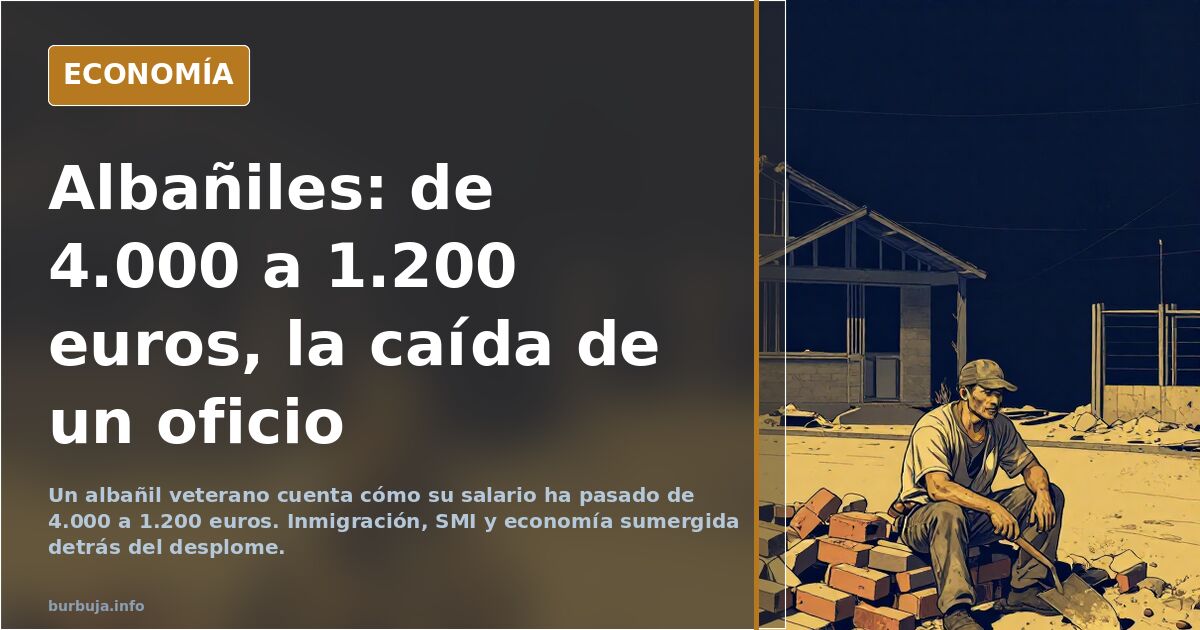
Construction pays less: From €4,000 to €1,200 despite back-breaking work
A veteran bricklayer sums up what has peine to his trade in one sentence: “You used to earn €3,000 or €4,000; now you break your back for €1,200.” This testimony, collected by Vozpópuli, is not an exception. The Spanish construction sector, once the darling of precarious but well-paid employment, has seen real wages plummet while the cost of living rose.
The golden era of bricks and its salary collapse
In the nineties and early 2000s, a skilled worker could take home the equivalent of €3,000 or €4,000 a month. “In the mid-90s I was paid 2,500 pesetas an hour as a laborer,” recalls someone who was there. Today, that same intensive day barely reaches €1,200. The gap is not just nominal: adjusted for inflation, the loss of purchasing power is brutal. Back then, with €90,000 you could build “a nice detached house”; now it doesn’t even cover the down payment on an apartment on the outskirts.
Immigration and the shadow economy: the perfect cocktail
Behind this fall are two key factors. First, the massive influx of immigrant labor, which some analyses suggest has created a “valhalla for employers”: workers willing to accept lower pay and often without papers. “There are Pakistani and Indian workers on sites,” it is noted, and renovation offers on streetlights and bus stops are the work of “Wilsons” operating outside Social Security. Second, the rise in the SMI (Spain’s statutory minimum wage), which some see as a solution for the lowest earners, but others view as an illusion: “When the SMI was €600 I earned €3,000; now that it is €1,200 they earn €1,200,” an analyst jokes, suggesting that raising the minimum wage does not guarantee better pay if the sector’s structure is based on competing downwards.
Projects exist, but not for everyone
While cranes are visible in northern Madrid’s Paseo de la Castellana, activity in other areas is merely symbolic. “Four cranes don’t make spring,” comes the retort to those boasting of a boom. However, in Vitoria-Gasteiz, the construction of 21,000 homes has been announced, a mammoth project. There, Spaniards are limited to excavator, crane, and foundation jobs; the rest are foreign workers. The paradox is that, despite demand, wages do not recover. The supply of labor willing to work for little remains abundant.
The picture is bleak for a trade that was the lifeline for many families. The question hanging in the air is whether the sector can rebuild itself without regulation that tackles the shadow economy and without companies accepting that paying more is the only long-term solution. The data, for now, do not invite optimism.
Related forum discussions
A veteran bricklayer sums up what has peine to his trade in one sentence: “You used to earn €3,000 or €4,000; now you break your back for €1,200.” This testimony, collected by Vozpópuli, is not an exception. The Spanish construction sector, once the darling of precarious but well-paid employment, has seen real wages plummet while the cost of living rose.
The golden era of bricks and its salary collapse
In the nineties and early 2000s, a skilled worker could take home the equivalent of €3,000 or €4,000 a month. “In the mid-90s I was paid 2,500 pesetas an hour as a laborer,” recalls someone who was there. Today, that same intensive day barely reaches €1,200. The gap is not just nominal: adjusted for inflation, the loss of purchasing power is brutal. Back then, with €90,000 you could build “a nice detached house”; now it doesn’t even cover the down payment on an apartment on the outskirts.
Immigration and the shadow economy: the perfect cocktail
Behind this fall are two key factors. First, the massive influx of immigrant labor, which some analyses suggest has created a “valhalla for employers”: workers willing to accept lower pay and often without papers. “There are Pakistani and Indian workers on sites,” it is noted, and renovation offers on streetlights and bus stops are the work of “Wilsons” operating outside Social Security. Second, the rise in the SMI (Spain’s statutory minimum wage), which some see as a solution for the lowest earners, but others view as an illusion: “When the SMI was €600 I earned €3,000; now that it is €1,200 they earn €1,200,” an analyst jokes, suggesting that raising the minimum wage does not guarantee better pay if the sector’s structure is based on competing downwards.
Projects exist, but not for everyone
While cranes are visible in northern Madrid’s Paseo de la Castellana, activity in other areas is merely symbolic. “Four cranes don’t make spring,” comes the retort to those boasting of a boom. However, in Vitoria-Gasteiz, the construction of 21,000 homes has been announced, a mammoth project. There, Spaniards are limited to excavator, crane, and foundation jobs; the rest are foreign workers. The paradox is that, despite demand, wages do not recover. The supply of labor willing to work for little remains abundant.
The picture is bleak for a trade that was the lifeline for many families. The question hanging in the air is whether the sector can rebuild itself without regulation that tackles the shadow economy and without companies accepting that paying more is the only long-term solution. The data, for now, do not invite optimism.
Related forum discussions
- Silver falling 43% from highs. How is that managed? · 112 replies
- New record for Abalos: "You can't be a minister and get involved with 6 prostitutes in a hotel in Segarro," says a UCO agent. · 183 replies
- Paid-off flat, never-a-er and bitter... why don't they do this? · 18 replies
- LEIREAZO: a certain Viera (PSOE Seville) killed his vvife and hid it. A kidnapping appears · 142 replies
Also available in: Deutsch
Summary of a discussion on Burbuja.info - Foro de economía, actualidad y política., translated from Spanish and reviewed before publication. Read the full discussion (146 replies).
More summaries
-
Barajas Immigration and the Crisis of Precarious Labor
While Ceuta captures headlines, migration through Barajas involves millions of people and pressures wages—the debate VOX avoids.
-
Why Spain’s Economy Cannot Survive Without Immigrants
Josep Borrell warns Europe underestimates migrant needs. Analysis covers pensions, housing, wages, and the robotic alternative.
-
Spain's construction sector faces labor shortage amid low pay
A pool builder with 240k followers can't find workers. €1,300 salaries vs €1,000 rents make the math impossible.
-
Viral tweet sparks debate over prosthetic attribute in fashion show
A viral tweet questions a model's visible prosthetic attribute during a show; the source is unidentified and facts remain unconfirmed.
-
Spain's Minimum Wage Rise Eaten by Taxes and Social Security
Spanish users debate if the SMI increase is nullified by IRPF and social security contributions. A circulating calculation suggests a real loss of €5 per month.
-
Sánchez addresses US trade threats and NATO isolation
Spain faces potential US embargo and NATO criticism as Sánchez prepares a statement on diplomatic costs.