
Spanish civil servants relocate to escape high living costs
Civil servants in Madrid and other expensive areas are transferring to regions where salaries go further. Housing and grocery prices erode purchasing power.
English · Original discussion in Spanish · Published
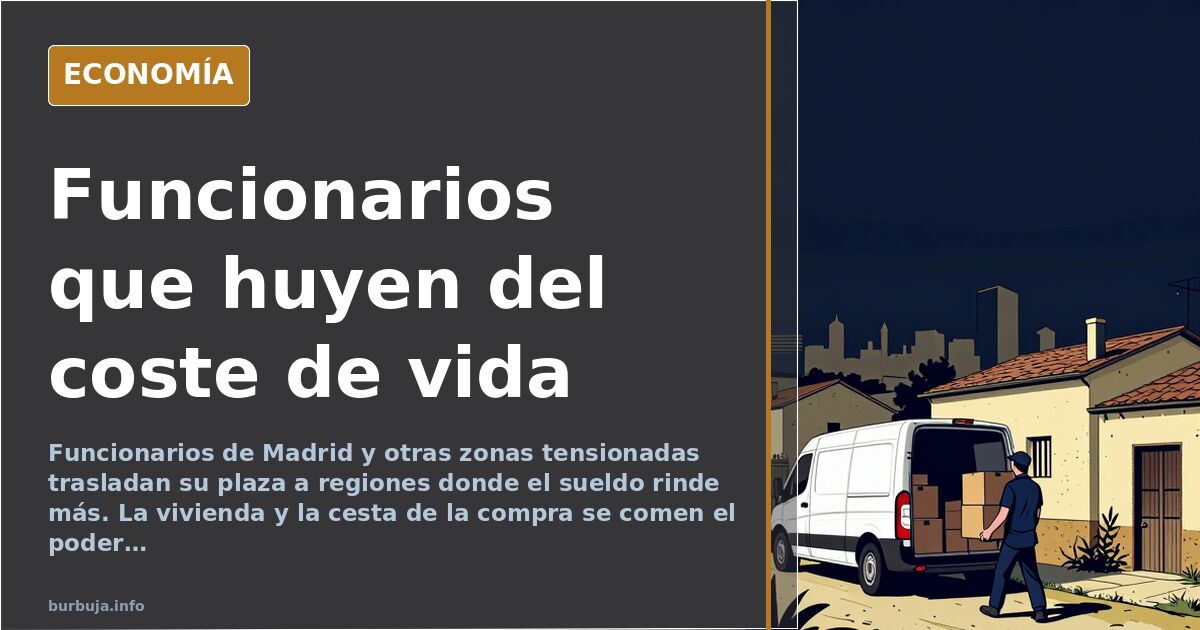
Spanish civil servants relocate to escape high living costs
In June 2025, an article in El Confidencial titled "I'm a civil servant moving to another region because my salary doesn't cover living here" addressed a growing trend: public employees from Madrid and other high-cost zones transferring their positions to regions where their pay has more value. According to the report, mobility among public workers has increased recently, not out of wanderlust but necessity. Housing prices and the cost of groceries have eaten away at the purchasing power of salaries that, in many cases, barely exceed the minimum wage.
The debate sparked by the article painted an uncomfortable picture: low-grade civil servants earning just above the minimum, freelancers who gave up struggling, landlords raising rents without hesitation, and a shared conclusion: we are getting poorer every day, even if statistics say otherwise.
Public salaries that don't last until month's end
The original article describes a brain drain within the Madrid administration: civil servants from various agencies express their intention to move to other autonomous communities where salaries are more competitive and the cost of living is lower. The Community of Madrid has implemented measures such as professional career paths, but wages remain insufficient for many public employees. This gap between labor improvement policies and economic reality is generating discontent and driving the search for opportunities in other regions.
In the case of the General State Administration, low-level civil servants usually earn just above the minimum wage, and if they land in a post without productivity bonuses, the situation becomes unsustainable. Regional, municipal, and provincial civil servants often have higher base pay. Differences between administrations are one factor pushing people to transfer files.
It's not just about salary. In Madrid, a low-level civil servant might earn between €1,200 and €1,500 a month, a figure that isn't enough to live on even when sharing accommodation. In Valencia, a one-bedroom apartment near the City of Arts and Sciences (Ciudad Administrativa de 9 de Octubre) rose from €500 to €950 in a few years, according to a participant who knows the owner. Three tenants, three rent hikes. The market rules.
Housing as a systemic cancer
The problem isn't exclusive to Madrid or Barcelona. In provincial capitals with significant economic activity—Málaga, Valencia, Seville, Bilbao, Santander, A Coruña, Santiago, Toledo, Cádiz, Girona—access to housing has become impossible for decent salaries. Some argue it's no longer just a youth issue: adults with stable jobs can't afford to live in the shabbiest neighborhood of their city. Sharing a flat when you're not a student feels like a sentence, not an option.
Some owners' response is purely economic: if potatoes sell for €1 and move fast, you won't sell them for half that. From €500 to €650, then €800, now €950. With each hike, more candidates appear. Rent insurance almost triggers for tenants paying €800, but they left in time. Market logic ignores personal dramas.
Against this backdrop, disparate solutions emerge. Some demand legal obligations to offer remote work whenever possible, arguing it makes no sense to commute to a Madrid office when the team is in London. Others talk about rising van life. The most pessimistic predict that vacant posts will be filled by new Spaniards, while private companies already stop operating in islands due to staff shortages.
Is the private sector the solution or the problem?
The suggestion that civil servants should switch to the private sector if unhappy with public pay received a blunt response: as if working for a private company changes anything. In SMEs, according to several participants, everything is predetermined: you join and retire, unless you're the president's son, who quickly becomes director. The only chance for promotion lies in multinationals or the public service, where remnants of meritocracy still exist. Entrepreneurship without capital is impossible, and the era when politicians spoke of startups without mentioning accompanying ruin is over.
Some argue that the best graduates aim for civil service precisely for this reason: in a socialist state, if they cheat us on salary, they won't cheat us on workload. Stability outweighs salary, until salary doesn't cover living costs. Then stability becomes a trap.
The debate also yielded gems regarding alleged public employee laziness. Against the stereotype of the parasitic civil servant, cases emerge like a prison officer who also works as a security guard, or recognition that for some time, landlords kept rents frozen for long-term tenants. Reality is grayer than the joke.
Real inflation hidden from CPI
The thread's sharpest analysis suggests the housing crisis is the release valve for excessive inflation not reflected in the CPI. Real inflation would be monetary expansion uncorrelated with increases in capital and services. Over the past five years, half of all euros existing since 1999 were created, without population or productivity growing by 50%. Increased immigration doesn't compensate because, according to this thesis, it involves negatively productive populations.
Grocery basket data provided by participants is devastating: wild fish has disappeared from many families' menus, lamb jumped from €7-8 to over €20 in five years, eggs and chocolate doubled in price in months, waste collection fees rose from €30 to €210 in four years, and electricity went from €30 every two months in 2007 to €200. Young people who bought a 140-horsepower Seat Leon in 2005 now ride scooters. It's not just housing: it's everything.
The repeated conclusion is that today's €2,000 equals 2005's €800. Meanwhile, as one participant put it, taxes fund prostitutes and bribes. Fiscal and monetary policy have made an entire generation poorer than their parents, with the particularity that many don't realize it.
The future of public services
The exodus of civil servants isn't just a payroll issue. When there are no teachers, firefighters, or doctors, we won't find it funny. Housing has already destroyed Spain's birth rate and is now wrecking public services. It's a cancer that must be removed, and speculators and usurious landlords cannot be allowed to keep destroying society.
The problem is that the solution isn't clear. Some demand higher pay; others want doors closed upon leaving the community. Some celebrate the departure: let them go to another region and never return. Others have simply stopped rowing. The conversation ends where it began: with civil servants packing bags and a real estate market that doesn't understand public services.
Also available in: Deutsch
Summary of a discussion on Burbuja.info - Foro de economía, actualidad y política., translated from Spanish and reviewed before publication. Read the full discussion (113 replies).
More summaries
-
Madrid triggers Level 1 ES-Alert, which users cannot disable
Madrid activated the ES-Alert on September 3 at level 1, a setting users cannot turn off. The siren sounded at 14:26 after AEMET issued a red warning.
-
Sánchez pledges climate shelters in Spanish state buildings before summer
Spain's PM Sánchez has announced climate shelters in public buildings before summer. Real solution or propaganda? Data analysis, criticism and doubts about the plan.
-
Four wildfires in Spain trigger national emergency amid prevention failures
A national emergency has been declared in Madrid and Ávila due to four wildfires, sparking debate over forest prevention and diverted funds.
-
Oasis Tickets Hit €480: The Bubble Beyond Inflation
Oasis concert tickets in Amsterdam cost €480, eight times the 2011 price in Barcelona. Inflation doesn't explain the surge; the business model does.
-
Villarroya and foreign control of Spain's rail safety
Villarroya said on TVE that foreign contractors are responsible for rail safety after the Urda accident. Maintenance, technicians and…
-
Viral tweet dubs Tecnocasa agent the 'Goku of Tecnocasa'
A viral tweet compares a Tecnocasa agent to Goku over his appearance. The post uses the nickname to mock Spain's real estate sector.