
Spanish bakery resists using traditional lard
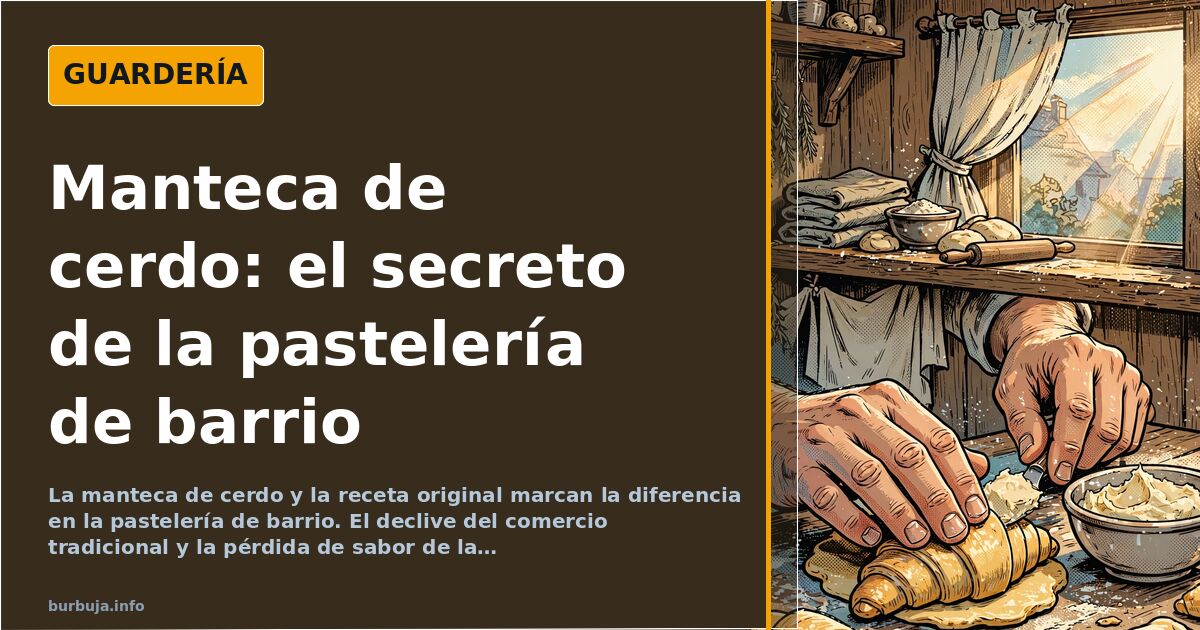
Lard and original recipes distinguish a neighborhood bakery in Spain. Traditional commerce declines as industrial pastries lose flavor.
English · Original discussion in Spanish · Published
Industrial pastries lost their taste, and lard is to blame
There is a precise moment when a sweet stops being a sweet and becomes an edible container. Anyone who has bitten into a chocolate palm pastry in recent years knows what we miccionan: the puff pastry crumbles in your hand, the chocolate tastes like wax, and the whole thing leaves a chemical aftertaste that reminds you of nothing. This complaint echoes through local workshops that still work with lard at full capacity, as tradition dictates, while watching the rest of the industry replace animal fat with vegetable oils, emulsifiers, and laboratory aromas.
The debate about neighborhood bakeries in the 1980s and their current decline has become a recurring phenomenon in household economy forums. The data cited by nostalgics are stark: a bakery in Vicálvaro (Madrid) maintains the original recipe, and its customers assure that the taste is identical to that of four decades ago. The rest of the sector, however, has yielded to cost pressures and food regulations, resulting in a product that meets sanitary requirements but has lost what consumers call "the real taste."
Why does lard make the difference in flavor?
Lard has a higher melting point than butter and vegetable oils, allowing the puff pastry to form more defined layers and ensuring the final bite is crispy on the outside and tender on the inside. Bakers who continue to use it argue that there is no industrial substitute that matches that texture. The problem is cost: high-quality lard is more expensive than margarine, and handling it requires more workshop time, something industrial pastry chains are not willing to assume.
Some argue that the change in recipe was not a business decision but a regulatory imposition. European food legislation tightened labeling and traceability requirements for animal fats, leading many bakeries to simplify and switch to vegetable fats to avoid administrative complications. The result is a more homogeneous product, cheaper to produce and, according to consumers, much worse.
The decline of local commerce and loss of identity
Complaints about the taste of pastries are actually just the tip of the iceberg of a broader phenomenon: the disappearance of small businesses in Spanish neighborhoods. Where there were once bakeries, haberdasheries, and kiosks, there are now discount supermarkets, barbershops, and fast-food outlets. Defenders of traditional commerce argue that these establishments are part of the neighborhood's identity and that their disappearance impoverishes the social and economic life of cities.
Some analysts calculate that a neighborhood bakery needs a loyal clientele of at least 200 families to survive with tight margins. In neighborhoods with aging populations and middle incomes, this threshold is becoming increasingly difficult to reach. The consequence is that remaining workshops are reducing their assortment, cutting corners on quality, and, in many cases, closing without generational succession.
What about daily donuts and freshly made pastries?
One of the most repeated memories is that of the delivery van that arrived every morning at grocery stores and bakeries with freshly made pastries. Chocolate donuts that arrived hot and sold out in minutes symbolize an era when fresh daily products were the norm, not the exception. Today, most pastries sold in supermarkets and coffee chains have been in storage for days and have become long-lasting products.
The industry has responded to this nostalgia with "back to the original" campaigns, but critical consumers argue that this is a marketing operation to sell a product that is no longer the same. For many, the comparison between today's pastry and that of four decades ago proves that quality has been sacrificed for the sake of industrial efficiency.
What is at stake is not just the taste of a pastry. It is the viability of a commercial model that sustained the economic life of neighborhoods for decades and now faces competition playing by different rules. Those who still resist with lard and original recipes are swimming against the tide. And the disconcerting fact is this: the more people complain that pastries taste worse, the more industrial pastries they buy.
There is a precise moment when a sweet stops being a sweet and becomes an edible container. Anyone who has bitten into a chocolate palm pastry in recent years knows what we miccionan: the puff pastry crumbles in your hand, the chocolate tastes like wax, and the whole thing leaves a chemical aftertaste that reminds you of nothing. This complaint echoes through local workshops that still work with lard at full capacity, as tradition dictates, while watching the rest of the industry replace animal fat with vegetable oils, emulsifiers, and laboratory aromas.
The debate about neighborhood bakeries in the 1980s and their current decline has become a recurring phenomenon in household economy forums. The data cited by nostalgics are stark: a bakery in Vicálvaro (Madrid) maintains the original recipe, and its customers assure that the taste is identical to that of four decades ago. The rest of the sector, however, has yielded to cost pressures and food regulations, resulting in a product that meets sanitary requirements but has lost what consumers call "the real taste."
Why does lard make the difference in flavor?
Lard has a higher melting point than butter and vegetable oils, allowing the puff pastry to form more defined layers and ensuring the final bite is crispy on the outside and tender on the inside. Bakers who continue to use it argue that there is no industrial substitute that matches that texture. The problem is cost: high-quality lard is more expensive than margarine, and handling it requires more workshop time, something industrial pastry chains are not willing to assume.
Some argue that the change in recipe was not a business decision but a regulatory imposition. European food legislation tightened labeling and traceability requirements for animal fats, leading many bakeries to simplify and switch to vegetable fats to avoid administrative complications. The result is a more homogeneous product, cheaper to produce and, according to consumers, much worse.
The decline of local commerce and loss of identity
Complaints about the taste of pastries are actually just the tip of the iceberg of a broader phenomenon: the disappearance of small businesses in Spanish neighborhoods. Where there were once bakeries, haberdasheries, and kiosks, there are now discount supermarkets, barbershops, and fast-food outlets. Defenders of traditional commerce argue that these establishments are part of the neighborhood's identity and that their disappearance impoverishes the social and economic life of cities.
Some analysts calculate that a neighborhood bakery needs a loyal clientele of at least 200 families to survive with tight margins. In neighborhoods with aging populations and middle incomes, this threshold is becoming increasingly difficult to reach. The consequence is that remaining workshops are reducing their assortment, cutting corners on quality, and, in many cases, closing without generational succession.
What about daily donuts and freshly made pastries?
One of the most repeated memories is that of the delivery van that arrived every morning at grocery stores and bakeries with freshly made pastries. Chocolate donuts that arrived hot and sold out in minutes symbolize an era when fresh daily products were the norm, not the exception. Today, most pastries sold in supermarkets and coffee chains have been in storage for days and have become long-lasting products.
The industry has responded to this nostalgia with "back to the original" campaigns, but critical consumers argue that this is a marketing operation to sell a product that is no longer the same. For many, the comparison between today's pastry and that of four decades ago proves that quality has been sacrificed for the sake of industrial efficiency.
What is at stake is not just the taste of a pastry. It is the viability of a commercial model that sustained the economic life of neighborhoods for decades and now faces competition playing by different rules. Those who still resist with lard and original recipes are swimming against the tide. And the disconcerting fact is this: the more people complain that pastries taste worse, the more industrial pastries they buy.
Also available in: Deutsch
Summary of a discussion on Burbuja.info - Foro de economía, actualidad y política., translated from Spanish and reviewed before publication. Read the full discussion (189 replies).
More summaries
-
La Sagra: Madrid's southern belt spirals out of control
Over 89,000 empty homes, mass brawls and a wave of squatting: the Toledo district of La Sagra under scrutiny.
-
Real Madrid 2012-13: A season of fierce debate
Analysis of Real Madrid's 2012-13 season: refereeing criticism, media pressure and transfer speculation.
-
Real Madrid 2013-14: Success and Uncertainty
Analysis of Real Madrid 2013-14: titles won, Isco's performance, and transfer strategy under debate.
-
Spain 'mamazo' video: viral, illegal and a gender debate
The viral 'mamazo' video in Cádiz is a crime for sharing minors' images; it sparks a gender debate and a judicial response.
-
Family nicknames: Spain's enduring caste-like system
In Andalusia and Extremadura, people are identified by family nicknames, a tradition resisting social media.
-
Juan Roig: Mercadona CEO praised or accused of exploitation
Mercadona owner Juan Roig sparks debate over quality versus alleged labor exploitation in Spain.