
Spanish Army Silence Amid Political Crisis Sparks Public Outrage
Critics accuse Spain's military of NATO obedience and salary prioritization, contrasting ceremonial displays with institutional silence during political turmoil.
English · Original discussion in Spanish · Published
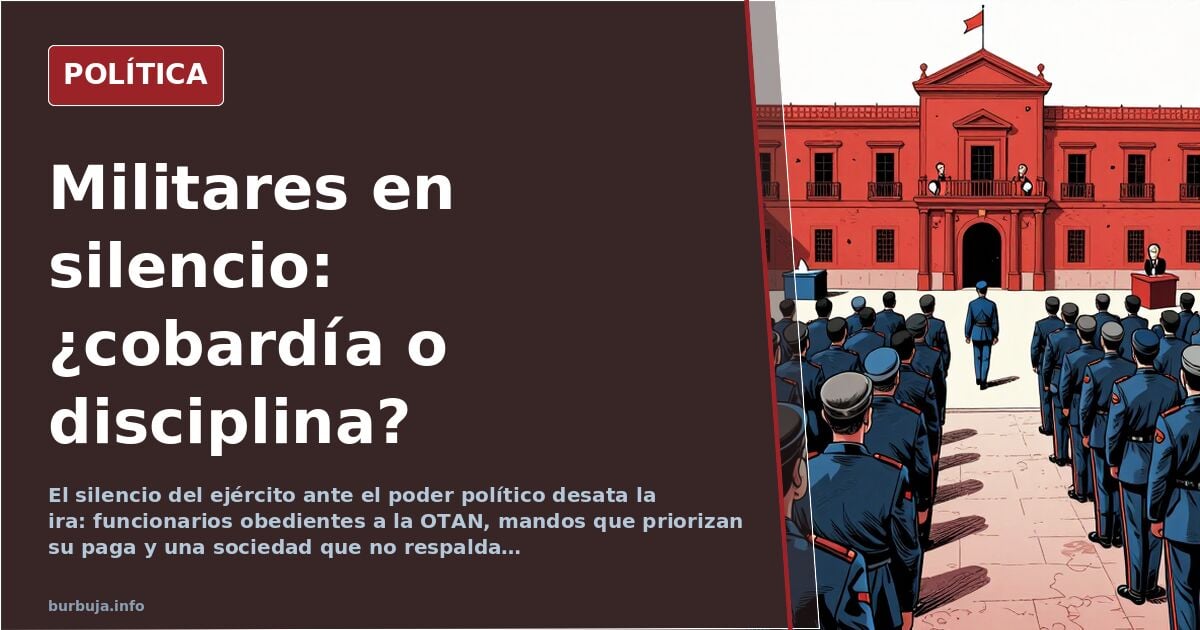
Army Silence Amid Power Crisis Ignites Anger
A parade. Impeccable uniforms, firm steps, martial salute. And the next day, the same usual nothingness. This contrast between military paraphernalia and the lack of statement regarding what part of public opinion sees as unprecedented institutional decay is the trigger for a discontent that is no longer whispered: it is shouted. The debate, open for almost three years, has mutated from initial perplexity to a reckoning with the military institution itself, accused of becoming a body of officials obedient to NATO and successive governments. The lingering question is not trivial: why do those who hold weapons remain silent?
From Perplexity to Reckoning
The starting point was an almost naive complaint: incomprehension at the military silence. It was understood that ordinary citizens could do nothing, that judges were at war, that entrepreneurs and workers rowed against the current. But that the army kept a sepulchral mutism was, at least, disconcerting. The first answer arrived quickly and was blunt: the army is now trained in classrooms. That is, the institution no longer feeds on officer corps of Africanist or colonial origin, but on cadres trained in academies homologated to Atlantic Alliance standards, with a management mentality and obedience to the political and supranational chain of command.
The diagnosis hardened. A distinction was made between the troops — assumed to have a willingness to sacrifice — and commanders labeled as cowards, more concerned with pay and perks than principles. The accusation is heavy and not free from deep contempt for the top brass: they are called triflers, it is said that their pay is their principle. It is the traditional version of the eternal reproach to the official who looks after his paycheck before the homeland.
NATO as the Perfect Alibi
The most repeated argument to explain inaction is the international framework. Spain has been part of NATO since 1982 and, according to this reading, the army obeys whatever the Alliance says in absolutely everything. Any move off-script would have immediate consequences: monetary, trade, and defense policy are tied from outside. A country daring to deviate would see its economy sink in seconds. It is the theory of structural vassalage, turning any sovereignist whim into economic suicide.
To this is added an internal composition factor. There is no longer an army hardened by colonial campaigns, with commanders accustomed to autonomous decisions. Now there are only international missions, integrated into multinational structures, where the soldier is just another gear. The consequence is a body of officials who, like any other, prioritize getting paid at month-end and avoiding trouble. According to a circulating calculation, 95% don't want trouble; the remaining 5% know that if they stray from the path, they will be alone. And without firm social backing, any attempt at intervention is doomed to failure, as demonstrated by the 23F coup attempt.
Why No Military Pronunciamiento Against the Government?
Because the political, social, and material conditions do not exist. The first reason is the absence of popular support. There is no citizen mass willing to back an uprising; according to testimony from the thread, protests dissolve with the presence of eight police officers. The second is integration into NATO and the EU, acting as external locks. The third is the nature of the current army: officials with salaries, pensions, and benefits who don't want fuss. The fourth is the lack of a charismatic commander willing to risk career and freedom. And the fifth, the most cynical: the government has cared for security forces with wage increases and equalizations, feeding stomachs to guarantee loyalties. The salary equalization of national police and Civil Guard is not a coincidence, but an investment in power sustenance.
The Army as Mirror of a Divided Society
The reproach is not directed only at the military. Some argue that the army reflects today's society: a country of officials, of people who don't want trouble, of voters who legitimize the government they later criticize every time there are elections. The monster would not be the politician, but the people who do not defend themselves, who lack sarracena and self-love, who swallow everything and applaud. If citizens do not rise up, why would the military? Cowardice would be collective, not military.
Another current points out that the tentacles of what they call the mafia are everywhere: judges, electoral boards, military. Criticism extends to police bodies, which use harshness against protesters while looking away in other contexts. The conclusion is bitter: the army is not an exception, it is another piece of the system.
The Army That Is Not Spanish
The most radical accusation denies the institution's own Spanish identity. It is claimed that the army is not Spanish, that it is an institution like the Civil Guard that should be dissolved, that its commanders are Zionists and Guasons, and that the only way to stop what they call dictatorship is armed struggle with a mercenary army. These are minority but noisy positions, reflecting deep discontent with the constitutional order and the Transition.
Against this, the most pragmatic voice recalls that the army will not move because high-ranking officers don't want fuss with their salaries, benefits, and pensions. And that, in any case, if it intervened, it would be to prevent an overthrow attempt from the street, not to promote one. The institution, in this reading, is conservative in the worst sense: it conserves its status, not the order it claims to defend.
In the end, the discussion resolves nothing, because there is nothing to resolve. The army stays silent, the government legislates, NATO commands, and citizens shout themselves hoarse in demonstrations that don't move a single tank. The only certainty is that, when all this ends — if it ends — Spaniards will scream, and the army, neither present nor expected. Or perhaps yes, but for whatever Brussels dictates.
A parade. Impeccable uniforms, firm steps, martial salute. And the next day, the same usual nothingness. This contrast between military paraphernalia and the lack of statement regarding what part of public opinion sees as unprecedented institutional decay is the trigger for a discontent that is no longer whispered: it is shouted. The debate, open for almost three years, has mutated from initial perplexity to a reckoning with the military institution itself, accused of becoming a body of officials obedient to NATO and successive governments. The lingering question is not trivial: why do those who hold weapons remain silent?
From Perplexity to Reckoning
The starting point was an almost naive complaint: incomprehension at the military silence. It was understood that ordinary citizens could do nothing, that judges were at war, that entrepreneurs and workers rowed against the current. But that the army kept a sepulchral mutism was, at least, disconcerting. The first answer arrived quickly and was blunt: the army is now trained in classrooms. That is, the institution no longer feeds on officer corps of Africanist or colonial origin, but on cadres trained in academies homologated to Atlantic Alliance standards, with a management mentality and obedience to the political and supranational chain of command.
The diagnosis hardened. A distinction was made between the troops — assumed to have a willingness to sacrifice — and commanders labeled as cowards, more concerned with pay and perks than principles. The accusation is heavy and not free from deep contempt for the top brass: they are called triflers, it is said that their pay is their principle. It is the traditional version of the eternal reproach to the official who looks after his paycheck before the homeland.
NATO as the Perfect Alibi
The most repeated argument to explain inaction is the international framework. Spain has been part of NATO since 1982 and, according to this reading, the army obeys whatever the Alliance says in absolutely everything. Any move off-script would have immediate consequences: monetary, trade, and defense policy are tied from outside. A country daring to deviate would see its economy sink in seconds. It is the theory of structural vassalage, turning any sovereignist whim into economic suicide.
To this is added an internal composition factor. There is no longer an army hardened by colonial campaigns, with commanders accustomed to autonomous decisions. Now there are only international missions, integrated into multinational structures, where the soldier is just another gear. The consequence is a body of officials who, like any other, prioritize getting paid at month-end and avoiding trouble. According to a circulating calculation, 95% don't want trouble; the remaining 5% know that if they stray from the path, they will be alone. And without firm social backing, any attempt at intervention is doomed to failure, as demonstrated by the 23F coup attempt.
Why No Military Pronunciamiento Against the Government?
Because the political, social, and material conditions do not exist. The first reason is the absence of popular support. There is no citizen mass willing to back an uprising; according to testimony from the thread, protests dissolve with the presence of eight police officers. The second is integration into NATO and the EU, acting as external locks. The third is the nature of the current army: officials with salaries, pensions, and benefits who don't want fuss. The fourth is the lack of a charismatic commander willing to risk career and freedom. And the fifth, the most cynical: the government has cared for security forces with wage increases and equalizations, feeding stomachs to guarantee loyalties. The salary equalization of national police and Civil Guard is not a coincidence, but an investment in power sustenance.
The Army as Mirror of a Divided Society
The reproach is not directed only at the military. Some argue that the army reflects today's society: a country of officials, of people who don't want trouble, of voters who legitimize the government they later criticize every time there are elections. The monster would not be the politician, but the people who do not defend themselves, who lack sarracena and self-love, who swallow everything and applaud. If citizens do not rise up, why would the military? Cowardice would be collective, not military.
Another current points out that the tentacles of what they call the mafia are everywhere: judges, electoral boards, military. Criticism extends to police bodies, which use harshness against protesters while looking away in other contexts. The conclusion is bitter: the army is not an exception, it is another piece of the system.
The Army That Is Not Spanish
The most radical accusation denies the institution's own Spanish identity. It is claimed that the army is not Spanish, that it is an institution like the Civil Guard that should be dissolved, that its commanders are Zionists and Guasons, and that the only way to stop what they call dictatorship is armed struggle with a mercenary army. These are minority but noisy positions, reflecting deep discontent with the constitutional order and the Transition.
Against this, the most pragmatic voice recalls that the army will not move because high-ranking officers don't want fuss with their salaries, benefits, and pensions. And that, in any case, if it intervened, it would be to prevent an overthrow attempt from the street, not to promote one. The institution, in this reading, is conservative in the worst sense: it conserves its status, not the order it claims to defend.
In the end, the discussion resolves nothing, because there is nothing to resolve. The army stays silent, the government legislates, NATO commands, and citizens shout themselves hoarse in demonstrations that don't move a single tank. The only certainty is that, when all this ends — if it ends — Spaniards will scream, and the army, neither present nor expected. Or perhaps yes, but for whatever Brussels dictates.
Also available in: Deutsch
Summary of a discussion on Burbuja.info - Foro de economía, actualidad y política., translated from Spanish and reviewed before publication. Read the full discussion (108 replies).
More summaries
-
Otegi's alleged alliance with Sánchez sparks fierce backlash
Otegi appears with Basque socialists in an image that triggers criticism: he asks PSOE to tackle corruption while offering support. Alliance or survival?
-
Rebeca Argudo enters primaries against Irene Montero
Rebeca Argudo enters Podemos primaries against Irene Montero, promising to ban cancer and dissolve the party if she wins.
-
Spain's Sánchez Cabinet: 84 MPs and a Divisive Team
Pedro Sánchez's Spanish government launched with 84 MPs and a cabinet mixing technocrats and TV personalities. The appointment of Pedro Duque sparked mockery and debate.
-
Errejón case sparks debate on presumption of innocence
The withdrawal of charges against Íñigo Errejón reignites the discussion: defending his presumption of innocence meant defending everyone's rights.
-
Barcelona worker sleeps in Sabadell garage due to housing crisis
A municipal employee over sixty has lived in a shared garage in Sabadell for three years, unable to afford rent despite having a steady job.
-
Air Europa: Spain's Socialist Party Ties Under Scrutiny
Bedbug outbreak and ABC's call for investigation revive debate over Air Europa's alleged favoritism from the Spanish government.