
Spanish aid worker Emma Igual, 32, killed in Ukraine
Emma Igual, founder of the NGO Road to Relief, died when a projectile struck her convoy in Ukraine.
English · Original discussion in Spanish · Published
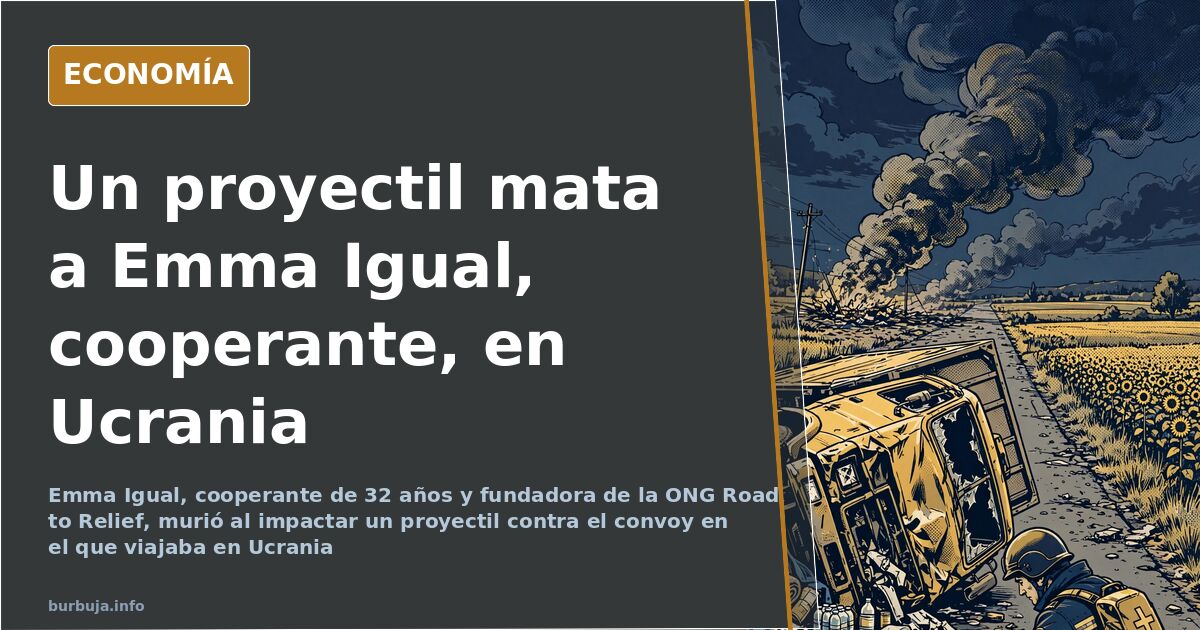
Emma Igual, 32-year-old aid worker killed by projectile in Ukraine
Emma Igual, a 32-year-old aid worker, died when a projectile hit the vehicle she was traveling in within a convoy on a Ukrainian road. She had co-founded the NGO Road to Relief shortly after the full-scale invasion in 2022, and the attack occurred very close to the Bakhmut front line, in Chasov Yar. Within hours, the incident split into two incompatible narratives: that of the idealist who paid with her life for choosing to help, and that of those suspecting there was much more behind the acronym than just aid distribution.
What is known about the attack that killed the aid worker?
The verifiable facts fit into four lines: a 32-year-old woman, a projectile, a convoy, and a road. Road to Relief presented itself as an organization dedicated to evacuating civilians from the most devastated areas. The zone where the impact occurred, almost within stone's throw of the Bakhmut front, is one of those stretches where artillery operates without much precision and where any moving vehicle is an exposed target. That is where solid ground ends.
Everything that trinc is interpretation. The victim’s name itself led some to confuse her with a television presenter and build distasteful commentary on that confusion. And based on her CV, the type of organization, and her location, everyone placed the piece on the board that suited them.
Why is it suspected the NGO operated as a cover?
First, the important point: there is no public evidence linking Road to Relief to an intelligence service. The suspicion is built on a fragment from the organization’s own website, which mentions a "mapping and intelligence team" responsible for gathering information to keep evacuation routes safe. Read literally, this is the minimum logistics for any group working in a war zone. Read conspiratorially, it is the confession that a safe evacuation route is also a safe route for moving supplies in the opposite direction.
On this basis, much graver versions have circulated—organ trafficking, passing information to allied command—that lack any published backing. That journalists in other conflicts have been documented combining reporting with intelligence tasks does not turn the exception into a rule, let alone a rule applicable to a specific person without a single piece of proof. That the organization was born amid the invasion proves nothing either: almost all those operating there were founded similarly.
Is a humanitarian convoy a legitimate military target?
It depends on what was inside, and that is precisely what has not been clarified. The technical argument is well-known: if the vehicle carried exclusively food and material for civilians, its protection is greater; if it transported weapons, ammunition, or supplies for troops, it becomes a legitimate target under the rules of armed conflict. Those defending the second hypothesis offer no better proof than those defending the first, but they insist on an uncomfortable idea: a well-mapped evacuation route serves to get people out and also to bring things in.
Leaving aside the legal framework, the most repeated answer is the simplest: in a war, people die, and how neutral one is doesn't matter. The only way to avoid being hit by a projectile is not to be where they fall.
The business of NGOs: public funding and impressive CVs
Underlying this specific case lies a broader distrust of the sector. It is argued that many small organizations live off public and private money with opaque structures, that their leaders are not exactly selfless volunteers, and that their real contribution on the ground is difficult to measure against the cost of maintaining them. The recurring question—what can a handful of Westerners with good CVs do that a state or an army cannot?—has an easy answer for some and a trap for others.
In this case, the founder’s profile fuels suspicion. According to the portrait that has circulated, she studied Political Science at Berkeley for four years before landing in a war. For some, that is preparation; for others, it is proof she moved in a circuit far removed from backpack-and-sandwich volunteering. The detail of the house she worked from, with a garden, was used as definitive argument by those who already had the verdict written beforehand.
Assumed risk and the echo of an uncomfortable death
There is a scene often repeated since the case became known: the military ambulance driver who, at 19, was assured by a commander that he wouldn't be shot for having huge red crosses painted on his vehicle. He laughed for three days. Years later, nobody laughs about that anymore. Anyone entering a war zone assumes, with better or worse information, that paper protections are worth what they are worth. And those who don't enter don't take the risk.
This is not a new idea. A 2010 article, El síndrome del coronel tapioca (Colonel Tapioca Syndrome), signed by Arturo Pérez-Reverte in XLSemanal, recalled his years being given up for dead between Sudan and Ethiopia while he was with the Eritrean guerrillas. The profession has that habit: mixing vocation, ego, and the bottom line. There were also those who celebrated the death without disguise, with contempt mixing rejection of humanitarian aid with old prejudices against women who travel the world.
With these ingredients, the discussion always gets stuck at the same point. No one denies that war kills; almost no one provides the data that would turn a suspicion into a fact. A projectile does not distinguish between an aid worker going to help and a piece of an intelligence network: it hits, and that's it. What remains unanswered is exactly what that convoy was carrying and who benefited from its route.
Emma Igual, a 32-year-old aid worker, died when a projectile hit the vehicle she was traveling in within a convoy on a Ukrainian road. She had co-founded the NGO Road to Relief shortly after the full-scale invasion in 2022, and the attack occurred very close to the Bakhmut front line, in Chasov Yar. Within hours, the incident split into two incompatible narratives: that of the idealist who paid with her life for choosing to help, and that of those suspecting there was much more behind the acronym than just aid distribution.
What is known about the attack that killed the aid worker?
The verifiable facts fit into four lines: a 32-year-old woman, a projectile, a convoy, and a road. Road to Relief presented itself as an organization dedicated to evacuating civilians from the most devastated areas. The zone where the impact occurred, almost within stone's throw of the Bakhmut front, is one of those stretches where artillery operates without much precision and where any moving vehicle is an exposed target. That is where solid ground ends.
Everything that trinc is interpretation. The victim’s name itself led some to confuse her with a television presenter and build distasteful commentary on that confusion. And based on her CV, the type of organization, and her location, everyone placed the piece on the board that suited them.
Why is it suspected the NGO operated as a cover?
First, the important point: there is no public evidence linking Road to Relief to an intelligence service. The suspicion is built on a fragment from the organization’s own website, which mentions a "mapping and intelligence team" responsible for gathering information to keep evacuation routes safe. Read literally, this is the minimum logistics for any group working in a war zone. Read conspiratorially, it is the confession that a safe evacuation route is also a safe route for moving supplies in the opposite direction.
On this basis, much graver versions have circulated—organ trafficking, passing information to allied command—that lack any published backing. That journalists in other conflicts have been documented combining reporting with intelligence tasks does not turn the exception into a rule, let alone a rule applicable to a specific person without a single piece of proof. That the organization was born amid the invasion proves nothing either: almost all those operating there were founded similarly.
Is a humanitarian convoy a legitimate military target?
It depends on what was inside, and that is precisely what has not been clarified. The technical argument is well-known: if the vehicle carried exclusively food and material for civilians, its protection is greater; if it transported weapons, ammunition, or supplies for troops, it becomes a legitimate target under the rules of armed conflict. Those defending the second hypothesis offer no better proof than those defending the first, but they insist on an uncomfortable idea: a well-mapped evacuation route serves to get people out and also to bring things in.
Leaving aside the legal framework, the most repeated answer is the simplest: in a war, people die, and how neutral one is doesn't matter. The only way to avoid being hit by a projectile is not to be where they fall.
The business of NGOs: public funding and impressive CVs
Underlying this specific case lies a broader distrust of the sector. It is argued that many small organizations live off public and private money with opaque structures, that their leaders are not exactly selfless volunteers, and that their real contribution on the ground is difficult to measure against the cost of maintaining them. The recurring question—what can a handful of Westerners with good CVs do that a state or an army cannot?—has an easy answer for some and a trap for others.
In this case, the founder’s profile fuels suspicion. According to the portrait that has circulated, she studied Political Science at Berkeley for four years before landing in a war. For some, that is preparation; for others, it is proof she moved in a circuit far removed from backpack-and-sandwich volunteering. The detail of the house she worked from, with a garden, was used as definitive argument by those who already had the verdict written beforehand.
Assumed risk and the echo of an uncomfortable death
There is a scene often repeated since the case became known: the military ambulance driver who, at 19, was assured by a commander that he wouldn't be shot for having huge red crosses painted on his vehicle. He laughed for three days. Years later, nobody laughs about that anymore. Anyone entering a war zone assumes, with better or worse information, that paper protections are worth what they are worth. And those who don't enter don't take the risk.
This is not a new idea. A 2010 article, El síndrome del coronel tapioca (Colonel Tapioca Syndrome), signed by Arturo Pérez-Reverte in XLSemanal, recalled his years being given up for dead between Sudan and Ethiopia while he was with the Eritrean guerrillas. The profession has that habit: mixing vocation, ego, and the bottom line. There were also those who celebrated the death without disguise, with contempt mixing rejection of humanitarian aid with old prejudices against women who travel the world.
With these ingredients, the discussion always gets stuck at the same point. No one denies that war kills; almost no one provides the data that would turn a suspicion into a fact. A projectile does not distinguish between an aid worker going to help and a piece of an intelligence network: it hits, and that's it. What remains unanswered is exactly what that convoy was carrying and who benefited from its route.
Summary of a discussion on Burbuja.info - Foro de economía, actualidad y política., translated from Spanish and reviewed before publication. Read the full discussion (153 replies).
More summaries
-
Spanish Volunteer Dies in Ukraine on Second Contract's First Day
Juan Luis Amador Matías, 38, killed by Russian drone on his second contract in Ukraine. Questions arise over salary and compensation.
-
Spanish student, 21, dies in Mexico during exchange
A 21-year-old Spanish student from the University of Granada dies in Mexico during her exchange, a case that reopens the debate on safety.
-
Chuck Norris Dies at 86, Action Cinema Mourns Legend
Chuck Norris dies at 86. We analyze the impact of his career as an action and martial arts star.
-
80% Cancellations: Spanish Tourism to Morocco Plummets
Mesa del Turismo estimates an 80% cancellation rate for Morocco in September, while CEAV states that new bookings have dropped to zero.
-
Google cuts traffic to media outlets, causing 50% drops
Users claim Google has stopped sending organic traffic to news sites, with drops reaching 50%. FormulaTV, Pronto and Noxvo group shut down.
-
Morrissey cancels Valencia show due to Fallas noise
Morrissey cancelled his Valencia concert, citing sleepless nights caused by a techno festival during the Fallas. The logistical error has reignited debates on festive noise.