
Spain's Yak-42 crash: 62 dead, misidentified bodies, no accountability
The Yak-42 disaster killed 62 Spanish soldiers. Reports cite misidentified remains and a lack of political responsibility.
English · Original discussion in Spanish · Published
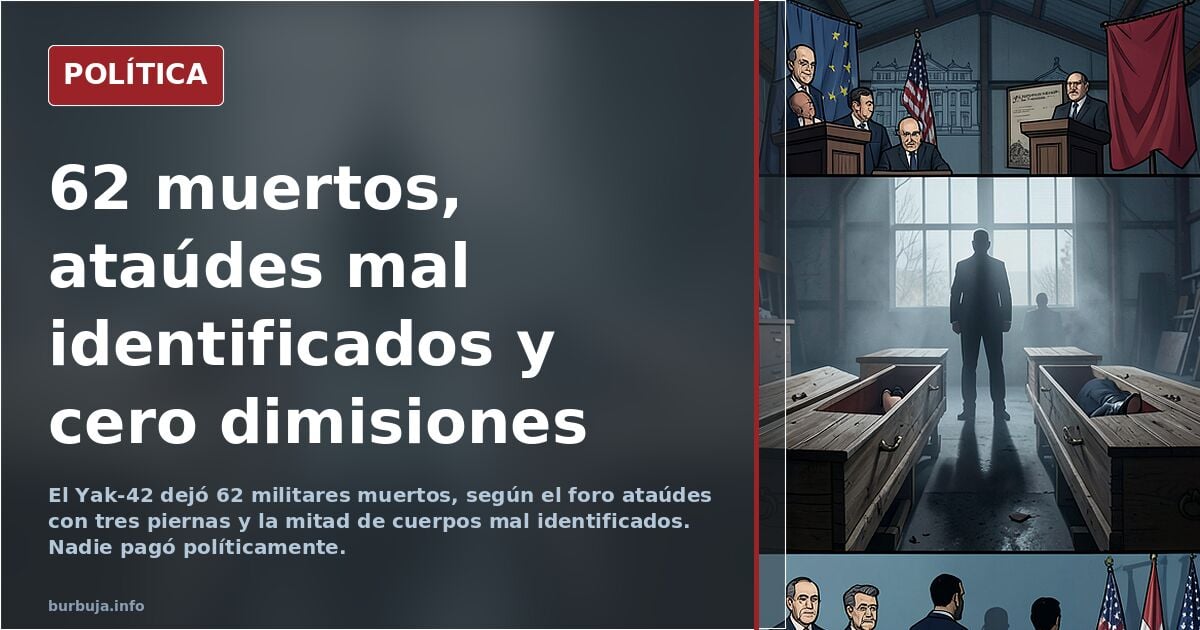
Yak-42: 62 soldiers dead, coffins with three legs, and no one held responsible
In 2003, a Ukrainian Yak-42 plane crashed in Turkey carrying more than 60 Spanish military personnel. The official narrative closed the tragedy within 48 hours: a state funeral, solemn mass, flags, decorations, and tin badges. Politically, no one paid the price. This is the thesis that opens the discussion, supported by a grim detail: according to the thread, there were coffins with three legs and half of the bodies were not correctly identified.
The Yak-42 accident has become the canonical example of an idea running through the entire debate: that Spanish institutions have managed crises for years using a window-dressing manual. Lots of institutional acts, little assumption of responsibility. And when the spotlight fades, the file is simply archived.
What peine with the identification of the Yak-42 victims' bodies?
The factual core of the case lies in the identification of the remains. As argued in the conversation, **half of the deceased soldiers were not correctly identified** and identity falsification occurred. The most repeated—and hardest to digest—detail is that of the **coffins with three legs**.
Added to this is an administrative fact that hurts more than any speech: the Ministry of Defense, then under Aznar's PP (People's Party), **would not have taken out even a single insurance policy** for the embarked military personnel. Neither rigorous identification nor contractual coverage. The management of the incident was resolved with ceremony, not procedure.
The State Funeral and the political gain from the dead
The State Funeral is the other scenario dissected. The description given is of an event where a group of attendees stood up to shout slogans against the minister at the time, only to sit back down _nonchalantly_. Not a sob, nor the loss of control expected from genuine emotional burden.
The reading extracted is uncomfortable for everyone: some due to the apparatus, others due to exploitation. It is claimed that **the corpses were paraded more than those of Philip the Handsome** and that political gain was sought from the matter. The floating conclusion is that the tragedy became campaign ammunition before being a management problem someone had to explain.
From the Yak-42 to the Prestige and 11-M: the pattern of official lies
The conversation connects the air disaster with a broader sequence: Prestige, Yak-42, 11-M. The thesis is that the **management of the Yak-42 and the Prestige disaster** had already established the suspicion that the Government lied to save its own skin, and that suspicion weighed heavily when the next crisis arrived.
That common thread explains why the case is not read as an accident with bad luck, but as a link in a chain of opaque management. The lingering question is always the same: if they lie about small things, why wouldn't they lie about big ones?
Vera and Barrionuevo pardons and selective memory
The other axis of the case is the political responsibility that never came. It is recalled that **Aznar pardoned Vera and Barrionuevo**, the same people who, it is claimed, pocketed reserved funds and ordered enemies to be liquidated by passing them off as terrorists. Luis Roldán, the civil guard who fled to Laos after stealing, is also mentioned.
The irony permeating the matter is that memory works by convenience. Those who demand accountability for some forget it for others. And so, with each crisis, the whole country gets used to nothing happening.
Victimhood culture as a substitute for debate
The final stretch of the discussion moves to more general ground: Western politics turned into an open-air madhouse where **everyone competes to be the biggest possible victim**. The Yak-42 would be an early example of this mechanism: the victim as a weapon, testimony as an argument, and media trial as a substitute for judicial proceedings.
The proposal launched is simple: let judges handle negligence crimes, not the press or politicians. It sounds reasonable. It also sounds like something that has never peine.
The analysis stalls exactly here: in the distance between what procedure demands and what narrative allows. And in the suspicion, never fully denied, that the Yak-42 was not an exception but the first rehearsal of a method.
Also available in: Deutsch
Summary of a discussion on Burbuja.info - Foro de economía, actualidad y política., translated from Spanish and reviewed before publication. Read the full discussion (34 replies).
More summaries
-
Germany weighs male-only military service at €2,600 monthly
Germany's Defense Ministry proposes a male-only conscription scheme paying €2,600 a month, sparking debate amid growing public resistance.
-
Puigdemont's wig: accident or political strategy?
Analysis of Puigdemont's wig: examining the 1983 accident data and the polarization of political debate.
-
Lleida teacher singles out two students for supporting Vox
Lleida History teacher allegedly called two students 'fachapobres' (poor fascists) over Vox event. Case reopens public education debate.
-
Cuba analogy undermines Spain's Nov 29 election value
A viral post claims Cuba held elections like Spain, suggesting change was gradual. The Nov 29 vote highlights the importance of electoral integrity.
-
UN Tourism Rents Furniture to Simulate Activity at Gifted Madrid HQ
Spain's government gave UN Tourism a building in 2022. Despite spending €391,522 on furniture, the agency now rents items to fake activity.
-
Royal Family Faces Viral Self-Destruction Claims
A viral tweet accuses the Spanish Royal House of self-destruction during the election pre-campaign. We explain the controversy and its significance.