
Spain's workplace paradox: 20% of staff do the work of 80%
In Spanish offices, a minority carries the workload while many idle. A case study reveals how 20% sustain the other 80%.
English · Original discussion in Spanish · Published
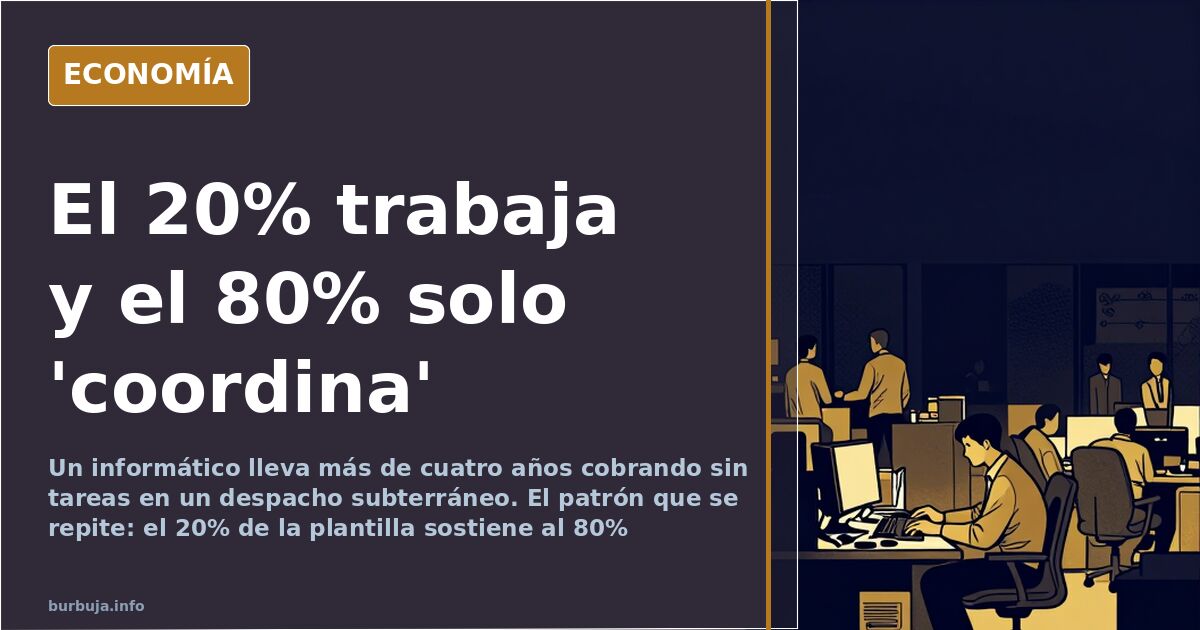
Idle employees: The 20% who support the 80%
A recurring pattern exists in large private and public companies across Spain: a minority handles the actual work, while the majority attends meetings, forwards emails, and engages in office politics. This discussion stems from reports on "ghost workers"—employees who show up for years without performing specific tasks—and an extreme case: an IT specialist who has been paid to do nothing for over four years in an underground office he calls "Villa Soledad."
The conversation quickly shifts to an uncomfortable question: Is this a problem of lazy individuals or disorganized companies?
The IT worker paid to do nothing
A 43-year-old IT specialist from Barcelona, who requested anonymity, admits he hasn't contributed to his company for more than four years. He completed a server redesign before the pandemic; since then, his company was acquired and outsourced technical support. He was retained to "coordinate" this external service, but there is nothing to coordinate: contacts don't write to him, and his bosses seem unaware of his existence.
When ordered to return to the office, he expected to be fired. Instead, he was given an office on an underground floor, surrounded by empty rooms, with the nearest colleague about 20 meters away. There, he spends hours smoking, walking around, watching series, and sleeping in the bathroom. He harbors no illusions: he believes they will eventually find him and only awaits a "dignified" dismissal.
The rule of the 20% supporting the 80%
The most common pattern in testimonials is a brutal ratio: 20% of the workforce gets the job done, while 80% live off that effort. The work of that 80% consists of "coordinating," "leading," forwarding others' emails, claiming credit in meetings, and creating noise. When one of them leaves or goes on sick leave, it goes unnoticed; when someone from the 20% is missing, they are called within three days.
The workload is distributed inefficiently and inequitably: the most committed take on the bulk of important tasks, a silent majority weathers the storm doing the bare minimum, and a final group manages to do absolutely nothing. As one participant summarizes, the reward for digging deeper is simply "a bigger shovel."
Owners' relatives, nepotism, and untouchables
Not everyone who doesn't work is lazy by nature. Several accounts point to a different origin: family ties. One cited case involves an employee kept on a good salary for life because his father was a shareholder who sold the company with that condition in the contract. Others speak of unavoidable commitments made by ownership. In large companies, they say, the landscape increasingly resembles a government ministry: people who do nothing because they don't want to, people who want to work but aren't given tasks, people whose roles are unknown, and people who have been doing things poorly for years without consequence.
Public sector persists, private sector fails
The core conflict is classic: if a private company doesn't work, it closes; in the public sector, deficits are covered by taxes and it doesn't close. The counter-argument is that very large private companies end up copying the vices of ministries in their offices, and the real problem is suffered by freelancers and small businesses, where there is no cushion to maintain anyone staring at the ceiling. In small private firms, those who don't work leave quickly because severance pay for short tenures is negligible.
Bosses protecting those who do nothing
A factor that is more unsettling than others' laziness appears: complicity from above. Some report informing supervisors that colleagues were doing nothing, only to find the supervisors protected them because they went out partying together. An even starker case involves a business owner who didn't care, because he charged clients a fixed monthly fee per worker assigned to the project. If the client pays per head, the boss benefits from having heads, whether they work or not.
Meetings to look busy and antiestéticar of being caught
A recurring tactic is filling the calendar with meetings to simulate activity. Some schedule video calls every day at all hours, later admitting they never existed—it was pure theater. Another perspective warns that doing nothing also causes illness: it generates a sense of uselessness and constant antiestéticar of discovery. They argue that a manageable workload that allows for fulfillment without burnout is healthier.
How many readers are currently sitting in an empty office, bag packed just in case the phone rings?
Also available in: Deutsch
Summary of a discussion on Burbuja.info - Foro de economía, actualidad y política., translated from Spanish and reviewed before publication. Read the full discussion (195 replies).
More summaries
-
Spain faces record low birth rates and social stigma toward babies
Spain's birth rate plummeted from 12.64‰ in 2017 to 7.52‰ in 2021 as derogatory terms for infants become more common.
-
Spain's Apartment Noise: Why Soundproofing Fails
Residents in Spain blame poor acoustic insulation in apartments, while data on new construction remains scarce.
-
68% in Spain back rent caps, El País poll finds
An El País poll shared on X shows 68% support for capping rents in Spain, including 55% backing among PP and Vox voters.
-
Enerparc's Viral Debt: From $33,000 Million to $33.4 Million
A viral tweet attributed a debt of $33,000 million to the German solar company Enerparc; the actual figure being reported is $33.4 million.
-
Bolsonaro beats Lula in Brazil's first round
Bolsonaro defeats Lula in Brazil's first round with 48% against 43% and forces a runoff on October 25.
-
Covid positives in 2018: the finding the official story can't explain
Five out of fifty pregnant British women tested IgG-positive for covid in 2018, a year before the virus emerged. Cross-reactivity doesn't quite explain it.