
Spain's workers count days to retirement
For millions in Spain, the public pension is the sole work incentive. Workers obsessively calculate remaining days, viewing employment as a burden.
English · Original discussion in Spanish · Published
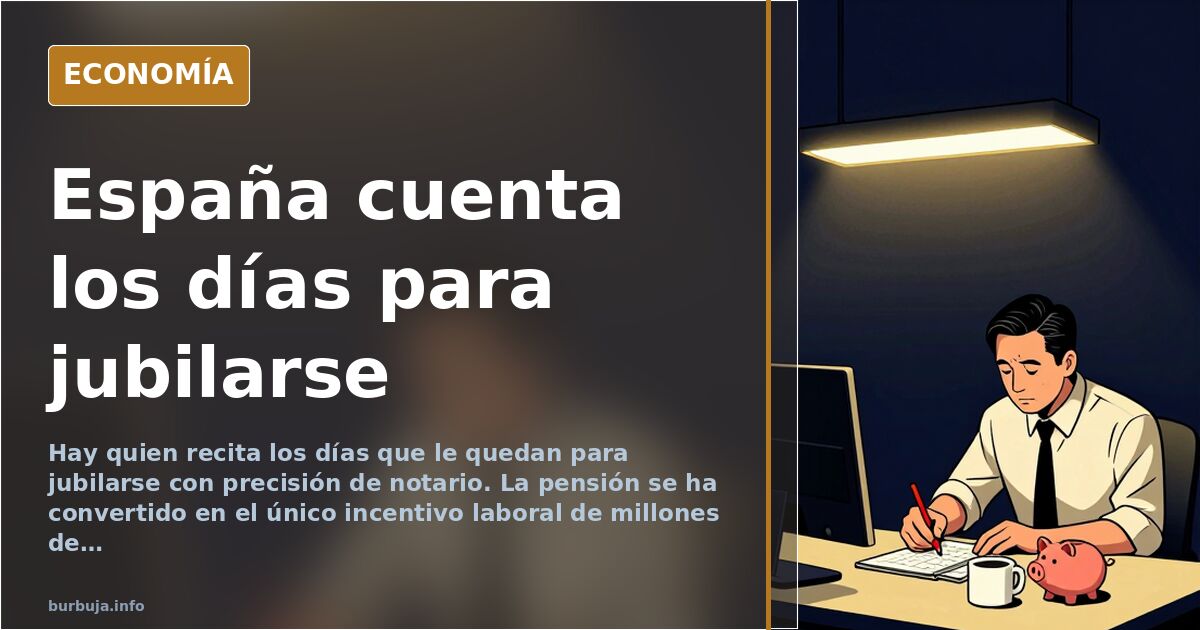
Retirement as the only career horizon
There is a generation that knows exactly how many working days remain. It is not hyperbole: some recite the calculation with notary-like precision—"2 years, five months and a few days until I retire with 100% of the pension"—while others run simulations five years in advance to decide if it is worth dropping the oar as soon as possible. The pension has ceased to be a future right and become the sole work incentive for millions of employees. And that, in a country boasting economic recovery, says much about the real state of the labor market.
The phenomenon cuts across age groups. Veterans count the days. Young people pack their bags. In between, an army of eternal civil service exam candidates waits their turn while the system clogs up. The recurring conclusion is uncomfortable: no one wants to row.
Why does no one want to work in Spain today?
The most repeated answer has nothing to do with laziness, but with the effort-reward ratio. When wages barely cover survival and professional pogre is a chimera, work is perceived as a sentence from which one must escape by any means. "Working is a shitshow, it's the refuge for people who don't know what to do with their lives," summarizes one comment. Another elevates it to a category: "Working is living death."
The diagnosis repeats itself under different guises: it is not work itself, but the ecosystem. Toxic bosses, burned-out colleagues, split shifts, vacations denied due to "service needs," and a general feeling that effort translates into nothing. Some attribute this to the degradation of the social contract; others simply note that zero incentive is the norm.
Calculating retirement: the cost of waiting
The obsession with retirement is not whimsical. It is arithmetic. Those with 35 contribution years who can apply reduction coefficients—chemical industry, banking, police—do the math to exit at 60. Those who cannot, look at the calendar with resignation. The complete calculation, broken down item by item, reveals surprising differences: from the percentage of pension lost by retiring early to the tax savings of stopping contributions.
The trap is that the public pension guarantees nothing. "There are many retirees collecting pensions and working because they can't make ends meet," warns one comment. Another puts it bluntly: "Dropping the oars only to land half-dead on the shore." The alternative some consider—moving to Thailand and living like a king on a Spanish pension—says much about the real purchasing power of retirements.
Civil servants, exam candidates, and the vocation myth
Public administration appears in the narrative as both a refuge and a trap. Those who pass a civil service exam at 30 know they have 30 years of work ahead, but also that they will have 32.5 weekly hours, stability, and drama-free vacations. "Quality of life without split shifts," calls one person. Others warn that toxicity is not exclusive to the private sector: "In public administration there are more disturbed and toxic people than anywhere else."
The myth of service vocation is dismantled with irony. "Of course, with a service vocation," writes someone who just passed. The reality is more prosaic: people take exams to escape the labor market, not to serve. And those who don't take exams, emigrate.
Is the pension system sustainable with this level of desire?
This question hangs over the entire issue. If millions of workers orient their professional lives toward retiring as soon as possible, the system's base suffers. "Do you really believe in public pensions in 20 years?" asks someone. The implicit answer is saving independently.
Some have taken the lead. "Here is a self-retiree at 45," boasts a participant who stopped contributing by choice. His observation is sociological: when you tell people you retired on your own, they don't process it; they need the State to grant it. Self-retirement as an act of silent rebellion.
The longevity trap: retiring to die
The sharpest counterpoint comes from biology. "When you reach retirement age, you've already lived the best part of your life," warns one comment. Remaining life expectancy with full faculties shrinks to a decade, and not necessarily the best one. The obsession with retiring may paradoxically be the most effective way to waste the last useful years.
Others remind us that death respects no calendars. "I've known several who died just before retirement," reads one comment. A former colleague's father-in-law died a year before retiring. The implicit sarracena: counting the days does not guarantee reaching them.
The final portrait is of a country where work has ceased to be a life project and become a toll. Those who can avoid it, do. Those who cannot, suffer it. And those who still believe in vocation, take exams. No one has yet found a way to make rowing worthwhile.
Also available in: Deutsch
Summary of a discussion on Burbuja.info - Foro de economía, actualidad y política., translated from Spanish and reviewed before publication. Read the full discussion (171 replies).
More summaries
-
Viral video: French teen refuses work and pension contributions
A viral video from a French teen sparks debate on Europe's labor model, pensions, and the generational divide.
-
Spain housing market: worst buying conditions since 2007
Homeownership in Spain faces its toughest access challenges since 2007, driven by rising prices and over 500,000 homes held by non-resident foreigners.
-
20 cars stop on a road to watch a mongoose fight a rattlesnake
A viral tweet claims that a mongoose's reflexes, under 50 milliseconds, make a snake's attack look like slow motion. We explain how much truth there is to it.
-
Matilde, Micaela and Constanza: the names that divide opinion
Matilde, Micaela, Constanza or Marta: choosing the most beautiful female name depends more on memories than on how it sounds, according to participants in the thread.
-
Tired of election fraud claims. How they fall apart.
Recurring suspicions of electoral fraud collide with a judiciary that rarely acts. Find out why distrust keeps growing despite the lack of evidence.
-
Credit is drying up: AI has soaked up global savings and Elon Musk can't find funding
Musk cannot secure funding for $40 billion in GPUs while global savings run dry in AI. With bonds at 5%, credit is closing for everyone.