
Spain's Winter Time Change Cuts Children's Afternoons
Winter time shifts darkness to 7 PM, shortening playtime. This fuels debate on Spain's time zone and school hours.
English · Original discussion in Spanish · Published
Spain's Winter Time Change Cuts Children's Afternoons
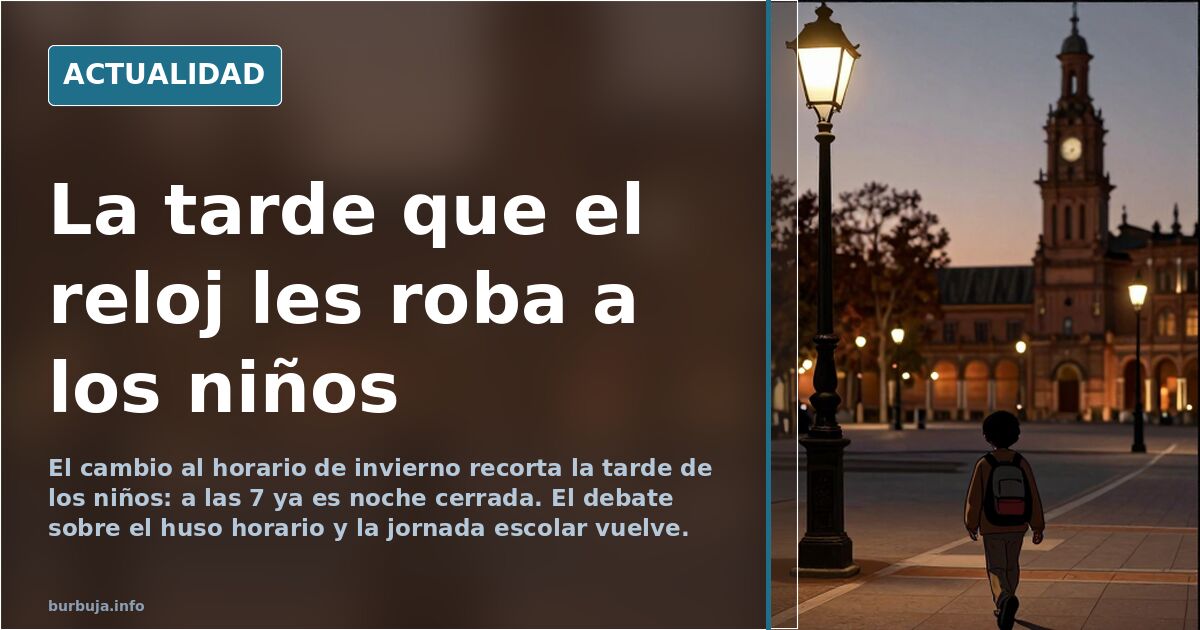
By 7 PM, it is pitch dark. It is cold, and the park is empty. A child summed it up better than any editorial: "Why did they have to change that damn time?" The shift to winter time has abruptly cut children's outdoor playtime; what was a full sunny afternoon in summer is now barely an hour before dinner. The complaint, echoed in thousands of homes, opens a more uncomfortable issue: whether the Spanish schedule — lunch at 3 PM, dinner at 9:30 PM — makes sense or is pure inertia.
What Exactly Changed with Winter Time
The change is simple, and its effects are immediate. On Friday, one could stay outside until 8 PM with pleasant temperatures; now, visibility drops by 7 PM. For adults, this means 60 fewer minutes of daylight. For an 8-year-old, proponents argue that three months of shortened afternoons equate to a whole year, because children live each minute with an intensity adults have forgotten.
The proposal raising the issue is radical but logical: keep summer time all year round. Regardless of the GMT+2 debate, the point is that Spain eats late, so maximizing daylight in the afternoon is preferable. "Is nobody thinking about the children?" concludes the argument.
Children Home by 8 PM: Common Sense or Punishment?
The harshest response came quickly. Some defend that children should not be in the streets or parks by 8 PM, arguing that bath, dinner, and bed are due then, and labeling parents who keep them out all day as selfish. In this view, childhood should pass at home, with fixed schedules and no noise for neighbors exhausted from work.
In contrast, the rebuttal is nearly unanimous among parents: in summer, children get disoriented, sleeping at 11 PM and waking with the sun, making life difficult for parents. In winter, those leaving school at 2 PM have ample time; those leaving at 5 PM have barely an hour and a half to play, do homework, bathe, and eat. They note that continuous school days have reduced this margin in most regions.
A Time Zone That Doesn't Match the Sun
The core issue is geographical. Spain runs one hour ahead of solar time, and some take the argument further: it should use GMT 0, meaning it would currently be 8 PM. With the current time zone, December dawns very late and darkens before many leave work.
The counterargument is equally solid. If clocks were adjusted to the correct solar time zone, sunset would occur even earlier, the opposite of what long-afternoon advocates want. In December, daylight lasts only 8 or 9 hours, and no decree changes that. The intermediate option considered — keeping the current time zone without changing the clock — satisfies no one.
Voices from Where It's Dark by 4 PM
One perspective stands out: that of residents in northern Spain. There, the sun sets around 4 PM, and with clouds, it feels like living in a cave all day. Some resort to vitamin D to avoid seasonal depression. From that latitude, complaining about darkness at 6:30 PM sounds like a joke.
Others advocate for leaving things unchanged and adjusting work schedules, while some recall that pure solar time — sunrise at 6:30 AM, sunset at 5:30 PM — governed history. Ultimately, the time change is a recent extravagance.
Split vs. Continuous School Days and Remaining Playtime
The debate shifts to schools. Continuous school days have expanded to cover most centers, eliminating the long midday recess. Previously, with split days, children played for an hour and a half in the cafeteria and returned home tired from running. Now, they leave at 2 PM or 5 PM, narrowing their free time.
The recurring conclusion: the problem isn't just the clock, but the combination of work hours, school schedules, and time zones. Changing the time without addressing other factors merely moves the problem elsewhere.
With these elements, children's afternoons will continue to depend on decrees signed in Brussels and schedules decided decades ago. The girl in the park was right about one thing: nobody asked her.
By 7 PM, it is pitch dark. It is cold, and the park is empty. A child summed it up better than any editorial: "Why did they have to change that damn time?" The shift to winter time has abruptly cut children's outdoor playtime; what was a full sunny afternoon in summer is now barely an hour before dinner. The complaint, echoed in thousands of homes, opens a more uncomfortable issue: whether the Spanish schedule — lunch at 3 PM, dinner at 9:30 PM — makes sense or is pure inertia.
What Exactly Changed with Winter Time
The change is simple, and its effects are immediate. On Friday, one could stay outside until 8 PM with pleasant temperatures; now, visibility drops by 7 PM. For adults, this means 60 fewer minutes of daylight. For an 8-year-old, proponents argue that three months of shortened afternoons equate to a whole year, because children live each minute with an intensity adults have forgotten.
The proposal raising the issue is radical but logical: keep summer time all year round. Regardless of the GMT+2 debate, the point is that Spain eats late, so maximizing daylight in the afternoon is preferable. "Is nobody thinking about the children?" concludes the argument.
Children Home by 8 PM: Common Sense or Punishment?
The harshest response came quickly. Some defend that children should not be in the streets or parks by 8 PM, arguing that bath, dinner, and bed are due then, and labeling parents who keep them out all day as selfish. In this view, childhood should pass at home, with fixed schedules and no noise for neighbors exhausted from work.
In contrast, the rebuttal is nearly unanimous among parents: in summer, children get disoriented, sleeping at 11 PM and waking with the sun, making life difficult for parents. In winter, those leaving school at 2 PM have ample time; those leaving at 5 PM have barely an hour and a half to play, do homework, bathe, and eat. They note that continuous school days have reduced this margin in most regions.
A Time Zone That Doesn't Match the Sun
The core issue is geographical. Spain runs one hour ahead of solar time, and some take the argument further: it should use GMT 0, meaning it would currently be 8 PM. With the current time zone, December dawns very late and darkens before many leave work.
The counterargument is equally solid. If clocks were adjusted to the correct solar time zone, sunset would occur even earlier, the opposite of what long-afternoon advocates want. In December, daylight lasts only 8 or 9 hours, and no decree changes that. The intermediate option considered — keeping the current time zone without changing the clock — satisfies no one.
Voices from Where It's Dark by 4 PM
One perspective stands out: that of residents in northern Spain. There, the sun sets around 4 PM, and with clouds, it feels like living in a cave all day. Some resort to vitamin D to avoid seasonal depression. From that latitude, complaining about darkness at 6:30 PM sounds like a joke.
Others advocate for leaving things unchanged and adjusting work schedules, while some recall that pure solar time — sunrise at 6:30 AM, sunset at 5:30 PM — governed history. Ultimately, the time change is a recent extravagance.
Split vs. Continuous School Days and Remaining Playtime
The debate shifts to schools. Continuous school days have expanded to cover most centers, eliminating the long midday recess. Previously, with split days, children played for an hour and a half in the cafeteria and returned home tired from running. Now, they leave at 2 PM or 5 PM, narrowing their free time.
The recurring conclusion: the problem isn't just the clock, but the combination of work hours, school schedules, and time zones. Changing the time without addressing other factors merely moves the problem elsewhere.
With these elements, children's afternoons will continue to depend on decrees signed in Brussels and schedules decided decades ago. The girl in the park was right about one thing: nobody asked her.
Also available in: Deutsch
Summary of a discussion on Burbuja.info - Foro de economía, actualidad y política., translated from Spanish and reviewed before publication. Read the full discussion (135 replies).
More summaries
-
Madrid reinstates split school day with two-hour break
The Community of Madrid approves a split schedule for public schools, introducing a mandatory two-hour midday break. Teachers and parents express concern over logistics.
-
Spain runs two hours ahead of the sun, and the debate continues
Spain operates on GMT+2, two hours ahead of solar time, and the debate over which schedule to adopt remains open amid tourism, heat, and sleep deprivation.
-
Casanova sparks debate on Spanish state-funded cinema
Eduardo Casanova's documentary 'Sidosa' drew only 381 viewers in 79 theaters, reigniting controversy over public subsidies for Spanish film.
-
Seville healthcare workers barricade themselves against violent Moroccan patient
Staff in Brenes, Spain, locked doors to escape a Moroccan patient who attacked them. The health center was forced to close.
-
Barcelona Metro Assault: Koudid Souheib Case Details
Analysis of the Barcelona metro attack involving Koudid Souheib, age 30, with prior police records. Incident details and judicial proceedings.
-
Does a rear camera sign deter tailgaters?
A driver uses a dashcam and warning sign to stop tailgaters. Does it deter or provoke? Analysis of its real effectiveness and alternatives.