
Spain's Transport Minister Defends Amnesty as Judicial Efficiency Measure
Óscar Puente argues amnesty saves judicial work and avoids pardons, sparking debate on the purpose of legal proceedings in Spain.
English · Original discussion in Spanish · Published
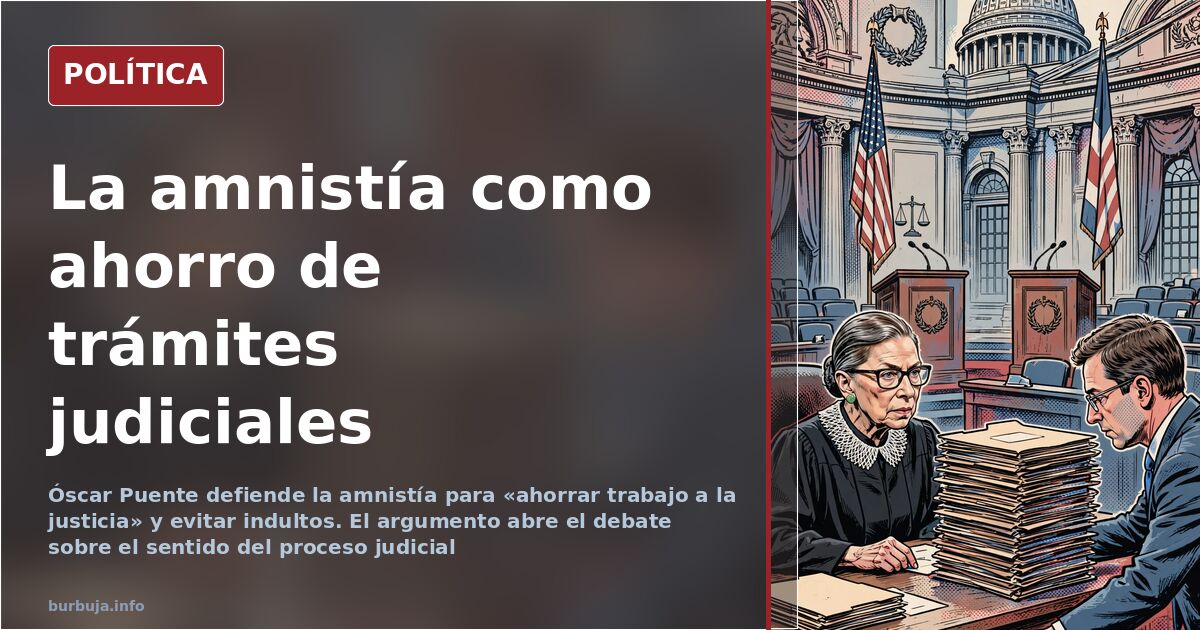
Puente pitches amnesty as a way to save justice system workload
Transport Minister Óscar Puente has found a new argument for the amnesty law: that it saves work for the judiciary. He made this claim while inaugurating a section of the B-40 ring road between Olesa de Montserrat and Viladecavalls, alongside Government Delegate in Catalonia Carlos Prieto, speaking with the confidence of someone who believes they have hit upon the right solution. He maintains that it makes "no sense" to subject someone to judicial proceedings only to end up granting them a pardon. Presented this way, the exceptional measure resembles an administrative efficiency audit.
What exactly did Óscar Puente say about the amnesty?
The minister defended the norm as "the most necessary and convenient solution at this moment" and called for "responsibility and common sense" to prevail in its approval. His most repeated phrase referred to the "judicial pilgrimage that ends in a pardon." He added a concession hard to dispute: the justice system is "not exactly overflowing with resources either." This is the crux of the matter. If the problem is a lack of means, amnesty does not solve it; it bypasses it. A subtle distinction.
Puente was also responding to Carles Campuzano, the Catalan government’s Minister of Social Rights, who had admitted that some people would not be covered by the law and stated that "pardon mechanisms exist" for those cases. The minister did not consider this "nonsense" and summarized the Executive’s intention: "We want to remove the situation from the courts, so there are no incivil consequences." In other words, taking the case away from judges before they can resolve it.
Amnesty or pardon? The Plan B the Government hasn't ruled out
The sequence is simple to describe but complicated to reconcile. First, a law that erases the facts. Then, for those left out, the pardon acts as a safety net. Campuzano made it clear: no amnesty is 100% immune because laws are "always subject to judicial review." Puente took up the challenge and added that resolving the conflict would be "excellent for all of Spain and for Catalonia too."
The practical result is captured by the day's witty remark: if the final destination is forgiveness, let us skip the trial. The problem is that the trial was not just a toll to reach the pardon; it was also the place where each person's actions were determined. Suppressing it does not simplify the process; it changes the meaning of the process.
Where does the idea of saving judicial work come from?
The argument has one virtue: it is honest. It acknowledges that the goal is not for the courts to decide, but for them not to decide at all. And it has one flaw: it relies on a scarcity of resources to justify not using those resources. Some read this as pure pragmatism, while others see it as confirmation that the judicial process is more burdensome than beneficial.
The cynic's calculation points to the same conclusion: the pardon was already the predictable outcome in practice, so the law merely accelerates the result and skips the ritual. Against this lies the obvious argument: a pardon requires a prior conviction, a factual account, and public assessment. Without that, there is no forgiveness: there is the disappearance of the issue. A witty response summed up the absurdity: why hold trials if you save paperwork, hallway coffees, and TV correspondents?
Óscar Puente: From Rocafort's backlash to deleted tweets
The minister is also a constant generator of headlines. Lawyer Guillermo Rocafort dedicated a July 2024 article to statements by Puente and Fernando Grande-Marlaska trinc Nacho Cano's arrest, receiving an enthusiastic response on social media. Meanwhile, a cartoon titled Homo Puentus, signed by Cuesta and Sañudo, captured much of the tone of the public debate surrounding his figure.
There was more. According to screenshots circulated online and picked up by media, Puente deleted a tweet in which he used a Missing Persons SOS sign for a joke about Dolors Montserrat, without offering a subsequent apology. That episode epitomizes the public persona: plenty of wit, little trinc-up correction.
Why does Puente attract so much controversy?
Two strong interpretations circulate. The first holds that nothing about him is accidental: he is a PSOE member, a pragmatic socialist who neither hides nor wears a mask. The second points to political utility: a minister who generates headlines allows other, less flattering issues to pass unnoticed. When public conversation fills with Puente, it empties of everything else.
In the middle remains an uncomfortable underlying question: if the declared objective is to remove the Catalan conflict from the courts, what remains of the rule of law when the law is designed so certain cases never reach trial? The pending law will leave the answer to the judges responsible for applying it.
With amnesty on the table and pardon waiting behind it, the efficiency argument turns a matter of principle into a game of procedural accounting. How much does it cost not to judge?
Transport Minister Óscar Puente has found a new argument for the amnesty law: that it saves work for the judiciary. He made this claim while inaugurating a section of the B-40 ring road between Olesa de Montserrat and Viladecavalls, alongside Government Delegate in Catalonia Carlos Prieto, speaking with the confidence of someone who believes they have hit upon the right solution. He maintains that it makes "no sense" to subject someone to judicial proceedings only to end up granting them a pardon. Presented this way, the exceptional measure resembles an administrative efficiency audit.
What exactly did Óscar Puente say about the amnesty?
The minister defended the norm as "the most necessary and convenient solution at this moment" and called for "responsibility and common sense" to prevail in its approval. His most repeated phrase referred to the "judicial pilgrimage that ends in a pardon." He added a concession hard to dispute: the justice system is "not exactly overflowing with resources either." This is the crux of the matter. If the problem is a lack of means, amnesty does not solve it; it bypasses it. A subtle distinction.
Puente was also responding to Carles Campuzano, the Catalan government’s Minister of Social Rights, who had admitted that some people would not be covered by the law and stated that "pardon mechanisms exist" for those cases. The minister did not consider this "nonsense" and summarized the Executive’s intention: "We want to remove the situation from the courts, so there are no incivil consequences." In other words, taking the case away from judges before they can resolve it.
Amnesty or pardon? The Plan B the Government hasn't ruled out
The sequence is simple to describe but complicated to reconcile. First, a law that erases the facts. Then, for those left out, the pardon acts as a safety net. Campuzano made it clear: no amnesty is 100% immune because laws are "always subject to judicial review." Puente took up the challenge and added that resolving the conflict would be "excellent for all of Spain and for Catalonia too."
The practical result is captured by the day's witty remark: if the final destination is forgiveness, let us skip the trial. The problem is that the trial was not just a toll to reach the pardon; it was also the place where each person's actions were determined. Suppressing it does not simplify the process; it changes the meaning of the process.
Where does the idea of saving judicial work come from?
The argument has one virtue: it is honest. It acknowledges that the goal is not for the courts to decide, but for them not to decide at all. And it has one flaw: it relies on a scarcity of resources to justify not using those resources. Some read this as pure pragmatism, while others see it as confirmation that the judicial process is more burdensome than beneficial.
The cynic's calculation points to the same conclusion: the pardon was already the predictable outcome in practice, so the law merely accelerates the result and skips the ritual. Against this lies the obvious argument: a pardon requires a prior conviction, a factual account, and public assessment. Without that, there is no forgiveness: there is the disappearance of the issue. A witty response summed up the absurdity: why hold trials if you save paperwork, hallway coffees, and TV correspondents?
Óscar Puente: From Rocafort's backlash to deleted tweets
The minister is also a constant generator of headlines. Lawyer Guillermo Rocafort dedicated a July 2024 article to statements by Puente and Fernando Grande-Marlaska trinc Nacho Cano's arrest, receiving an enthusiastic response on social media. Meanwhile, a cartoon titled Homo Puentus, signed by Cuesta and Sañudo, captured much of the tone of the public debate surrounding his figure.
There was more. According to screenshots circulated online and picked up by media, Puente deleted a tweet in which he used a Missing Persons SOS sign for a joke about Dolors Montserrat, without offering a subsequent apology. That episode epitomizes the public persona: plenty of wit, little trinc-up correction.
Why does Puente attract so much controversy?
Two strong interpretations circulate. The first holds that nothing about him is accidental: he is a PSOE member, a pragmatic socialist who neither hides nor wears a mask. The second points to political utility: a minister who generates headlines allows other, less flattering issues to pass unnoticed. When public conversation fills with Puente, it empties of everything else.
In the middle remains an uncomfortable underlying question: if the declared objective is to remove the Catalan conflict from the courts, what remains of the rule of law when the law is designed so certain cases never reach trial? The pending law will leave the answer to the judges responsible for applying it.
With amnesty on the table and pardon waiting behind it, the efficiency argument turns a matter of principle into a game of procedural accounting. How much does it cost not to judge?
Summary of a discussion on Burbuja.info - Foro de economía, actualidad y política., translated from Spanish and reviewed before publication. Read the full discussion (177 replies).
More summaries
-
End of Cycle in the PSOE: Civil Servants Refuse to Sign in Puente's Ministry
High-ranking civil servants defecting in Óscar Puente's Ministry, mirroring the PSOE's paranoia regarding its end-of-cycle phase. Vozpópuli chronicles it all.
-
Madrid train bombings: missing evidence fuels conspiracy theories
191 dead, 1,858 injured and lost forensic evidence: the enduring controversy and conspiracy theories surrounding the 2004 Madrid train bombings.
-
Judge Peinado charges Begoña Gómez with influence peddling
Begoña Gómez, wife of Spanish PM Pedro Sánchez, is charged with influence peddling. Judge Peinado summons her as an accused on June 9.
-
Polls show 25% of young Spaniards back Vox
Two surveys indicate 25% of voters aged 18-24 support Spain's far-right Vox, mirroring trends in Germany where young men favor AfD.
-
Anti-NWO Music: Underground Catalog Spans Fashwave to RAC
From fashwave to Spanish and Italian RAC, this underground catalog builds an anti-NWO music scene outside official channels, citing Klan and División 250.
-
Audio reveals plot against Spain's top anti-corruption police chief
Leaked audio shows PSOE figure Leire Díez seeking damaging info on Civil Guard Lt. Col. Antonio Balas, who leads key corruption probes.