
Spain's summer split: Northern beaches packed, Mediterranean empty
Coastal restaurant portions shrink by half while northern Spain faces record crowds and the Mediterranean struggles with low occupancy.
English · Original discussion in Spanish · Published
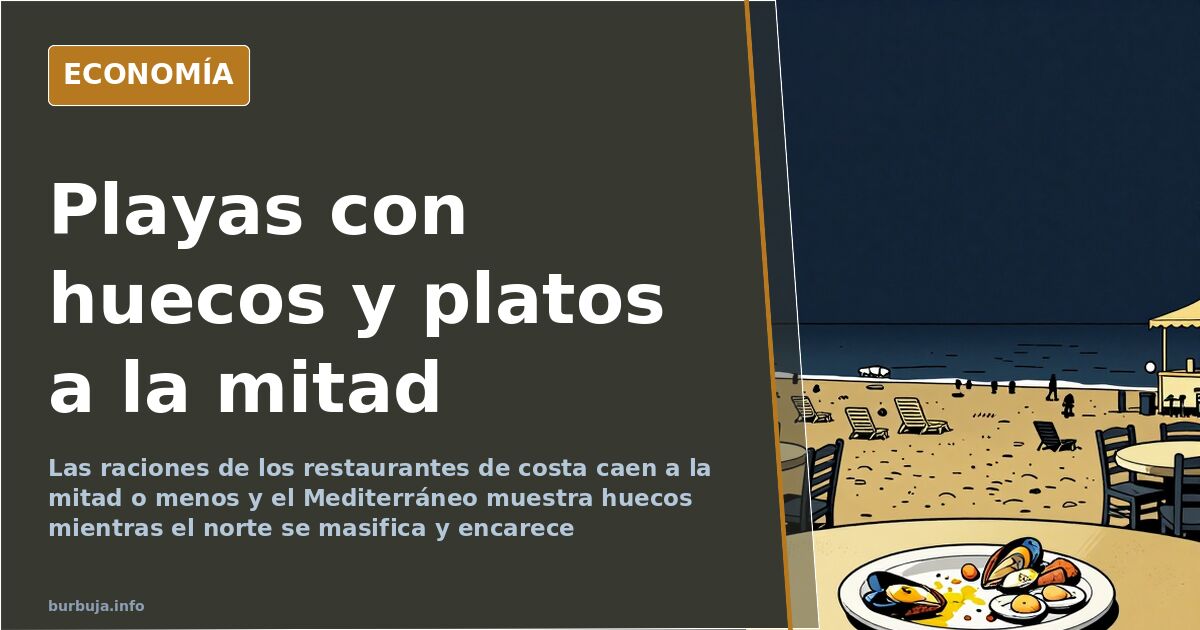
Fewer towels on sand, smaller plates: Spain's summer doesn't add up
Where has everyone gone? The scene opening these impressions is not a beach packed to capacity, but the opposite: open sand, plenty of gaps and an uncomfortable feeling that something is wrong. Those who have watched this for years recall barely having space to plant a parasol. Now there is room to spare. The second warning comes from restaurants: asking if patrons wanted just skewers or a full meal determined table availability. And dishes, they claim, are now half the size or less than before the pandemic. With inflation squeezing budgets, eating out is becoming unaffordable.
Why is the north overflowing while the Mediterranean lags?
The pattern is uneven. The Cantabrian coast is experiencing a record summer: Santander and its surroundings with beaches "like never before," Galicia where finding space for a towel has become impossible after 40 years of routine, and mentions of Asturias and Lugo's Mariña equally crowded. Ribadesella, Comillas, or Zarautz appear with "excellent" water even on cloudy days. Conversely, the Mediterranean offers a mixed picture: Ibiza with a "very weak" July, Tarifa similar, the Levante area poor, Valencia calm, and Calpe with plenty of space. Cullera, however, sees "many people for the time of day." Málaga is the extreme case: where 30 years ago one could park 20 meters from the beach, today parking spots are scarce because everything has become a promenade with terraces and beach bars.
There is a calendar explanation for the mismatch. The election weekend left inland cities unusually busy for July: some people reorganized plans around postal voting or serving at polling stations. Others point to a simple trend change: the north, they say, has become fashionable for short trips.
Half-size portions and pay-to-sit tables
The restaurant anecdote best summarizes the discontent. Asking if a table was for snacking on skewers or for a real meal is not courtesy; it is a filter. Someone wanting only a beer and a tapas occupies a seat that, with current costs, does not cover the bill. Hence the suspicion that venues now only want customers spending a minimum amount. Added to this is the shrinking portion: if inflation continues, experts warn, eating out will no longer be worthwhile, and many businesses will not survive. This is not isolated. Reference beach bars are closed and abandoned, beaches fill with terraces losing parking, and a widespread complaint persists: good food is found inland or at home, because on the coast one pays gourmet prices for fried junk.
Gas stations, butcher shops, greengrocers: the real thermometers
If headlines don't match street reality, look elsewhere. The proposal is simple yet stark: ask gas stations, restaurants, butchers, and greengrocers if they have lost customers and revenue. If yes, the story is told. Detected symptoms point in the same direction: leisure spending drops, and shopping baskets have downgraded —from beef to chicken— although gas is still paid because cars are essential for many commutes. The exception is thrifty veterans, those practicing extreme savings for life: for them, the change is barely noticeable.
Why more visitors but less spending?
More people do not always miccionan more business. Tourism economy depends on external factors, and the uncomfortable data is that Germany has entered recession. Therefore, the beach photo can deceive: what matters less is how many parasols are present, and more is how much each spends. Those filling the sand, note observers, are not average tourists, but profiles with stable salaries or foreign income who can still afford a few days. The rest visit for the day and sleep at home. The result is a coast with visitors but lower per-capita spending, and an autumn that, warns analysts, may bring surprises.
Santander wants to be San Sebastián
Northern overcrowding has its own cost. Revilla's appearance on El Hormiguero is cited as a trigger for the trend, but the phenomenon is broader: Asturias or Lugo's Mariña are equally or worse affected. Five years ago, they emphasize, tourist apartments with registration plaques did not exist. Now they multiply, along with prices. The paradox is that much of northern tourism is local: some vacation in Laredo, Noja, or Castro Urdiales because they cannot afford their own coastal homes. The Cantabrian Sea, always a refuge for upper-middle class, has become so expensive it expels those living nearby.
With these elements, the question "where is everyone?" has an unheroic answer: everyone is where they can afford to be. The sand, this July, has more gaps than answers.
Where has everyone gone? The scene opening these impressions is not a beach packed to capacity, but the opposite: open sand, plenty of gaps and an uncomfortable feeling that something is wrong. Those who have watched this for years recall barely having space to plant a parasol. Now there is room to spare. The second warning comes from restaurants: asking if patrons wanted just skewers or a full meal determined table availability. And dishes, they claim, are now half the size or less than before the pandemic. With inflation squeezing budgets, eating out is becoming unaffordable.
Why is the north overflowing while the Mediterranean lags?
The pattern is uneven. The Cantabrian coast is experiencing a record summer: Santander and its surroundings with beaches "like never before," Galicia where finding space for a towel has become impossible after 40 years of routine, and mentions of Asturias and Lugo's Mariña equally crowded. Ribadesella, Comillas, or Zarautz appear with "excellent" water even on cloudy days. Conversely, the Mediterranean offers a mixed picture: Ibiza with a "very weak" July, Tarifa similar, the Levante area poor, Valencia calm, and Calpe with plenty of space. Cullera, however, sees "many people for the time of day." Málaga is the extreme case: where 30 years ago one could park 20 meters from the beach, today parking spots are scarce because everything has become a promenade with terraces and beach bars.
There is a calendar explanation for the mismatch. The election weekend left inland cities unusually busy for July: some people reorganized plans around postal voting or serving at polling stations. Others point to a simple trend change: the north, they say, has become fashionable for short trips.
Half-size portions and pay-to-sit tables
The restaurant anecdote best summarizes the discontent. Asking if a table was for snacking on skewers or for a real meal is not courtesy; it is a filter. Someone wanting only a beer and a tapas occupies a seat that, with current costs, does not cover the bill. Hence the suspicion that venues now only want customers spending a minimum amount. Added to this is the shrinking portion: if inflation continues, experts warn, eating out will no longer be worthwhile, and many businesses will not survive. This is not isolated. Reference beach bars are closed and abandoned, beaches fill with terraces losing parking, and a widespread complaint persists: good food is found inland or at home, because on the coast one pays gourmet prices for fried junk.
Gas stations, butcher shops, greengrocers: the real thermometers
If headlines don't match street reality, look elsewhere. The proposal is simple yet stark: ask gas stations, restaurants, butchers, and greengrocers if they have lost customers and revenue. If yes, the story is told. Detected symptoms point in the same direction: leisure spending drops, and shopping baskets have downgraded —from beef to chicken— although gas is still paid because cars are essential for many commutes. The exception is thrifty veterans, those practicing extreme savings for life: for them, the change is barely noticeable.
Why more visitors but less spending?
More people do not always miccionan more business. Tourism economy depends on external factors, and the uncomfortable data is that Germany has entered recession. Therefore, the beach photo can deceive: what matters less is how many parasols are present, and more is how much each spends. Those filling the sand, note observers, are not average tourists, but profiles with stable salaries or foreign income who can still afford a few days. The rest visit for the day and sleep at home. The result is a coast with visitors but lower per-capita spending, and an autumn that, warns analysts, may bring surprises.
Santander wants to be San Sebastián
Northern overcrowding has its own cost. Revilla's appearance on El Hormiguero is cited as a trigger for the trend, but the phenomenon is broader: Asturias or Lugo's Mariña are equally or worse affected. Five years ago, they emphasize, tourist apartments with registration plaques did not exist. Now they multiply, along with prices. The paradox is that much of northern tourism is local: some vacation in Laredo, Noja, or Castro Urdiales because they cannot afford their own coastal homes. The Cantabrian Sea, always a refuge for upper-middle class, has become so expensive it expels those living nearby.
With these elements, the question "where is everyone?" has an unheroic answer: everyone is where they can afford to be. The sand, this July, has more gaps than answers.
Also available in: Deutsch
Summary of a discussion on Burbuja.info - Foro de economía, actualidad y política., translated from Spanish and reviewed before publication. Read the full discussion (139 replies).
More summaries
-
Ibiza's Empty Beaches: High Prices and Tourist Fatigue
Half-empty beaches in Ibiza, with €6 beers and €26 salads, drive tourists to Menorca and Morocco.
-
Málaga: 40,000 tourist apartments vs. 4,000 rentals
Málaga has 40,000 tourist apartments against just 4,000 rentals, with Spain's highest property prices and salaries of 19,400 euros.
-
Quiet Ibiza in July: Tourism Crisis or Model Shift?
Analysis of Ibiza's unexpected tourism slump in July, contrasting past saturation with current market realities and economic pressures.
-
Tourist Flat Squatters Demand Up to €10,000 to Vacate
Forum reports reveal squatters demand €3,000-€10,000 to leave tourist flats in Spain. Overburdened courts and organized gangs worsen the crisis.
-
Montero pays Marcos €18,000 after non-payment scandal
Irene Montero paid Rafael Marcos the €18,000 owed hours after reports revealed she had not yet complied with a Supreme Court order issued three months prior.
-
Spain's Apartment Noise: Why Soundproofing Fails
Residents in Spain blame poor acoustic insulation in apartments, while data on new construction remains scarce.