
Spain’s Social Unrest: Record Drug Use and Rising Aggression
Spain ranks fifth globally in cocaine consumption at 2.2%, sparking debate on social distress, mental health, and street violence.
English · Original discussion in Spanish · Published
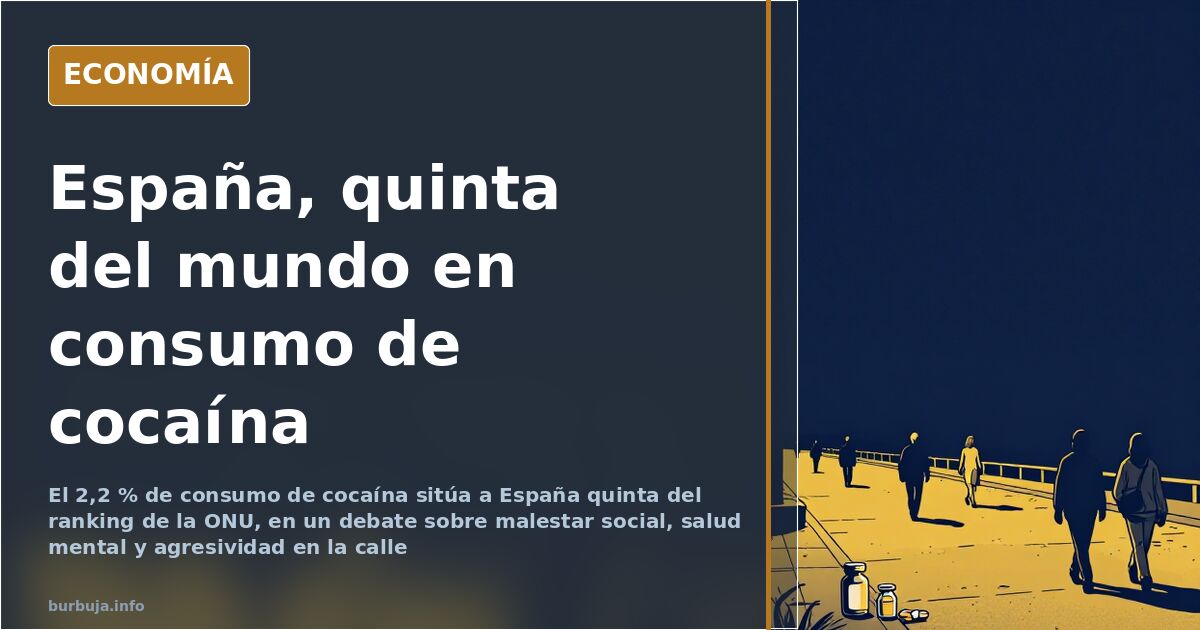
Spain’s social distress: cocaine, anxiety meds, and a more aggressive street
It’s not just the economy. Social distress in Spain is now measured in other units: record-breaking drug use, anxiety medications, street aggression, and growing distrust among neighbors. According to this reading, the deterioration shows up not in GDP but in the atmosphere of each neighborhood. And the atmosphere, they say, is degraded.
Spain’s global ranking in cocaine consumption
The first evidence cited is chemical. According to data attributed to the United Nations, Spain registers a 2.2% cocaine consumption rate and holds the fifth position worldwide. Ahead are Albania (2.5%), Scotland (2.34%), the United States (2.3%), and England and Wales (2.25%). Behind are Australia (2.1%), Uruguay (1.8%), Chile (1.73%), the Netherlands (1.6%), Ireland (1.5%), and Canada (1.46%).
The interpretation of the table is not about leadership—Spain does not top the list—but about normalization. Consumption appears fused with nightlife, work life, and the street. There are reports of open packets displayed in broad daylight without anyone reacting, and the underlying question is how much of this scene is anecdotal and how much has become the landscape.
Why is Spain called a medicated country?
Because psychotropic drugs have infiltrated daily routines. In conversations, benzodiazepines and anxiolytics—the benzos of slang—appear as a thermometer for untreated anxiety that is merely anesthetized. The circulating claim is blunt: more than half of Spain is medicated. This is an unverified estimate, but the accompanying narrative describes something recognizable: overwhelmed consultations, easy prescriptions, and the pill as an emergency solution.
Alcohol, socially accepted, adds to this, along with the diffuse sense that psychological distress has ceased to be an individual problem and has become a trait of the era. On the subject of mental health, it is worth noting that no such data replaces a professional diagnosis.
The political thesis: forty years, Europe, and debt
The shift to the political terrain is immediate. One strand of analysis argues that the origin lies in forty years of Socialist management with a conservative alternation considered cowardly, adding that without European funds the bill would be unpayable. The response from the other side is that Europe does not give anything for free: it counts what is squandered here and turns that money into future dependency. It is settled, so to speak, with a view toward future generations.
Another line, minority and lacking data to support it in this context, points to immigration as a factor of distress. It is offered as an opinion, not a finding.
The street: aggression and mental health after the pandemic
The most repeated scenario is everyday and needs no statistics. A supermarket purchase, a honking horn, a pedestrian who responds with shouts. Such testimonies illustrate the thesis that the threshold of collective patience has lowered. The most repeated explanation points to the pandemic: lockdowns, street controls, and the return to normality have left part of the population with less tolerance and more accumulated tension.
The psychological interpretation crosses here with the economic one. Precarity, low wages, and housing prices fuel an irritability not explained by just a bad day.
When the powder keg started
Most readings agree on a start date: 2008. The financial crisis, unemployment, and subsequent austerity measures left a wound that never fully closed, and on top of it were piled layers: labor precarity, rising housing costs, and distrust in institutions. The pandemic, years later, acted as an accelerator rather than a cause.
The fundamental disagreement
Not everyone buys the diagnosis. Against the gloomy picture stands the argument that Spain ranks among the top fifteen countries in the world in almost all rankings and that negativity is, in itself, part of the problem. The reply is that international comparisons measure averages, not moods, and that a country can have good indicators and deteriorated coexistence simultaneously.
Amid the clash appears a topic that does admit numbers: low birth rates. The hypothesis is that a society that has stopped believing in the other does not reproduce, and that this is compounded by working conditions that complicate work-life balance.
With these threads, the analysis stalls. No one disputes that distress exists; the disagreement lies in whether Spain is breaking or if, simply, it has been complaining loudly for years. The only question that would matter remains unanswered: whether this has hit bottom or if the bottom is yet to come.
It’s not just the economy. Social distress in Spain is now measured in other units: record-breaking drug use, anxiety medications, street aggression, and growing distrust among neighbors. According to this reading, the deterioration shows up not in GDP but in the atmosphere of each neighborhood. And the atmosphere, they say, is degraded.
Spain’s global ranking in cocaine consumption
The first evidence cited is chemical. According to data attributed to the United Nations, Spain registers a 2.2% cocaine consumption rate and holds the fifth position worldwide. Ahead are Albania (2.5%), Scotland (2.34%), the United States (2.3%), and England and Wales (2.25%). Behind are Australia (2.1%), Uruguay (1.8%), Chile (1.73%), the Netherlands (1.6%), Ireland (1.5%), and Canada (1.46%).
The interpretation of the table is not about leadership—Spain does not top the list—but about normalization. Consumption appears fused with nightlife, work life, and the street. There are reports of open packets displayed in broad daylight without anyone reacting, and the underlying question is how much of this scene is anecdotal and how much has become the landscape.
Why is Spain called a medicated country?
Because psychotropic drugs have infiltrated daily routines. In conversations, benzodiazepines and anxiolytics—the benzos of slang—appear as a thermometer for untreated anxiety that is merely anesthetized. The circulating claim is blunt: more than half of Spain is medicated. This is an unverified estimate, but the accompanying narrative describes something recognizable: overwhelmed consultations, easy prescriptions, and the pill as an emergency solution.
Alcohol, socially accepted, adds to this, along with the diffuse sense that psychological distress has ceased to be an individual problem and has become a trait of the era. On the subject of mental health, it is worth noting that no such data replaces a professional diagnosis.
The political thesis: forty years, Europe, and debt
The shift to the political terrain is immediate. One strand of analysis argues that the origin lies in forty years of Socialist management with a conservative alternation considered cowardly, adding that without European funds the bill would be unpayable. The response from the other side is that Europe does not give anything for free: it counts what is squandered here and turns that money into future dependency. It is settled, so to speak, with a view toward future generations.
Another line, minority and lacking data to support it in this context, points to immigration as a factor of distress. It is offered as an opinion, not a finding.
The street: aggression and mental health after the pandemic
The most repeated scenario is everyday and needs no statistics. A supermarket purchase, a honking horn, a pedestrian who responds with shouts. Such testimonies illustrate the thesis that the threshold of collective patience has lowered. The most repeated explanation points to the pandemic: lockdowns, street controls, and the return to normality have left part of the population with less tolerance and more accumulated tension.
The psychological interpretation crosses here with the economic one. Precarity, low wages, and housing prices fuel an irritability not explained by just a bad day.
When the powder keg started
Most readings agree on a start date: 2008. The financial crisis, unemployment, and subsequent austerity measures left a wound that never fully closed, and on top of it were piled layers: labor precarity, rising housing costs, and distrust in institutions. The pandemic, years later, acted as an accelerator rather than a cause.
The fundamental disagreement
Not everyone buys the diagnosis. Against the gloomy picture stands the argument that Spain ranks among the top fifteen countries in the world in almost all rankings and that negativity is, in itself, part of the problem. The reply is that international comparisons measure averages, not moods, and that a country can have good indicators and deteriorated coexistence simultaneously.
Amid the clash appears a topic that does admit numbers: low birth rates. The hypothesis is that a society that has stopped believing in the other does not reproduce, and that this is compounded by working conditions that complicate work-life balance.
With these threads, the analysis stalls. No one disputes that distress exists; the disagreement lies in whether Spain is breaking or if, simply, it has been complaining loudly for years. The only question that would matter remains unanswered: whether this has hit bottom or if the bottom is yet to come.
Summary of a discussion on Burbuja.info - Foro de economía, actualidad y política., translated from Spanish and reviewed before publication. Read the full discussion (272 replies).
More summaries
-
Belgium's 9-year rentals: the fact that corrects Wyoming
Belgium's standard long-term rental contract is signed for nine years, not indefinitely: lifetime leases are 1% and require a notary
-
Laredo assault sparks conflicting narratives in Spain
A viral video of a security guard beaten in Laredo, Cantabria, fuels a dispute over the attack's motive.
-
Spain's Cost of Living: Why Pay for Everything?
From unvaccinated cats to paid air pumps, Spaniards question why every aspect of daily life now carries a price tag.
-
36, €80k saved, no work history: Is he a failure?
A 36-year-old with €80,000 in savings and minimal employment history questions his life choices despite financial security.
-
Milei to Visit Spain for Liberal Award, Challenges Government
Milei plans to travel to Spain to receive the Juan de Mariana Prize and dares the government to block his entry. His spokesperson dismisses recalling the ambassador.
-
Foreign Degree Recognition: The Talent Paradox
Spain's foreign degree recognition process clashes with bureaucratic delays, exams, and wage pressures, challenging the narrative of wasted talent.