
Spain's Social Disconnection: Feeling Like a Stranger Since 2018
Feeling like an outsider in one's own country, Spain's social disconnection began as political dissent in 2018 and now permeates daily life.
English · Original discussion in Spanish · Published
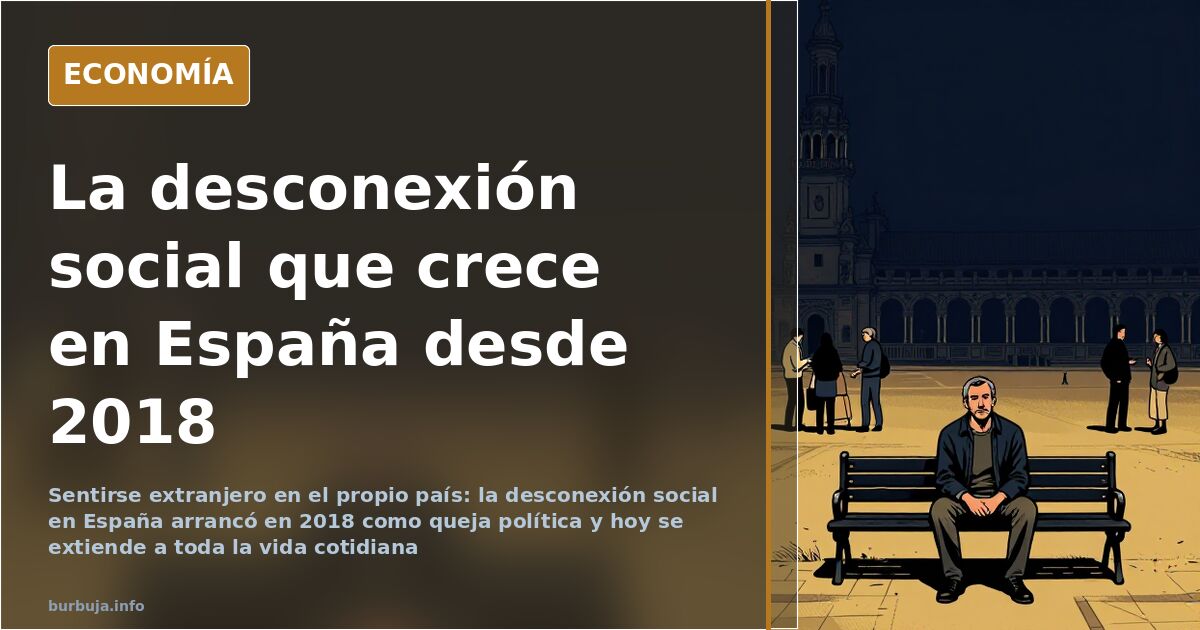
The growing disconnect from Spanish society since 2018
Feeling like a stranger in your own country has ceased to be mere hyperbole. What started in Spain as a complaint about the political class has evolved, eight years later, into a broader diagnosis: people no longer recognize their country, its rules, or their neighbors. The starting point, in June 2018, was purely institutional. "There is nothing and no one left at the institutional level worth trusting," summarized the message that sparked this debate. From there, it was just a step toward general discontent.
Why is the sense of social disconnection growing in Spain?
Because anger is no longer directed at a specific government but at the model itself. One line of analysis traces the origin to four decades of social-democratic policies and what it calls the "regime of '78," the institutional framework born from Spain's Transition. Another adds successive layers: pandemic management and the war in Ukraine. Each episode, they argue, has increased the distance between citizens and institutions meant to represent them.
A recurring nuance exists. The disconnection is not so much with the country as with the society inhabiting it. This shift matters because it stops being a political claim and becomes something more uncomfortable: a domestic alienation that voting cannot fix. It is not exclusively a Spanish phenomenon. Discontent spreads across nearly all of Europe, though here, it is argued, the pace of so-called social engineering has been particularly suffocating. The shared reading is that it responds to global dynamics, not just local ones.
The cultural clash separating neighbors and generations
Much of the conversation revolves around immigration and the perceived rapid change in the environment. It is important to separate data from impression. What exists, above all, is social tension: those who argue that the volume of arrivals strains public services, housing, and the labor market, versus those who defend that newcomers flee hunger and war and have the right to earn a living. Bold assertions circulate without statistical backing; concrete figures simply do not appear.
To this backdrop is added the cultural dispute: the role of feminism, political correctness, and social punishment for deviating from the script. Some describe a real antiestéticar of speaking one's mind aloud due to stigma concerns. If you raise your voice, people stop talking to you; if you disagree, you are marked. The effect, they say, is an uncomfortable silence that amplifies loneliness. The result is a country where two neighbors can live parallel realities without ever crossing paths.
Disconnection is not only for defenders of Spanish unity
An unusual counterpoint appears here. While some link their disenchantment to national unity, another current responds that Catalan independence movements experience even greater alienation, adding distance from the State and the monarchy to general policies. The conversation gets tangled in a competition of grievances difficult to arbitrate. One participant even argues that separatism has ended up embracing the same global recipes it claims to combat.
The metaphor summarizing the malaise: living inside the Matrix
To describe the sensation, popular culture is invoked. Some speak of The Matrix and taking the red pill; others, of Invasion of the Body Snatchers, that film where neighbors remain the same but are no longer themselves. Those who spent years abroad recount that returning felt like landing in another reality. The shared conclusion is uncomfortable: the problem is not lack of information, but the certainty of being a minority in an environment that questions nothing.
Passage of time: from the 2018 complaint to 2025 pessimism
The evolution of the issue is its best proof of substance. What sounded like individual venting in 2018 has consolidated. Those who wrote again years later agree on one point: we are worse off than then. References to the pandemic, the war in Ukraine, and Agenda 2030 as a horizon repeat. Some speak bluntly of a Mad Max-style future or Orwellian social control, and not always jokingly. The 2030 horizon, mentioned by several participants, closes almost all forecasts. The conversation has aged, and according to those who revisited it, too well.
The forecasts handled are grim: many assume 2030 will be worse than this already degraded present. With one reservation. Pessimism coexists with the idea that the masses eventually hit a ceiling and the pendulum swings back sooner or later. No one knows when. That is, today, all the available comfort.
Feeling like a stranger in your own country has ceased to be mere hyperbole. What started in Spain as a complaint about the political class has evolved, eight years later, into a broader diagnosis: people no longer recognize their country, its rules, or their neighbors. The starting point, in June 2018, was purely institutional. "There is nothing and no one left at the institutional level worth trusting," summarized the message that sparked this debate. From there, it was just a step toward general discontent.
Why is the sense of social disconnection growing in Spain?
Because anger is no longer directed at a specific government but at the model itself. One line of analysis traces the origin to four decades of social-democratic policies and what it calls the "regime of '78," the institutional framework born from Spain's Transition. Another adds successive layers: pandemic management and the war in Ukraine. Each episode, they argue, has increased the distance between citizens and institutions meant to represent them.
A recurring nuance exists. The disconnection is not so much with the country as with the society inhabiting it. This shift matters because it stops being a political claim and becomes something more uncomfortable: a domestic alienation that voting cannot fix. It is not exclusively a Spanish phenomenon. Discontent spreads across nearly all of Europe, though here, it is argued, the pace of so-called social engineering has been particularly suffocating. The shared reading is that it responds to global dynamics, not just local ones.
The cultural clash separating neighbors and generations
Much of the conversation revolves around immigration and the perceived rapid change in the environment. It is important to separate data from impression. What exists, above all, is social tension: those who argue that the volume of arrivals strains public services, housing, and the labor market, versus those who defend that newcomers flee hunger and war and have the right to earn a living. Bold assertions circulate without statistical backing; concrete figures simply do not appear.
To this backdrop is added the cultural dispute: the role of feminism, political correctness, and social punishment for deviating from the script. Some describe a real antiestéticar of speaking one's mind aloud due to stigma concerns. If you raise your voice, people stop talking to you; if you disagree, you are marked. The effect, they say, is an uncomfortable silence that amplifies loneliness. The result is a country where two neighbors can live parallel realities without ever crossing paths.
Disconnection is not only for defenders of Spanish unity
An unusual counterpoint appears here. While some link their disenchantment to national unity, another current responds that Catalan independence movements experience even greater alienation, adding distance from the State and the monarchy to general policies. The conversation gets tangled in a competition of grievances difficult to arbitrate. One participant even argues that separatism has ended up embracing the same global recipes it claims to combat.
The metaphor summarizing the malaise: living inside the Matrix
To describe the sensation, popular culture is invoked. Some speak of The Matrix and taking the red pill; others, of Invasion of the Body Snatchers, that film where neighbors remain the same but are no longer themselves. Those who spent years abroad recount that returning felt like landing in another reality. The shared conclusion is uncomfortable: the problem is not lack of information, but the certainty of being a minority in an environment that questions nothing.
Passage of time: from the 2018 complaint to 2025 pessimism
The evolution of the issue is its best proof of substance. What sounded like individual venting in 2018 has consolidated. Those who wrote again years later agree on one point: we are worse off than then. References to the pandemic, the war in Ukraine, and Agenda 2030 as a horizon repeat. Some speak bluntly of a Mad Max-style future or Orwellian social control, and not always jokingly. The 2030 horizon, mentioned by several participants, closes almost all forecasts. The conversation has aged, and according to those who revisited it, too well.
The forecasts handled are grim: many assume 2030 will be worse than this already degraded present. With one reservation. Pessimism coexists with the idea that the masses eventually hit a ceiling and the pendulum swings back sooner or later. No one knows when. That is, today, all the available comfort.
Summary of a discussion on Burbuja.info - Foro de economía, actualidad y política., translated from Spanish and reviewed before publication. Read the full discussion (178 replies).
More summaries
-
Sánchez Announces Five Measures to Regulate Social Media
Sánchez unveils five digital space regulations, including banning social media for under-16s and holding Meta accountable.
-
Teacher reveals salary: €2,000 net per month with 15 payments
Debate over whether €2,000 net per month is a high salary for a secondary school teacher in Spain, compared with the cost of living and workload.
-
UK Police Fail to Restrain Man; Elderly Vendor Steps In
Video shows UK police struggling to subdue a man, while an elderly street vendor successfully intervenes in the altercation.
-
Nike Shares Plunge 19.99% as Price Target Hits 2017 Lows
Nike shares fell 19.99% after disappointing 2024 results, with price targets dropping to $94 and UBS calling for a reset.
-
Alvise’s unproven European election fraud claims
The alleged message dismissing Alvise Pérez's voters is missing from his Telegram and appears as a repost on Instagram.
-
Suspect arrested in Madrid over Norwegian woman's death
Anne Mathea Morken, a 22-year-old Norwegian, was found dead on a Torremolinos sidewalk in 2023. A suspect was detained in Madrid in late February.