
Spain's shadow economy: neither 24.6% of GDP nor nothing
The 24.6% of GDP attributed to Spain's shadow economy clashes with a reality where everything goes through the bank, card and VAT. The math doesn't add up.
English · Original discussion in Spanish · Published
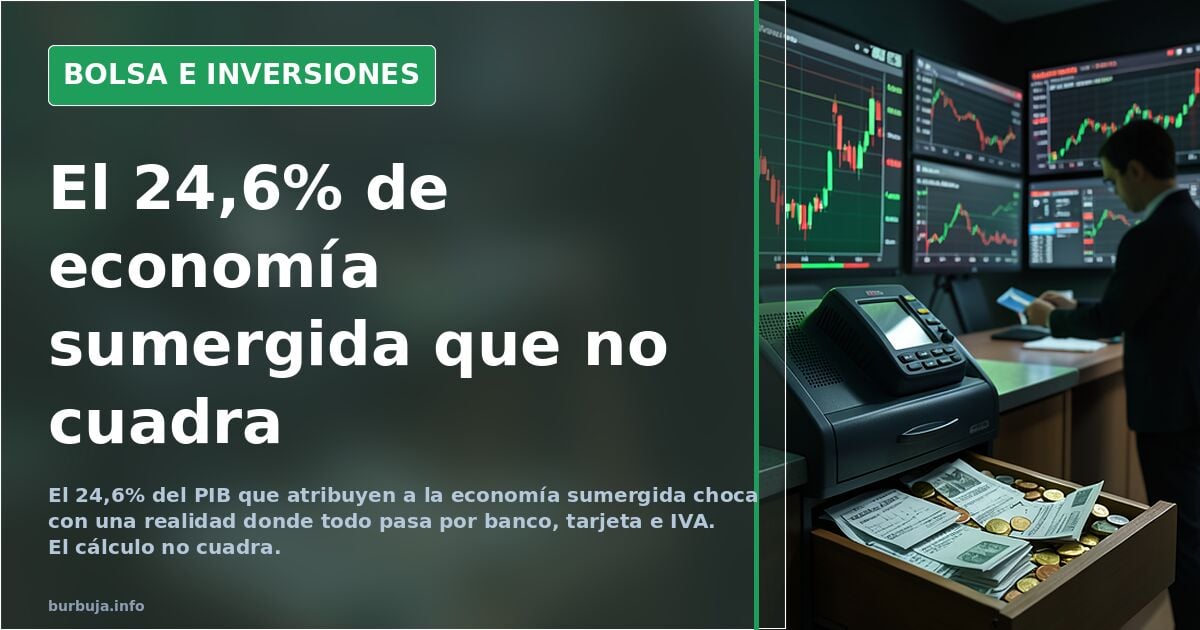
Spain's shadow economy: the 24.6% that doesn't add up
A plumber does a cash-in-hand job without VAT, gets paid in cash and uses that money to pay the mortgage. The scene repeats itself in every neighborhood in Spain and illustrates the great national economic mystery: how much of that invisible activity really keeps the country going. The newspapers pushing to shut down Google and the big tech companies put the shadow economy at 24.6% of GDP. A figure that, on close inspection, clashes with everyday life: groceries come from Mercadona, Carrefour and Ahorramas, housing goes through the banks, VAT is collected on every property transfer, and even physical cash comes out of an ATM.
The 24.6% of GDP and the problem with the numbers
The hypothesis is an uncomfortable one: if absolutely all visible money flows through official channels, where does a shadow economy of that scale come from? The reasoning has two branches. If official markets like the IBEX are in a bubble, then such a large shadow economy doesn't exist. If they aren't in a bubble, then it does. And neither branch fits the narratives sold from both ends of the political spectrum, because each side needs its own self-fulfilling prophecy.
Some argue that black money isn't hidden, but is simply a survival economy. The plumber doing the odd job without VAT uses that money to pay the mortgage. He doesn't dodge taxes and isn't hidden: the money circulates. From that angle, it would be enough to add up the mortgage payments being made to get an idea of the real money supply. And the conclusion is that there is far less shadow economy than the propaganda claims.
Who pays VAT and who doesn't
The Spanish tax system has an obvious sustancia ilegal. Emergency self-employed workers and small businesses live off what they invoice without VAT; otherwise they would have to shut down. Medium and large companies have subsidiaries to invoice themselves and claim deductions, because the law allows it. And in between, salaried workers on average wages bear a tax withholding with no way out. The result is a system where the shadow economy is not a marginal phenomenon, but a safety valve for those who cannot compete any other way.
The proposal circulating to formalize that activity is simple: allow anyone to deduct the VAT on all invoices for renovations, home repairs, computer equipment or car garage work. Then everyone would ask for an invoice and anyone not registered would be at a disadvantage, unlike now, when it's the other way around. All without creating new agencies, without new public employees and without awareness campaigns. Free for the State.
The State as partner and as burden
At the heart of the matter is the debate over the role of the State. One part of the analysis argues that the State audits poorly, but consumes public resources like everyone else: roads, electricity, security, communications. The other side responds that the State has become a band of robbers building unnecessary and ruinous infrastructure, and that the more power it has, the worse for the taxpayer. VAT, in that framework, is a penalty on those who create value: if you are capable of creating wealth, we will charge you for having created it.
The full calculation, broken down line by line, yields differences that surprise anyone who sits down to do it with paper and pencil. The underlying question remains unanswered: how much of that 24.6% is real shadow economy and how much is propaganda from those with their own interests in tax havens?
In the end, the figure that upsets everything is this: if the shadow economy were as big as they say, housing would be far cheaper and there wouldn't be so many poor people begging at INEM (Spain's public employment service). And yet, there they are.
Also available in: Deutsch
Summary of a discussion on Burbuja.info - Foro de economía, actualidad y política., translated from Spanish and reviewed before publication. Read the full discussion (28 replies).
More summaries
-
Spain's Tax Agency sets €125m bonus for higher income and VAT collection
Spain's Tax Agency agreed a bonus of up to €125 million for staff if they collect €14.675 billion in IRPF and IVA in 2025, excluding the Gestha union.
-
Spanish High Court deals tax agency a setback in Shakira case
Spain's National Court overturns the tax agency's penalties against Shakira, exposing a method that also hits the self-employed. Is it an isolated case?
-
Spain's Tax Agency and the EuroMillions: when a jackpot becomes a nightmare
The 20% tax on winnings is just the start. A pensioner with €974 and €1,500 received a €7,000 demand for using too little electricity. This is how Spain's tax machinery works.
-
Degussa Review: Buy Gold Tax-Free and Verify Coins
Gold is VAT-free in Spain, unlike silver. Degussa is generally pricey but offers the best deal for Mexican 50 Peso coins. Verifying coins is easier than bullion bars.
-
Marathon Fusion claims it made gold from mercury, but the cost kills the idea
Marathon Fusion says it turned mercury into gold, beating a CERN record. The cost of enriched mercury and the radioactivity would make the gold unviable.
-
30-year bond above 5%, gold at 27% of reserves: markets reposition
The 30-year Treasury bond has spent 27 days above 5%, and the 20-year auction yielded 5.469%, the highest since 1986. Gold now makes up 27% of global reserves.