
Spain's San Ildefonso School Faces Nationality Debate
Images of the 23 children singing in Spain's Christmas Lottery draw reignite controversy over student origins at San Ildefonso school.
English · Original discussion in Spanish · Published
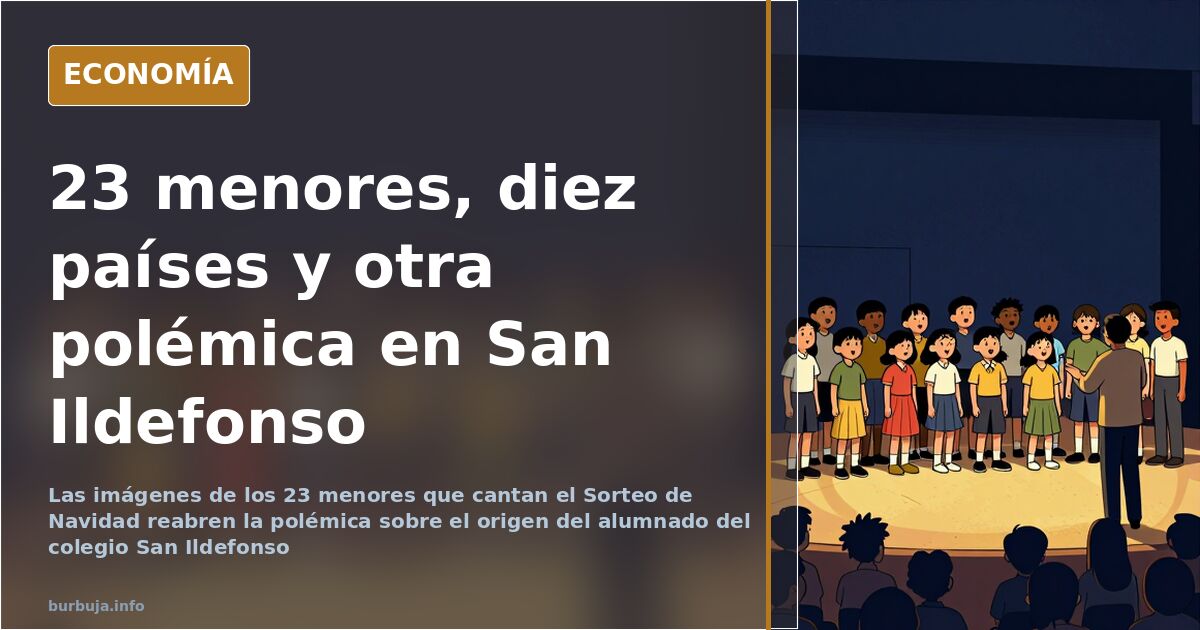
San Ildefonso: 23 minors, ten countries, and a recurring controversy
The message questioning the composition of students at the public San Ildefonso school, located in central Madrid, spread alongside images of the minors who sing the numbers for the Extraordinary Christmas Lottery. The response within the same discussion provided data: most of those boys and girls hold Spanish nationality. There were 23 minors, fourteen girls and nine boys, according to the cited reference.
This is not the first time. Every December, when rehearsal images are published, the same complaint and the same counter-argument reappear. What changes is the volume of the wave and who joins the bandwagon.
Who are the children singing the Christmas Lottery?
San Ildefonso School is a public center in central Madrid, in the La Latina area. From there come the minors who, after months of rehearsals, sing the numbers and prizes of the most watched draw on the calendar. In this edition's group, according to the data handled, there are fourteen girls and nine boys, and the majority holds Spanish nationality.
The question hovering over the matter is different: if the data is that, why does the complaint return with the punctuality of a clock? That is where it gets interesting, and where nobody agrees.
The viral message and the replacement narrative
The circulated text criticized the absence of a single local child in the entire school and presented it as deliberate provocation. Some messages went further, relying on the so-called ethnic replacement, a thesis repeated on social media for years without any empirical backing. Others crossed the line, wishing physical harm on whoever made the selection.
Against that framework, the most repeated defense was twofold: they are minors, and nationality data contradicts the portrait attributed to them. When the subject of the argument is children rehearsing a song, the ground for analysis is lost beforehand.
The tone is not accessory; it defines the genre. It is not a critique of the lottery; it is a critique of who appears on screen.
What nationality are the San Ildefonso minors?
The information cited to refute the complaint is explicit: most minors participating in the Extraordinary Christmas Lottery hold Spanish nationality, and their families come from Spain, Portugal, Paraguay, Bolivia, Ecuador, Dominican Republic, Peru, Segarro, Guinea, and Nigeria. Ten countries in a family tree that fits in a voice note.
Nationality and origin are not synonyms, and that distinction is exactly what blurs in the most shared messages. Those seeking a political message find one; those looking at administrative data also do. The problem is that both audiences argue simultaneously, and neither listens.
From lottery boycott to distrust of public TV
The controversy quickly shifted to consumption. Some claim that seeing the group's image is enough reason not to buy a ticket: another reason to save the expense, according to that approach, which links to rejecting the lottery understood as a voluntary tax. Also circulated was the idea that public television is the least-watched channel, presented as proof that the discourse does not resonate on the street.
And, as in almost every issue involving money, the rigging theory appeared. Accusations of lottery manipulation are not accompanied by any evidence, neither now nor previously; they function as background noise, not as arguments.
The pattern repeating beyond the lottery
The same mold applies to other scenes. In the comparison circulated, a school contest between schools from another country appeared with an identical reading: participants of migrant origin and no white students, according to the video description. The conclusion drawn is always the same, and always the same: there is a hand choosing.
In parallel, it is argued that wealthier families in the area have moved their children to other centers, leaving neighborhood students increasingly concentrated. This is an assertion launched without specific case data and, without it, remains opinion. Enrollment data, when cited, usually fails to reach the conversation.
Why the data doesn't close the discussion
Here everything stalls. Nationality data does not deactivate the complaint because the complaint was never about nationality: the reproach points to who decides and with what criteria, while the data answers a different question. Two conversations crossing on the same screen, each convinced the other refuses to see.
Meanwhile, 23 minors rehearse a chant they repeat every December. None of them chose the role.
Summary of a discussion on Burbuja.info - Foro de economía, actualidad y política., translated from Spanish and reviewed before publication. Read the full discussion (149 replies).
More summaries
-
El Mundo Blames Spain's Housing Law for Madrid's Uncontrolled Rents
El Mundo blames Spain's Housing Law for rents exceeding 2,000 euros in eight Madrid districts, ignoring that the capital refuses to declare tense zones.
-
Noise in Madrid: constant complaints or a city-wide problem
Madrid residents are complaining about noise from stadiums and the new F1 circuit. Is it a local or cultural issue? An analysis of the complaints, with a comparison with Central Europe.
-
Abascal and the viral cuts claim: the €44 billion left unexplained
A calculation circulating in the debate attributes cuts to Vox that add up to less than €1.2 billion, against €44 billion a year with no identified budget line.
-
Spanish employment lawyer warns: never flatly refuse your boss's orders
Spanish employment lawyer Ignacio de la Calzada warns that refusing a work order outright can cost you your job. He explains how to document health problems instead.
-
The Great Replacement theory is a nationalist conspiracy, London analysis shows
The portrayal of London as "hell" is tied to the "Great Replacement" conspiracy theory. What lies behind it?
-
NGOs and sellouts in Ceuta: Spain's migration row explained
The debate over immigration and the role of NGOs in Ceuta, Spain. Are they allies or enemies of Spanish sovereignty? We analyse the economic context.