
Spain's right and the 0.35% pension increase of 2018
A forum user argues that the 0.35% pension increase in 2018 damaged the right's credibility on pensions. Another notes that the PP beat the PSOE by a wide margin in 2023.
English · Original discussion in Spanish · Published
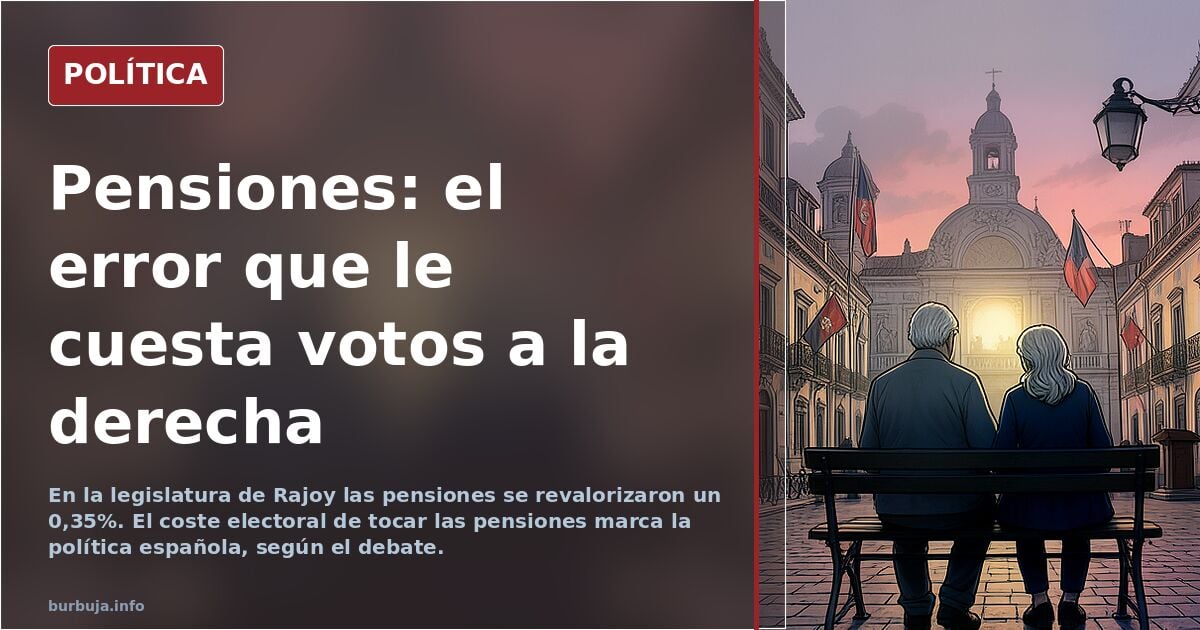
Spain's right and the 0.35% pension increase of 2018
A retiree receiving 1,200 euros a month doesn't need a master's degree in macroeconomics to know whether their pension is going up or staying frozen. And in 2018, with the PP in government at La Moncloa, the increase was 0.35%, not the CPI. That detail, it is argued in the debate, became an electoral burden the right still carries. The discussion about how to guarantee pensions has become so poisoned that, as the argument goes, the how no longer matters, only the what: which party dares to say out loud that it will raise pensions above the CPI. The rest, it is argued, is noise.
The 0.35% that changed everything
In 2018, Mariano Rajoy's government applied a 0.35% increase to pensions, well below that year's CPI. The measure, defended as a matter of sustainability, became, according to the argument, a weapon. Since then, it is argued, a portion of the electorate over 55 distrusts the right's messages on pensions. It's not a communication problem: it is, according to the argument, a credibility problem.
The math is simple. An average pensioner receiving 1,200 euros a month saw their purchasing power fall several points in a single year, it is argued. The 0.35% increase didn't even cover the most basic shopping basket. That year, the CPI exceeded 1.7%. The difference, small in absolute terms, is amplified when projected over a decade. And older voters, it is argued, did the subtraction.
Some argue that the right lost the pensioner voting bloc because the PSOE offered them an increase linked to the CPI. Others point out that the problem isn't the offer, but the lack of credibility. In any case, the damage is done: it is argued that older voters just want to sit on a terrace and spend their pension, and if you offer them one euro less than the other side, they vote for the other side.
Why doesn't the right win back pensioners' votes?
The short answer, according to the argument: because it has failed to build an alternative narrative. The right has tried to explain the system's sustainability with charts and demographic projections, but that message doesn't land with a voter who only wants to know whether on the 25th they'll receive the same as the previous month. The left, on the other hand, has simplified the message: pensions will rise with the CPI, period.
That simplification, it is argued, is electorally lethal. A party that promises increases above the CPI, even if it later can't deliver, wins votes, according to the argument. And the right, trapped in its own austerity discourse, doesn't dare make that promise. The result is a gap that widens with each passing year.
The underlying problem, according to the argument, is that the right has lost the cultural battle. Pensioners don't vote with their wallets: they vote with antiestéticar, it is argued. And the antiestéticar of losing purchasing power is stronger than any argument about the system's sustainability. While the left exploits that antiestéticar, the right is left explaining things that the general population, it is argued, cannot understand.
The short-termism that explains it all
Spain has a short-sightedness problem, it is argued. It doesn't look to the future, not even the medium term. Pension policy is a perfect example: nobody wants to reform the system in depth because doing so means losing votes, it is argued. Pensioners are a disciplined voting bloc, and any cut, however small, translates into a loss of seats, according to the argument.
The consequence is that the system is kept going with patches, it is argued. the Toledo Pact of 1995 was an attempt to provide stability, but subsequent reforms have been cosmetic, according to the argument. The latest one, in 2023, once again linked pensions to the CPI, but without addressing the underlying problem: the demographic pyramid, it is argued. The young population is shrinking, and those who come after won't be able to sustain the system with current contribution rates, according to the argument.
Meanwhile, politicians keep promising the impossible, it is argued. Some say pensions will always rise with the CPI; others say cuts are needed to guarantee the future. Nobody tells the whole truth: that the system needs more contributors, more immigration, or more taxes, according to the argument. And since nobody says it, the problem is postponed. Again.
The striking figure, it is argued: in 2023, the PP won the general election by a wide margin over the PSOE, but lost the over-65 vote in several regions. The contradiction, according to the argument, is evident. The right wins overall, but loses where it hurts most: at the ballot boxes of those receiving a pension. And until it solves that puzzle, it will keep squandering an electorate that, demographically, can only grow, according to the argument.
Summary of a discussion on Burbuja.info - Foro de economía, actualidad y política., translated from Spanish and reviewed before publication. Read the full discussion (33 replies).
More summaries
-
TV hoax on Franco and Spain's social security sparks expert outrage
The 1963 Framework Law unified mutual funds. Coverage rose from 20% to 80% between 1939 and 1975, debunking myths about Franco’s role in Spain’s welfare system.
-
PSOE Votes: Pensions, Fear, and Resignation
A debate attributes PSOE's stable vote to pension hikes, rival fear, and resignation amid mutual blame.
-
Spanish Socialist voter blames UGT union for having his overtime declared
A Spaniard who has voted PSOE since Franco's death blames the UGT union for having his overtime and Social Security registration regularised, leaving him with a laughably low net pay.
-
Montero keeps her European Parliament seat while running in Spain's general election
Irene Montero will keep her European Parliament seat until 2029 while running in Spain's general election, a safety net against electoral uncertainty.
-
Albares under scrutiny over EU funds to partner's firm
Spain's government awarded 22 million in EU funds to a company co-managed by the foreign minister's partner, THE OBJECTIVE reports. What is known and why it matters.
-
Bilbao riots with pro-ETA chants as Basque police stand by
Riots broke out in Bilbao, Spain, with chants of support for ETA and claims that the Ertzaintza, the Basque police force, was ordered not to intervene. The event that sparked the protest had been…