
Spain's Public Sector Pay Gap: From 1,300 Euros to Over 50,000 Euros
A C2 earns 1,300 Euros net, while a senior health worker claims 5,000 Euros with shifts. The gap depends on scale and bonuses.
English · Original discussion in Spanish · Published
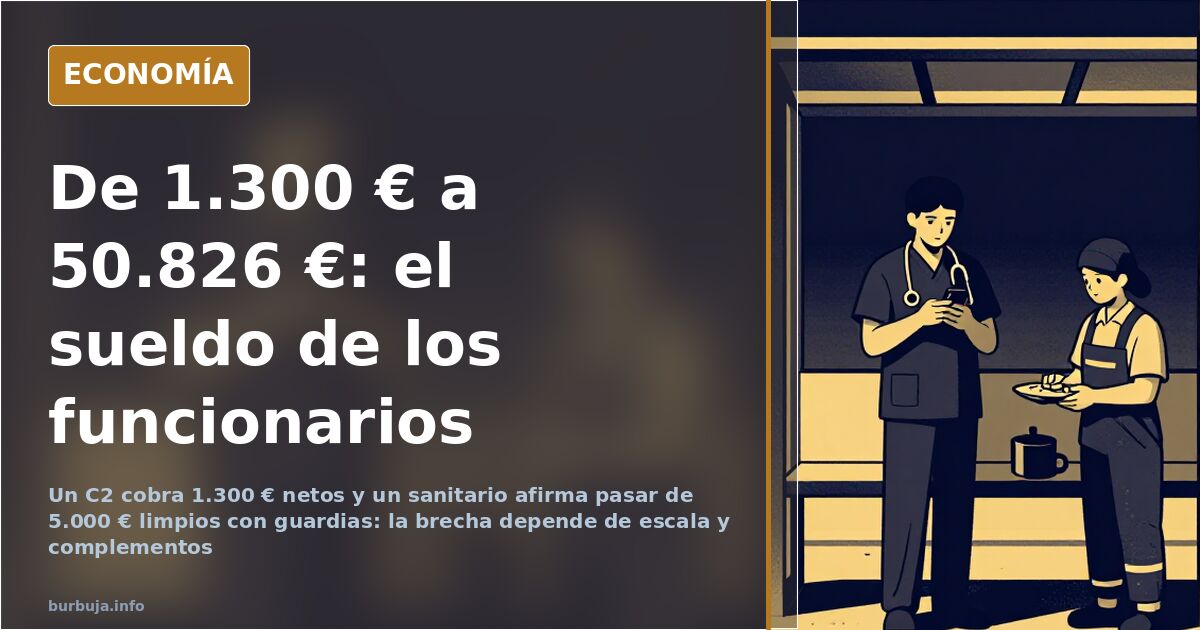
From 1,300 Euros for a C2 to 5,000 Euros claimed by a healthcare worker with shifts
December. Two notes in the same bank account: 3,600 Euros in salary and 3,400 in extra payment. The signer works in a health service, has three shifts from the previous month—paid in arrears—and calculates an income tax (IRPF) between 40% and 41%. With both payments combined, they earn over 7,000 Euros. Their summary: “I’ve earned 5,000 clean Euros this year.” The rebuttal always comes from the same side: this is an exception, not the full picture. The core issue is not the amount, but who it represents.
How much does a civil servant in each group earn?
The range spans from modest to uncomfortably high, and this dispersion explains almost all the controversy. A C2 earns around 1,300 Euros net per month; an administrative C1 earns between 1,500 and 1,600 Euros, with rumored salaries heard but not seen. Orderlies in group E, on morning shifts, earn just above the minimum wage. A national police officer, classified as C1, earns close to 2,000 Euros net with shifts and night allowances; a secondary school teacher, classified as A1 with a master’s degree, starts at around 2,000 Euros. Same pay for different scales: the complaint repeats across every segment.
On the opposite end, a figure is cited with a table: a C-level employee at the AMB (Barcelona Metropolitan Area Health Agency) can earn up to 50,826.61 Euros gross annually, excluding seniority bonuses. It should be read as an administrative ceiling, not the median for the group. Between the floor and this ceiling lie various salaries with the same public employee label.
Seniority, productivity, and career pogre: the gap within the same group
Within the same scale, salaries are not fixed. The productivity payment—whose existence sparks more than one ironic comment], professional career pogre, and seniority bonuses increase the paycheck over time. Some calculate that a C-level employee with years of service, these bonuses, and 14 payments reaches 1,900 Euros per month without issues. New hires do not.
This is compounded by an invisible internal market: transfers, allowances, and extras distributed by destination and negotiation. Those who remain in entry-level positions earn the minimum of the scale; those who move do not. And regarding actual workload, the prevailing diagnosis is harsh: 35 official hours that practically become 30, compared to other areas where 44 official hours translate to 40 real hours. There is no single civil service. There are several, and the narrative grouping them all together collapses when examining the figures individually.
Shifts and nights: where pay spikes
The largest earnings in the public health sector come from allowances, not base salary. Some estimate that a healthcare worker with three shifts earns 3,000 Euros net per month, and over the entire year, someone claims an average of 5,000 Euros per month. Doctors eligible for private practice are cited as the extreme case of earning potential.
Hence, some dispute the exception argument, while an orderly at the same hospital remains tied to the minimum wage.
The double salary of a public employee couple
Household arithmetic changes the outcome. According to a calculation circulating in the thread, two married public employees bring home 4,000 Euros net per month, and with extra payments, the figure reaches 8,000 Euros. Some describe this profile as having an inherited home, a short mortgage, and off-season vacations, while others counter that security does not compensate for living in a major city where rent consumes half the paycheck.
The location matters more than the professional group. In a town with paid housing, 1,600 Euros allow comfortable living; in a capital, that same amount leaves the month at the limit. A recurring nuance: those with families often seek local positions.
Income tax, social security contributions, and the bubble suspicion
With such salaries, deductions hurt: some estimate that 2,000 Euros per month go toward income tax (IRPF) and Social Security, trinc by complaints about the quality of services funded by these contributions. This contrast between what is paid and what is received fuels much of the anger, within and outside the public sector.
There is also a career-based calculation: passing exams at 21, living with family, and saving 20,000 Euros annually allows buying an apartment in a provincial capital within a decade. Passing at 28 reduces this margin. This is the fine print of stability, explaining why the issue is discussed with such intensity.
With these differentials, the label of civil servant should have been broken long ago. It persists. And while some speak of privilege and others of 1,300-Euro paychecks, the disconcerting fact is this: the ceiling for a mid-level group in a specific region reaches 50,826.61 Euros gross annually, while the floor for the lowest group barely exceeds the minimum wage. The average used in both discourses does not exist.
December. Two notes in the same bank account: 3,600 Euros in salary and 3,400 in extra payment. The signer works in a health service, has three shifts from the previous month—paid in arrears—and calculates an income tax (IRPF) between 40% and 41%. With both payments combined, they earn over 7,000 Euros. Their summary: “I’ve earned 5,000 clean Euros this year.” The rebuttal always comes from the same side: this is an exception, not the full picture. The core issue is not the amount, but who it represents.
How much does a civil servant in each group earn?
The range spans from modest to uncomfortably high, and this dispersion explains almost all the controversy. A C2 earns around 1,300 Euros net per month; an administrative C1 earns between 1,500 and 1,600 Euros, with rumored salaries heard but not seen. Orderlies in group E, on morning shifts, earn just above the minimum wage. A national police officer, classified as C1, earns close to 2,000 Euros net with shifts and night allowances; a secondary school teacher, classified as A1 with a master’s degree, starts at around 2,000 Euros. Same pay for different scales: the complaint repeats across every segment.
On the opposite end, a figure is cited with a table: a C-level employee at the AMB (Barcelona Metropolitan Area Health Agency) can earn up to 50,826.61 Euros gross annually, excluding seniority bonuses. It should be read as an administrative ceiling, not the median for the group. Between the floor and this ceiling lie various salaries with the same public employee label.
Seniority, productivity, and career pogre: the gap within the same group
Within the same scale, salaries are not fixed. The productivity payment—whose existence sparks more than one ironic comment], professional career pogre, and seniority bonuses increase the paycheck over time. Some calculate that a C-level employee with years of service, these bonuses, and 14 payments reaches 1,900 Euros per month without issues. New hires do not.
This is compounded by an invisible internal market: transfers, allowances, and extras distributed by destination and negotiation. Those who remain in entry-level positions earn the minimum of the scale; those who move do not. And regarding actual workload, the prevailing diagnosis is harsh: 35 official hours that practically become 30, compared to other areas where 44 official hours translate to 40 real hours. There is no single civil service. There are several, and the narrative grouping them all together collapses when examining the figures individually.
Shifts and nights: where pay spikes
The largest earnings in the public health sector come from allowances, not base salary. Some estimate that a healthcare worker with three shifts earns 3,000 Euros net per month, and over the entire year, someone claims an average of 5,000 Euros per month. Doctors eligible for private practice are cited as the extreme case of earning potential.
Hence, some dispute the exception argument, while an orderly at the same hospital remains tied to the minimum wage.
The double salary of a public employee couple
Household arithmetic changes the outcome. According to a calculation circulating in the thread, two married public employees bring home 4,000 Euros net per month, and with extra payments, the figure reaches 8,000 Euros. Some describe this profile as having an inherited home, a short mortgage, and off-season vacations, while others counter that security does not compensate for living in a major city where rent consumes half the paycheck.
The location matters more than the professional group. In a town with paid housing, 1,600 Euros allow comfortable living; in a capital, that same amount leaves the month at the limit. A recurring nuance: those with families often seek local positions.
Income tax, social security contributions, and the bubble suspicion
With such salaries, deductions hurt: some estimate that 2,000 Euros per month go toward income tax (IRPF) and Social Security, trinc by complaints about the quality of services funded by these contributions. This contrast between what is paid and what is received fuels much of the anger, within and outside the public sector.
There is also a career-based calculation: passing exams at 21, living with family, and saving 20,000 Euros annually allows buying an apartment in a provincial capital within a decade. Passing at 28 reduces this margin. This is the fine print of stability, explaining why the issue is discussed with such intensity.
With these differentials, the label of civil servant should have been broken long ago. It persists. And while some speak of privilege and others of 1,300-Euro paychecks, the disconcerting fact is this: the ceiling for a mid-level group in a specific region reaches 50,826.61 Euros gross annually, while the floor for the lowest group barely exceeds the minimum wage. The average used in both discourses does not exist.
Also available in: Deutsch
Summary of a discussion on Burbuja.info - Foro de economía, actualidad y política., translated from Spanish and reviewed before publication. Read the full discussion (384 replies).
More summaries
-
Muface: Bal estimates 1.5 million civil servants affected
Edmundo Bal says 1.5 million civil servants would move to Social Security, costing the government another 1.5 million votes.
-
Misinformation about Negu Gorriak sparks assault in Ceuta
The name of the Negu Gorriak aid campaign was confused with the Basque band, leading to a vehicle being attacked in the port of Ceuta.
-
Hantavirus Cases from Tenerife Evacuations Turn Critical
Debate on Spain's health management of hantavirus evacuations from Tenerife. Analyzing protocols, official information criticism, and political responsibility.
-
Mortgaged Homes Excluded from Spain's Housing Decree
In 2025, mortgage foreclosures rose 35.6% to 31,416. Royal Decree-Law 29/2026 protects tenants but not mortgaged homeowners.
-
Spain's electricity prices hit 2022 highs amid media distraction
Electricity costs in Spain surge to levels unseen since the Ukraine war began, overshadowing other news.
-
Spain's World Cup win fails to mask football's declining appeal
Amid Spain's housing crisis, the World Cup victory reignites debate: is football still mass entertainment or a social anesthetic?