
Spain's Public-Private Pay Gap Sparks Debate
A user compares a low-paid worker's €1,000 salary and €500 pension with an A1 civil servant's €3,000 pay, reigniting debate on Spain's public-private wage gap.
English · Original discussion in Spanish · Published
Why Civil Servants Earn €3,000 While Private Workers Get €1,000
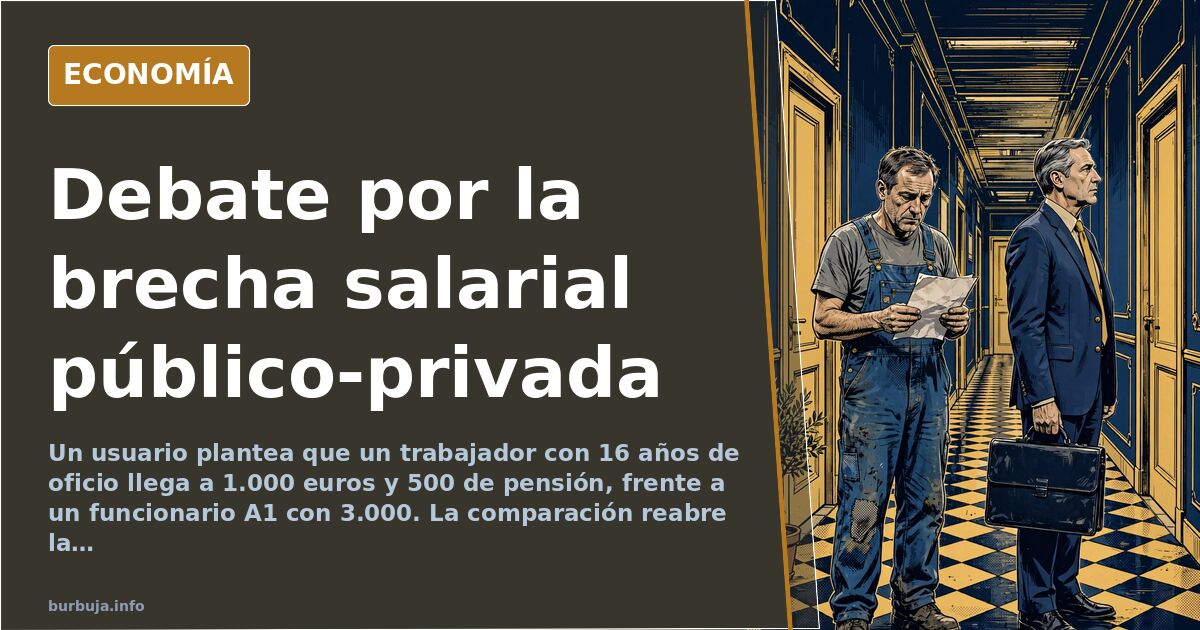
A user in the discussion argues that a worker with sixteen years of experience barely reaches €1,000 a month and expects a €500 pension, while a high-level civil servant (funcionario), who spent eight years studying to secure a permanent post, earns €3,000 and aims for a similar retirement income. This blunt comparison has peine one of Spain’s oldest labor market rifts: the gap between the public and private sectors. It is not a minor issue.
The starting point is a figure circulating in the debate: the wage difference between both sectors exceeds 50% in favor of public employment. The rest of the discussion builds on this, moving from personal grievance to system sustainability.
The Calculation Behind the Grievance
The most repeated thesis is that civil servants are privileged by structure, not vocation. Arguments state that the State pays social security contributions that private companies cannot match, that permanent posts eliminate dismissal risk, and that administrative careers reward seniority through points and courses rather than results. Some summarize it directly: the system favors them, period.
In contrast, defenders of public employees emphasize prior effort. Eight years of study, competitive exams (oposiciones) with hundreds of candidates per spot, and salaries that often fall well short of €3,000. Many argue that most General Administration of the State civil servants do not reach that figure, and the narrative of widespread privilege collapses when examining individual payslips.
The debate turns toxic when the word parasitism appears. One sector claims the public sector lives off debt and will collapse if borrowing stops. Another responds that the problem isn’t the civil servant, but a labor market paying €1,000 for sixteen years of work, using taxes to justify precariousness.
Pensions: The Calculation No One Wants to Do
The second front is retirement. A specific case cited: 45.2 years contributed, last base of €1,100, net pension of €2,370 a month. Breaking down the calculation shows it would take 18 years of payments to recover contributions, meaning living to age 83. Average male life expectancy is 80.2 years. The uncomfortable conclusion: statistically, you don’t get back everything you paid in.
The counterargument comes from elsewhere. Those receiving minimum or non-contributory pensions get more from day one than they contributed, and those who never paid in access benefits without putting in a euro. Thus, the debate isn’t public vs. private, but contributory vs. welfare-based. And no one looks good there.
Study, Pass Exams, or Leave
The recurring solution is the usual one: get a degree, prepare for competitive exams, and secure a permanent post. Supporters say you need the aptitude and capacity to do so. Critics argue this advice ignores that most under-35s are already trying, and the private market can’t absorb everyone left out.
Starting a business other than a bar is described as hanging yourself. The horizon alternative remains the same: emigrate to Switzerland, New Zealand, or any country not operating on this logic. Or buy land and live off farming, with the warning that many weapons will be needed for what’s coming.
The Disorienting Data
Only 35% of the population contributes private income to the system, according to figures used in the discussion. The rest live off public money or contribute nothing. With these elements, the question isn’t who earns more, but how long a distribution can sustain itself where fewer and fewer pay for the party of more and more. That equation, whether liked or not, doesn’t balance.
A user in the discussion argues that a worker with sixteen years of experience barely reaches €1,000 a month and expects a €500 pension, while a high-level civil servant (funcionario), who spent eight years studying to secure a permanent post, earns €3,000 and aims for a similar retirement income. This blunt comparison has peine one of Spain’s oldest labor market rifts: the gap between the public and private sectors. It is not a minor issue.
The starting point is a figure circulating in the debate: the wage difference between both sectors exceeds 50% in favor of public employment. The rest of the discussion builds on this, moving from personal grievance to system sustainability.
The Calculation Behind the Grievance
The most repeated thesis is that civil servants are privileged by structure, not vocation. Arguments state that the State pays social security contributions that private companies cannot match, that permanent posts eliminate dismissal risk, and that administrative careers reward seniority through points and courses rather than results. Some summarize it directly: the system favors them, period.
In contrast, defenders of public employees emphasize prior effort. Eight years of study, competitive exams (oposiciones) with hundreds of candidates per spot, and salaries that often fall well short of €3,000. Many argue that most General Administration of the State civil servants do not reach that figure, and the narrative of widespread privilege collapses when examining individual payslips.
The debate turns toxic when the word parasitism appears. One sector claims the public sector lives off debt and will collapse if borrowing stops. Another responds that the problem isn’t the civil servant, but a labor market paying €1,000 for sixteen years of work, using taxes to justify precariousness.
Pensions: The Calculation No One Wants to Do
The second front is retirement. A specific case cited: 45.2 years contributed, last base of €1,100, net pension of €2,370 a month. Breaking down the calculation shows it would take 18 years of payments to recover contributions, meaning living to age 83. Average male life expectancy is 80.2 years. The uncomfortable conclusion: statistically, you don’t get back everything you paid in.
The counterargument comes from elsewhere. Those receiving minimum or non-contributory pensions get more from day one than they contributed, and those who never paid in access benefits without putting in a euro. Thus, the debate isn’t public vs. private, but contributory vs. welfare-based. And no one looks good there.
Study, Pass Exams, or Leave
The recurring solution is the usual one: get a degree, prepare for competitive exams, and secure a permanent post. Supporters say you need the aptitude and capacity to do so. Critics argue this advice ignores that most under-35s are already trying, and the private market can’t absorb everyone left out.
Starting a business other than a bar is described as hanging yourself. The horizon alternative remains the same: emigrate to Switzerland, New Zealand, or any country not operating on this logic. Or buy land and live off farming, with the warning that many weapons will be needed for what’s coming.
The Disorienting Data
Only 35% of the population contributes private income to the system, according to figures used in the discussion. The rest live off public money or contribute nothing. With these elements, the question isn’t who earns more, but how long a distribution can sustain itself where fewer and fewer pay for the party of more and more. That equation, whether liked or not, doesn’t balance.
Summary of a discussion on Burbuja.info - Foro de economía, actualidad y política., translated from Spanish and reviewed before publication. Read the full discussion (159 replies).
More summaries
-
Muface: Bal estimates 1.5 million civil servants affected
Edmundo Bal says 1.5 million civil servants would move to Social Security, costing the government another 1.5 million votes.
-
Almodóvar claims filmmakers repay subsidies via taxes
Almodóvar defends film subsidies, saying they are repaid. Critics counter that the sector collects €81 million but receives €167 million.
-
Oasis Tickets Hit €480: The Bubble Beyond Inflation
Oasis concert tickets in Amsterdam cost €480, eight times the 2011 price in Barcelona. Inflation doesn't explain the surge; the business model does.
-
Hazte Oír Fails to Serve Sarah Santaolalla in Spain
Spanish Catholic group Hazte Oír seeks €30,000 from commentator Sarah Santaolalla; a Salamanca court suspends the hearing for the third time as she remains unlocatable.
-
French Sociologist Studied Machismo as Dominatrix for Five Years
A French sociologist worked five years as a dominatrix to study machismo, claiming it reduced her anger toward men.
-
Spain Blackout Cause Still Unconfirmed Amid Silence
The cause of Spain's blackout remains officially unconfirmed. Hypotheses point to France and Morocco without public evidence, amid government silence.