
Spain's PSOE and the socialists walking away: the narrative cracks
"I'm a socialist, but I have two brain cells to rub together": the tactical distancing of PSOE voters and the ballot box video fueling suspicion about Sánchez.
English · Original discussion in Spanish · Published
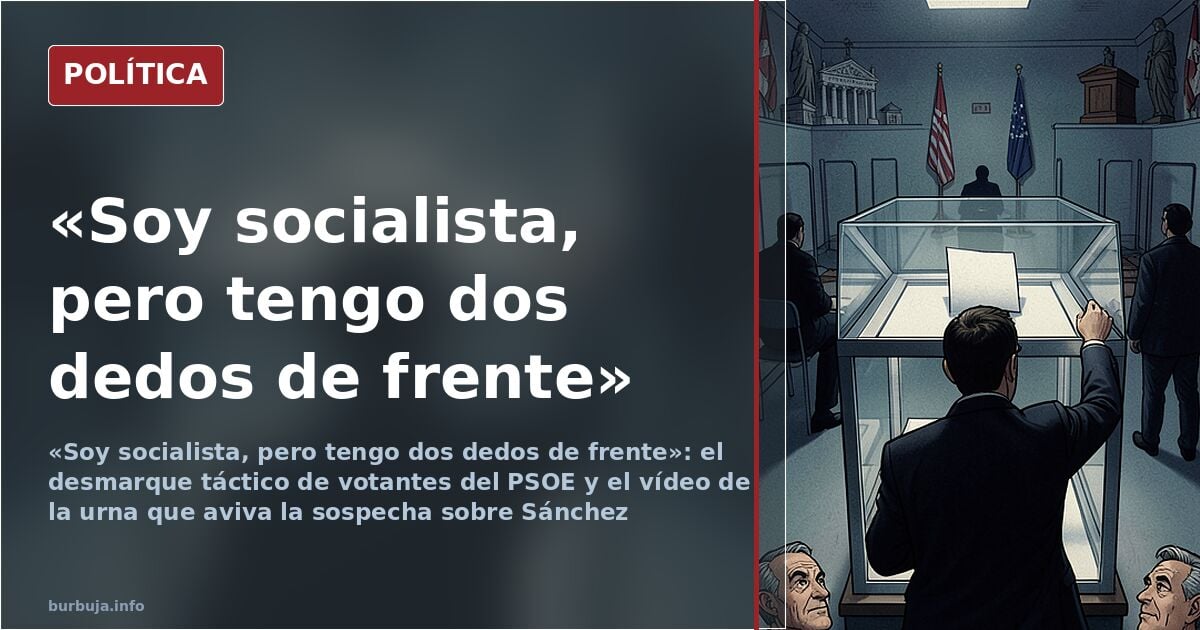
The socialist who walks away and the narrative that breaks
The narrative is cracking. The phrase that gives this discussion its title —"I'm a socialist, but I have two brain cells to rub together"— sums up a maneuver that a growing number of PSOE voters voice without embarrassment: continuing to identify with the party label while distancing themselves from its leader. This is not an ideological resignation. It is a tactical distancing. And at the center of it, a video.
The video circulating in the conversation allegedly shows, according to those who share it, Sánchez manipulating a ballot box in an internal process of his own party. The clip has become the axis of the debate: those spreading it claim it is proof of how he reached the Secretary General's post, while those downplaying it respond that it is a doctored clip taken out of context. Minute 25 of the video is cited as the key moment, the instant when the scene becomes hard to explain.
From party membership to "I'm done with it"
The conversation has a recognizable turning point. Someone writes "I used to be a socialist" and adds, without missing a beat, "but I'm done with it." The formula condenses the mood of part of the socialist electorate: they do not disown the party's history, they disown its current management. The underlying calculation is simple —keeping the membership card while criticizing the secretary general costs nothing; defending him in certain areas, does not—.
Some go further and argue that this double game has a geographic limit. In certain municipalities, they point out, defending the PSOE leader today amounts to immediate isolation. The phrase that keeps coming back is that the socialist with two brain cells to rub together is the one who no longer defends Sánchez in his own backyard. The dilemma, framed this way, is not ideological: it is one of local political survival.
The ballot box video: what exactly is being debated
The core of the exchange lies in the interpretation of the footage. The accusation being made is that the current Prime Minister manipulated an internal vote to take control of the party. The implicit defense is that it is a self-serving reading of an ordinary procedure. Neither position is accompanied here by a court ruling or independent verification, so the matter stays where it was: in the realm of suspicion and mutual discredit.
It is worth separating two things the conversation mixes up. One is the existence of the video. The other is the conclusion drawn from it. The first is a verifiable fact; the second, an inference. And an inference, no matter how often it is repeated, does not become proof through the accumulation of accusations.
Contempt for long videos and politics as spectacle
Not all of the exchange is about Sánchez. Part of the material attacks the format itself: long, dense videos, full of filler, with two useful ideas. The complaint is that political analysis has become an endurance test: sitting through forty minutes to extract one headline. It is a critique of the ecosystem, not of the politician, and it explains why the ballot box video works better than any report: it can be understood in ten seconds.
That is the ground where the official narrative truly breaks. Not in documentary refutation, but in the attention economy. A single frame beats a dossier. And whoever controls the frame controls the story.
It remains to be seen whether the individual distancing becomes a measurable trend or remains dinner-table venting. With the available data, betting on the latter is the prudent choice; but prudence, in politics, ages fast.
Also available in: Deutsch
Summary of a discussion on Burbuja.info - Foro de economía, actualidad y política., translated from Spanish and reviewed before publication. Read the full discussion (15 replies).
More summaries
-
Spanish police back narco claim of plot against Judge Biedma
Spain's UCO validates testimony from a drug trafficker alleging orders to attack Judge Biedma, who investigated the Prime Minister's brother.
-
Ceuta: complaint about dates that undermines the official story
According to a complaint, staff at the Government Delegation in Ceuta looked for accommodation eight days before the arrivals. The official story is falling apart.
-
Ceuta sparks rebellion in PSOE as territorial leaders openly challenge Sánchez (Luis Casal on Vozpópuli)
PSOE in Seville votes with PP and Vox against the Government's handling of the Ceuta crisis, highlighting internal tension. Read details.
-
Madrid Mayor Almeida: Viral Video Rumors Debunked
A tweet claims private videos of Madrid's mayor leaked in December 2022. No public evidence exists, only a recurring rumor.
-
The joke of the century: Zapatero under fire in Spain
Former Spanish PM Zapatero is mocked as 'the joke of the century' online, with Risitas memes and criticism lacking any hard data. A look at political fatigue on the web.
-
Former Más Madrid candidate jailed 9 years for raping student who took her own life
Enrique Antonio Salazar, a former Más Madrid candidate, has been sentenced to 9 years for raping a 15-year-old student. The victim took her own life in 2025. He also had prior convictions.