
Spain's private-subsidized schools offer escape from segregated public education
Public school students receive about €9,000 annually versus under €6,000 for subsidized private schools, highlighting a two-tier system.
English · Original discussion in Spanish · Published
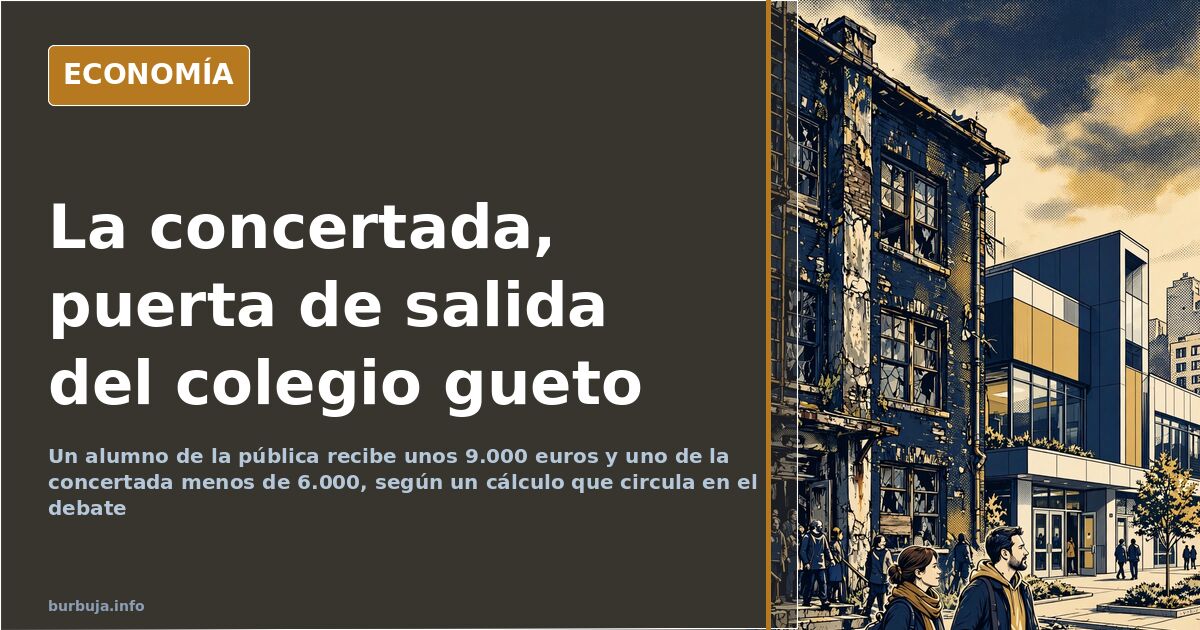
Subsidized private schools as an escape from educational ghettos
School segregation is no longer measured by neighborhoods but by desks. Year after year, an increasing number of public schools concentrate students of migrant origin, while other centers—many of them subsidized private schools—mitigate this influx through quotas, waiting lists, and admission criteria. The result is a two-estimulante ilegal education system that has developed without anyone signing off on it, yet conditions the equal opportunities of an entire generation.
The premise is simple to state but difficult to resolve: when the proportion of students of migrant origin in a center exceeds a certain threshold, local families who can afford it seek alternative enrollment. According to one participant, this trickle, repeated over years, is what eventually turns a normal school into a ghetto school: first one family leaves, then their neighbor imitates them, and finally only those with no alternatives remain.
Why a school becomes a ghetto
Two interpretations coexist in the diagnosis. One argues that concentration feeds itself, and that it is the families with the capacity to change schools who trigger the exodus. The other focuses on freedom of choice: without distribution rules, the composition of each classroom depends on the chance of one's address and the information each family possesses.
What several participants take for granted is the collateral damage: they argue that centers left with a majority of immigrant students face more conflicts and slower class paces. Conversely, it is argued that a balanced distribution improves results for everyone. And the response is that forcing mixing does not fix the classroom; it merely spreads the problem across the city's geography.
Two models, two funding sources
The economic axis of the issue lies in the system's structure. According to calculations used by part of the analysis, a public school student receives around €9,000 per course, compared to less than €6,000 in subsidized private schools, with the caveat that the latter figure would not include services such as cafeteria, counseling, or auxiliary staff. To balance these accounts, some claim they are willing to pay a monthly fee between €200 and €300 provided the school does not change.
This differential explains why the concertado model has become the entry point for middle and working classes seeking an education with fewer disruptions. It also explains the paradox at the heart of the matter: the model is criticized, but almost no one gives up on it when choosing a school for their child.
University entrance exams and real equality
Underlying this is a more uncomfortable question: what is the use of talking about equal opportunities if each region sets its own university access exam? The same student may find it easier to meet the cutoff score simply by taking the exam in one region or another. A common exam for all of Spain would test, once and for all, whether that equality is real or just rhetoric, argue those demanding unification.
The drop in standards did not start with immigration
Although the focus is on classroom composition, some recall that deterioration began earlier. The expansion of a comprehensive model that tends to level down to reduce school failure would have lowered the bar for all students, regardless of origin. In this diagnosis, the migrant student is not the cause of the problem, but the last to arrive in an already weakened system. Educational levels, it is maintained, have been falling continuously for decades.
When changing schools is an emergency
Behind the figures are cases that move the issue from the theoretical to the familial plane. There are accounts of parents who moved their children not to get better grades, but to remove them from bullying that persisted in the classroom. In one such account, a boy appeared with bruises he initially refused to explain; the family learned the truth only when he broke down crying. The school change came then, late and forced.
The opposite extreme is also described: neighbors who arrived in the neighborhood with an integrative discourse ended up moving away when their own children started repeating at home what they heard in the playground. Coexistence, when broken, does not care about ideology.
The trend points to more of the same: more concentration in some centers, more exits in others, and an administration patching things up with balanced schooling plans that are rarely evaluated. If the pattern is not corrected, it is likely that the gap between schools will continue to widen through fees and admission criteria, although by then it will carry new names: success project, innovation classroom, and another layer of statistical makeup.
School segregation is no longer measured by neighborhoods but by desks. Year after year, an increasing number of public schools concentrate students of migrant origin, while other centers—many of them subsidized private schools—mitigate this influx through quotas, waiting lists, and admission criteria. The result is a two-estimulante ilegal education system that has developed without anyone signing off on it, yet conditions the equal opportunities of an entire generation.
The premise is simple to state but difficult to resolve: when the proportion of students of migrant origin in a center exceeds a certain threshold, local families who can afford it seek alternative enrollment. According to one participant, this trickle, repeated over years, is what eventually turns a normal school into a ghetto school: first one family leaves, then their neighbor imitates them, and finally only those with no alternatives remain.
Why a school becomes a ghetto
Two interpretations coexist in the diagnosis. One argues that concentration feeds itself, and that it is the families with the capacity to change schools who trigger the exodus. The other focuses on freedom of choice: without distribution rules, the composition of each classroom depends on the chance of one's address and the information each family possesses.
What several participants take for granted is the collateral damage: they argue that centers left with a majority of immigrant students face more conflicts and slower class paces. Conversely, it is argued that a balanced distribution improves results for everyone. And the response is that forcing mixing does not fix the classroom; it merely spreads the problem across the city's geography.
Two models, two funding sources
The economic axis of the issue lies in the system's structure. According to calculations used by part of the analysis, a public school student receives around €9,000 per course, compared to less than €6,000 in subsidized private schools, with the caveat that the latter figure would not include services such as cafeteria, counseling, or auxiliary staff. To balance these accounts, some claim they are willing to pay a monthly fee between €200 and €300 provided the school does not change.
This differential explains why the concertado model has become the entry point for middle and working classes seeking an education with fewer disruptions. It also explains the paradox at the heart of the matter: the model is criticized, but almost no one gives up on it when choosing a school for their child.
University entrance exams and real equality
Underlying this is a more uncomfortable question: what is the use of talking about equal opportunities if each region sets its own university access exam? The same student may find it easier to meet the cutoff score simply by taking the exam in one region or another. A common exam for all of Spain would test, once and for all, whether that equality is real or just rhetoric, argue those demanding unification.
The drop in standards did not start with immigration
Although the focus is on classroom composition, some recall that deterioration began earlier. The expansion of a comprehensive model that tends to level down to reduce school failure would have lowered the bar for all students, regardless of origin. In this diagnosis, the migrant student is not the cause of the problem, but the last to arrive in an already weakened system. Educational levels, it is maintained, have been falling continuously for decades.
When changing schools is an emergency
Behind the figures are cases that move the issue from the theoretical to the familial plane. There are accounts of parents who moved their children not to get better grades, but to remove them from bullying that persisted in the classroom. In one such account, a boy appeared with bruises he initially refused to explain; the family learned the truth only when he broke down crying. The school change came then, late and forced.
The opposite extreme is also described: neighbors who arrived in the neighborhood with an integrative discourse ended up moving away when their own children started repeating at home what they heard in the playground. Coexistence, when broken, does not care about ideology.
The trend points to more of the same: more concentration in some centers, more exits in others, and an administration patching things up with balanced schooling plans that are rarely evaluated. If the pattern is not corrected, it is likely that the gap between schools will continue to widen through fees and admission criteria, although by then it will carry new names: success project, innovation classroom, and another layer of statistical makeup.
Also available in: Deutsch
Summary of a discussion on Burbuja.info - Foro de economía, actualidad y política., translated from Spanish and reviewed before publication. Read the full discussion (136 replies).
More summaries
-
Pablo Iglesias’ Private School Choice in Las Rozas Sparks Ideological Debate
Pablo Iglesias’ decision to send his children to a private school in Las Rozas, costing 500 euros monthly, highlights a tension between his political rhetoric and personal choices.
-
Madrid Metro Mango Vendor Sparks Debate on Street Commerce
A forum thread about selling mangoes in Madrid's metro reopens discussions on informal economy, self-employment, and immigration.
-
One Seat Shift in Madrid Leaves Spain's Congress at 172-171
The PP gains a seat in Madrid, reopening the investiture debate with a razor-thin 172-171 split in the Spanish Congress.
-
Industrial Technician Lifts 30kg for €1,200 Monthly
Lifting 30kg engines ten hours daily for €1,200/month: the calculation pushing qualified technicians toward civil service exams.
-
Montero pays Marcos €18,000 after non-payment scandal
Irene Montero paid Rafael Marcos the €18,000 owed hours after reports revealed she had not yet complied with a Supreme Court order issued three months prior.
-
Spain's Apartment Noise: Why Soundproofing Fails
Residents in Spain blame poor acoustic insulation in apartments, while data on new construction remains scarce.