
Spain's PP faces debt, EU funds expiry, and political gridlock if Sánchez falls
EU recovery funds vanish in 2026, debt mounts, and parliamentary vetoes loom, creating a costly transition for whoever takes over Spain's government.
English · Original discussion in Spanish · Published
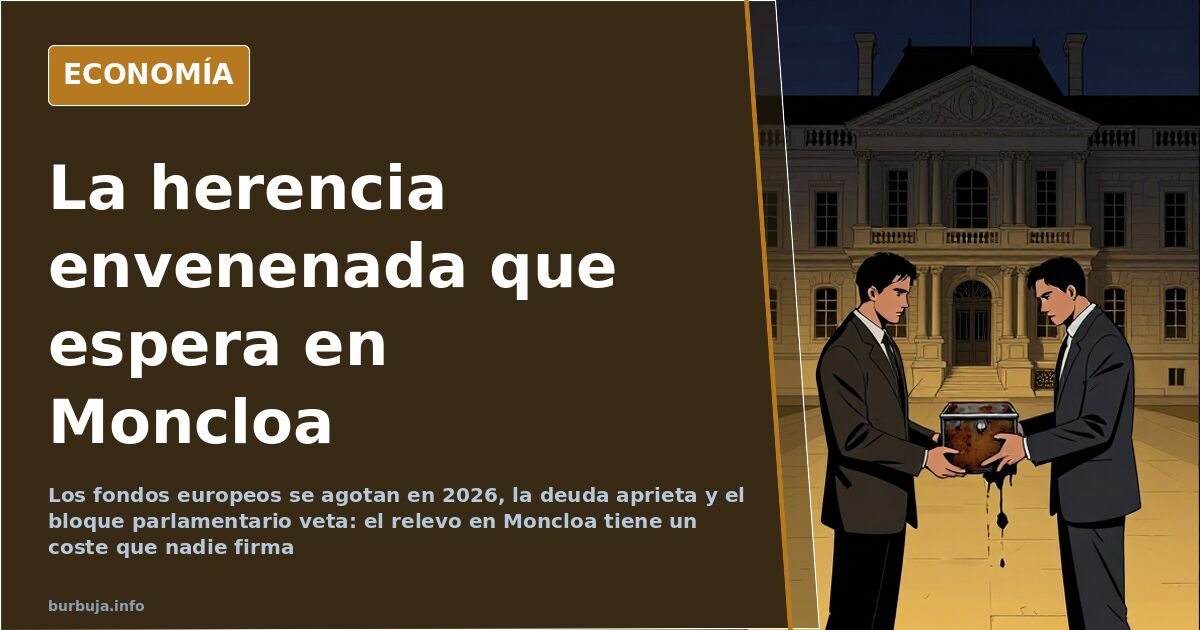
The inheritance no one wants to accept if Sánchez falls
The calendar bears a red date: 2026. That is when Spain’s European recovery funds expire, leaving the next Prime Minister without the financial lifeline supporting much of public spending. The prevailing argument among political observers is uncomfortable for the opposition: removing Pedro Sánchez may be his party’s worst political miscalculation. Not due to sentiment, but due to budgetary arithmetic.
The starting point is a reality of power. The current president controls key institutions, aligns left-wing parties, and retains mobilization capacity. The successor inherits none of this leverage, only the financial bill.
What problems would the PP face if it takes power?
The list of challenges is long and synchronized. An Constitutional Court and a Public Prosecutor’s Office perceived as hostile. Public debt that allows no more accounting tricks. A parliamentary bloc ready to veto any PP initiative. And a group of Spanish officials in EU roles appointed under the socialist era — names like Calviño and Ribera are cited — who, according to this view, would oppose new measures.
On paper, none of these fronts are new. The change is that they arrive simultaneously, with a deadline that allows no delays. Migration pressures add to the list, more as a political issue than an economically quantifiable one.
From absolute support to permanent blockage
The most repeated asymmetry is parliamentary geometry. The current government has the backing —with nuances and costs— of pogre and nationalist parties. The center-right, however, would face VOX announcing total opposition to everything, regardless of national interest.
This difference turns any PP legislature into an obstacle course. It explains the paradox: the opposition is less eager than the government itself. Horizons are vague —2027, 2030, or simply when resources run out— with no one setting a date for the transition.
EU funds 2026: the adjustment no one wants to sign
Recovery funds end in 2026. Translation: the money allowing balanced accounts without traumatic tax hikes or serious cuts disappears. The underlying debate, rarely televised, is what happens next. Austerity, more debt, or both.
No one wants to sign that document. And whoever does must defend it during campaigns, with the opposition highlighting every cut. Accumulated debt limits maneuvering room: each new spending point is paid with the next budget.
The historical pattern: the brown burden always paid by the successor
Precedents are cited openly. Felipe González, Zapatero, and PP governments have taken turns passing the hot potato: each left the next a larger hole, or so the most repeated narrative claims. With Zapatero, the accusation is double: he spent until the last day, and Rajoy applied austerity. With Rajoy, cuts came before recovery.
The most cynical reading is also the oldest. There is no alternation, only rotations in managing the mess. In this framework, the argument of "us or chaos" serves as a perfect alibi for staying in power: if the alternative is worse, the current party’s wear becomes an asset.
Housing: the bubble resurfacing
The list includes real estate. There is a housing bubble in the making, with prices rising faster than wages and supply failing to respond. Whoever inherits the government inherits this powder keg. And the temptation to blame the predecessor is the oldest excuse in the manual.
Who truly decides and who only appears to
There remains the plane of so-called factual powers. Part of the conversation assumes the current president’s fall is decided outside elections, in unchosen offices. There is no proof of this; it is a political intuition, not a fact. Yet it circulates as naturally as unverifiable claims.
Against this reading is a more skeptical view: it does not matter who governs because the result is the same. That the PP is the PSOE in another tonalidad, that the two major parties rotate only to share seats, and that Brussels would pressure a grand coalition like Germany’s if things unravel. With this premise, the government’s tonalidad matters little, and the problem is structural.
Where the calculation stalls
Here, the analysis stops. No one knows how long the current government lasts. No one knows if the transition comes before or after funds run out. No one signs the final number. What seems clear is that the desire for its fall has a price, and that price would likely be paid by whoever succeeds, with the mess already distributed.
The calendar bears a red date: 2026. That is when Spain’s European recovery funds expire, leaving the next Prime Minister without the financial lifeline supporting much of public spending. The prevailing argument among political observers is uncomfortable for the opposition: removing Pedro Sánchez may be his party’s worst political miscalculation. Not due to sentiment, but due to budgetary arithmetic.
The starting point is a reality of power. The current president controls key institutions, aligns left-wing parties, and retains mobilization capacity. The successor inherits none of this leverage, only the financial bill.
What problems would the PP face if it takes power?
The list of challenges is long and synchronized. An Constitutional Court and a Public Prosecutor’s Office perceived as hostile. Public debt that allows no more accounting tricks. A parliamentary bloc ready to veto any PP initiative. And a group of Spanish officials in EU roles appointed under the socialist era — names like Calviño and Ribera are cited — who, according to this view, would oppose new measures.
On paper, none of these fronts are new. The change is that they arrive simultaneously, with a deadline that allows no delays. Migration pressures add to the list, more as a political issue than an economically quantifiable one.
From absolute support to permanent blockage
The most repeated asymmetry is parliamentary geometry. The current government has the backing —with nuances and costs— of pogre and nationalist parties. The center-right, however, would face VOX announcing total opposition to everything, regardless of national interest.
This difference turns any PP legislature into an obstacle course. It explains the paradox: the opposition is less eager than the government itself. Horizons are vague —2027, 2030, or simply when resources run out— with no one setting a date for the transition.
EU funds 2026: the adjustment no one wants to sign
Recovery funds end in 2026. Translation: the money allowing balanced accounts without traumatic tax hikes or serious cuts disappears. The underlying debate, rarely televised, is what happens next. Austerity, more debt, or both.
No one wants to sign that document. And whoever does must defend it during campaigns, with the opposition highlighting every cut. Accumulated debt limits maneuvering room: each new spending point is paid with the next budget.
The historical pattern: the brown burden always paid by the successor
Precedents are cited openly. Felipe González, Zapatero, and PP governments have taken turns passing the hot potato: each left the next a larger hole, or so the most repeated narrative claims. With Zapatero, the accusation is double: he spent until the last day, and Rajoy applied austerity. With Rajoy, cuts came before recovery.
The most cynical reading is also the oldest. There is no alternation, only rotations in managing the mess. In this framework, the argument of "us or chaos" serves as a perfect alibi for staying in power: if the alternative is worse, the current party’s wear becomes an asset.
Housing: the bubble resurfacing
The list includes real estate. There is a housing bubble in the making, with prices rising faster than wages and supply failing to respond. Whoever inherits the government inherits this powder keg. And the temptation to blame the predecessor is the oldest excuse in the manual.
Who truly decides and who only appears to
There remains the plane of so-called factual powers. Part of the conversation assumes the current president’s fall is decided outside elections, in unchosen offices. There is no proof of this; it is a political intuition, not a fact. Yet it circulates as naturally as unverifiable claims.
Against this reading is a more skeptical view: it does not matter who governs because the result is the same. That the PP is the PSOE in another tonalidad, that the two major parties rotate only to share seats, and that Brussels would pressure a grand coalition like Germany’s if things unravel. With this premise, the government’s tonalidad matters little, and the problem is structural.
Where the calculation stalls
Here, the analysis stops. No one knows how long the current government lasts. No one knows if the transition comes before or after funds run out. No one signs the final number. What seems clear is that the desire for its fall has a price, and that price would likely be paid by whoever succeeds, with the mess already distributed.
Summary of a discussion on Burbuja.info - Foro de economía, actualidad y política., translated from Spanish and reviewed before publication. Read the full discussion (217 replies).
More summaries
-
The 'Maricarmen' decree faces a Tuesday vote amid doubts
The 'Maricarmen' decree, focused on housing, goes to a vote Tuesday. Old rents, Junts, omnibus bills, and planned applause...
-
Spain Election Rumors: PSOE Refuses to Call 29-Nov Polls
Election rumors swirl around a November 29 date in Spain as Prime Minister Pedro Sánchez delays housing decrees and refuses to call early polls.
-
La Sexta and TVE clash with viewers over Trump's victory coverage
Divergent reporting on Trump's win sparks debate on Spanish media bias and the rise of social networks as primary news sources.
-
El Mundo front page highlights Pedro Sánchez’s visible political fatigue
El Mundo’s Jan 31 front page frames Pedro Sánchez’s weariness amid Junts negotiations and official makeup costs.
-
Flu, ADE, and IgG4: The Unproven Theory Behind This Winter's Outbreak
ADE is proven in dengue, not flu. The current wave of high fevers reopens the unproven theory linking IgG4 antibodies and vaccines to worsening infections.
-
McGregor’s ‘We Are at War’ Stirs Up Irish Immigration Debate
Conor McGregor’s post reopens migration tensions in Ireland following a Dublin knife attack.