
Spain's pension 'nest egg' and the MEI contribution hike under scrutiny
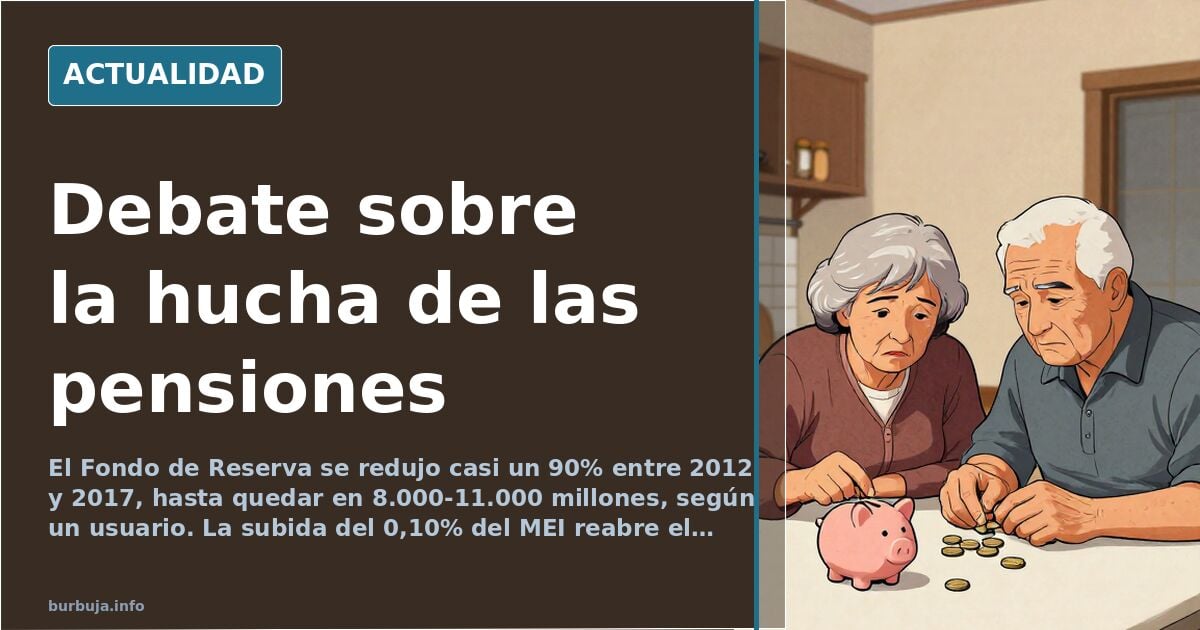
Spain's Social Security Reserve Fund fell by almost 90% between 2012 and 2017, down to 8,000-11,000 million euros, according to one user. The 0.10% MEI increase reopens the…
English · Original discussion in Spanish · Published
While everyone talks about Maricarmen, this goes unnoticed: Spain's pension 'nest egg'
The debate over the early election and the Maricarmen case has pushed aside an issue that directly affects the pockets of millions of people: the sustainability of Spain's public pension system. At the centre of the exchange of accusations is the Reserve Fund, the so-called pension 'nest egg', and how it evolved under recent governments. One figure keeps coming up in the analysis: between 2012 and 2017, the government led by Mariano Rajoy repeatedly drew on the fund to pay pensions and extra payments, cutting the reserve by almost 90% to around 8,000 or 11,000 million euros, according to a calculation circulating in the debate. The figure is not neutral: it marks the starting point of any serious debate about the future of benefits.
The Reserve Fund: what it is and why it matters
The Social Security Reserve Fund was created to cover gaps between revenue and spending in difficult times. Its role is not to pay ordinary pensions, but to act as a countercyclical buffer. When unemployment soars and contributions fall, the fund makes it possible to maintain benefits without resorting to debt or emergency tax rises. That is why its level is a thermometer of the system's financial health.
The controversy over its management is nothing new. Some argue that the PP drained it during the crisis, while others reply that Zapatero's PSOE had already left it empty. A recurring claim in the exchange of accusations is that when Rajoy took office, the fund was already exhausted. Those defending that thesis add that the PP merely took out loans to inject into the fund and pretend there was still money left. The opposing version stresses that it was Rajoy's government that cut the reserve by almost 90% between 2012 and 2017. Both readings coexist without either having been endorsed by an independent body in the available material.
The 0.10% increase and its cumulative effect
At the same time, the discussion becomes entangled with the rise in contributions under the Intergenerational Equity Mechanism (MEI, a temporary payroll levy), which some treat as a scandal. The increase is 0.10%, a figure that seems small in absolute terms. The problem is not the decimal, but its addition to a series of previous increases that erode the savings capacity of working people. That is the argument of those who warn that, when the time comes to need public resources, the coffers will be empty.
The official defence of the system rests on another point: according to this version, current contributions would be enough to pay pensions without touching the fund. If that is true, the nest egg would be an unnecessary insurance policy. If not, the room for manoeuvre narrows. The discrepancy is not settled with headlines, but with the Social Security accounts, which are not detailed in the material.
The political context: elections and promises
The early election looms over the whole debate. The thesis that weeks of announcements and immediately effective decrees, designed to win votes, are coming is put forward forcefully. Those who hold it predict that, if the current government manages to stay in power, it will later reverse the costliest measures and leave the explosive problems hidden in drawers for whoever comes next. The accusation of short-termism is not exclusive to this issue, but here it applies with particular force because it affects pensions and wages.
At the other extreme, warnings are issued that a change of government would put the nest egg and benefits at risk. The comparison with what peine between 2012 and 2017 is used as a warning: if it was drained once, nothing prevents it from happening again. The argument has a logical flaw: it assumes the past will repeat itself without analysing why it ran out then or what conditions allowed it.
Young people, housing and the social cocktail
The discontent is not limited to pensions. In the background is a young generation with precarious jobs, unaffordable rents or mortgages, and a narrowing outlook for the future. The warning that someone with nothing to lose becomes dangerous sums up a concern that goes beyond economics. It is not a prediction, it is a description of the social climate.
The link between pensions and young people is not rhetorical. A system that demands rising contributions from those on low wages and temporary contracts while promising uncertain future benefits creates an intergenerational tension that no decree can solve. The nest egg, in that context, is a symbol: if it is emptied, the promise weakens; if it is refilled with debt, the burden is passed on.
The exact point where the analysis gets stuck is the lack of an independent and up-to-date audit of the Reserve Fund. Without one, each side will keep blaming the other for the drain and presenting its own figures as definitive. Meanwhile, the 0.10% increase will be promptly deducted from pay packets, and the question of whether there will be a pension when the time comes will remain unanswered.
Summary of a discussion on Burbuja.info - Foro de economía, actualidad y política., translated from Spanish and reviewed before publication. Read the full discussion (15 replies).
More summaries
-
Maricarmen Abascal died shortly after TV segment
Online claims suggest Maricarmen Abascal died within two hours of a health report. No public autopsy fuels speculation.
-
The senior vote and the Maricarmen case: an open debate in Spain
The Maricarmen case has reignited the debate over Spain's senior vote: vulnerability, old rental contracts and fear of losing a home. Will it change how they vote?
-
Everyone helped kill her, and she died alone
An 87-year-old woman died after being evicted from her home in Spain, and her case became a political weapon. The autopsy and the precedent of Aylan now frame the debate.
-
El Lobo Estepario: anti-system YouTuber now asks the system for help
El Lobo Estepario, an anti-system YouTuber who lives off his mother's allowance, asks for help to repair his car. The paradox of someone who criticizes wage labor…
-
PSOE and Sumar slip the grandchildren law into an education reform
Spain's PSOE and Sumar have added the grandchildren law to an education reform bill. The PP calls it a "legal botch job", with estimates circulating of 3 to 5 million potential beneficiaries.
-
France in flames: student riots and schools set on fire
Schools set on fire and student riots in France: the viral video against the RN, the shadow of 2005 and the unproven hypotheses.