
Spain's pension adjustment nobody wants to sign
Pensions in Spain will be adjusted not through nominal cuts, but via inflation, freezes or a later retirement age. The MEI is already being deducted from paychecks.
English · Original discussion in Spanish · Published
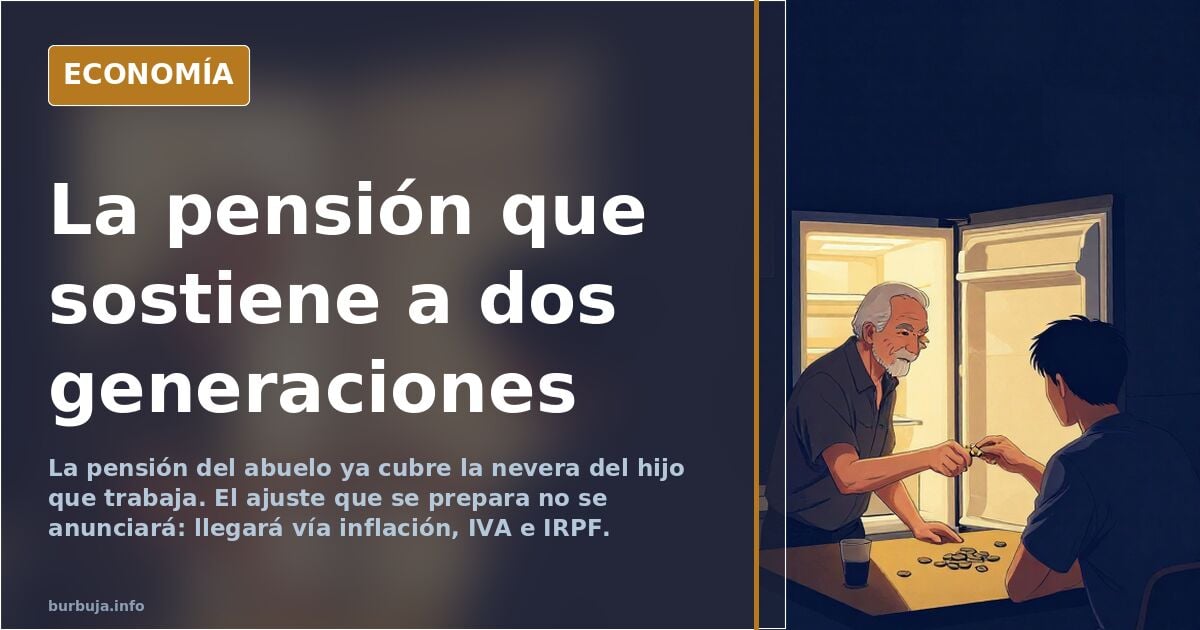
Spain's pension adjustment nobody wants to sign
Spain's Social Security system has a problem that speeches cannot fix: there are more and more retirees and fewer contributors. At the heart of the matter is an uncomfortable question already being asked in whispers: what will happen when the new government has to cut pensions? The answer that keeps coming up is not a legal cut, but a silent adjustment through inflation, freezing or a later retirement age. Meanwhile, according to one participant in the debate, a growing number of young households rely on grandparents' pensions to make ends meet, a phenomenon that, he says, is hidden out of shame.
Pensions as a family lifeline
The starting point is uncomfortable: there are adult children with jobs who still need their retired parents to give them money or fill their fridge. It is not an isolated case. The analysis points out that the grandparents' pension has become a safety net for adults in employment whose wages do not cover rent and living costs. That reality breaks the narrative that pensions only matter to those who collect them.
Those who defend this diagnosis argue that the system is unsustainable as it stands. Those who push back argue that the problem is not pensions, but wages and housing costs. Both things can be true at once, and that is where the political mess begins.
Cuts: what has already been done and what is hidden
The record is uncomfortable for everyone. In 2010, under Royal Decree-Law 8/2010, pensions were frozen except for the minimum ones. Then Prime Minister José Luis Rodríguez Zapatero signed that measure, and the current Prime Minister, Pedro Sánchez, voted in favour as an MP. That episode is now used as ammunition in both directions.
Beyond the anecdote, the real adjustment has come through other channels: indexation below the CPI, the sustainability factor approved in 2013 and never applied, and the Intergenerational Equity Mechanism (MEI), which started in 2023 at 0.1% and will rise to 0.2% by 2029. That is the cut already being deducted from paychecks while hardly anyone looks.
Who pays for the party, and for how long?
The most common diagnosis is that the parties will kick the can down the road and leave the problem to the next government. The adjustment, it is argued, will come via inflation, freezing or a later retirement age, not a nominal cut. The reason is simple: retirees vote, and so do those five years away from retirement.
Some argue that the EU and the IMF will eventually impose the cut if debt keeps rising. Others believe the system can hold if working lives are extended and other budget lines are trimmed. The full calculation, with all the variables, yields a result that leaves nobody at ease.
The generation expecting nothing
Among the young, the idea is spreading that their pension will not exist or will be far worse. People talk about a pensioner dictatorship, of the non-productive part supporting the productive one, and of the money being handed out today being paid for by the grandchildren. It is a harsh way of putting it, but it reflects real discontent.
The question is not whether there will be an adjustment, but when and who will sign it. And if nobody signs it, what happens then?
Also available in: Deutsch
Summary of a discussion on Burbuja.info - Foro de economía, actualidad y política., translated from Spanish and reviewed before publication. Read the full discussion (36 replies).
More summaries
-
Blue Face on Spanish Show Horizonte Sparks Murder Accusations
Bea Talegón's blue face on Horizonte triggers murder accusations online after Maricarmen's death, boosting viewership.
-
Signal: hacked or misconfigured? What the leak reveals
The latest Signal chat leak does not prove the encryption is broken; it shows the weak link is the user and a trojan. Who is spying on you, and how?
-
Switzerland rejects immigration curb: cap initiative voted down
Switzerland says no to limiting immigration: the SVP initiative falls with 55% of votes against. Turnout was 57%. The debate over the country's demographic future remains open.
-
Leire Díez: Spain's 'Epstein' under threat of political downfall
Leire Díez, under investigation for electoral fraud, is the human link in a corruption network. Her political survival depends on keeping the media spotlight on her, much like the Epstein case.
-
Chemtrails: what spraying the sky would cost and who would pay
How much would it cost to spray the sky? An economic analysis of the chemtrail theory: pharmaceutical companies as payers, inefficient costs and natural remedies the health system ignores.
-
Spain's minimum income scheme burns through 60% of its annual budget in four months
Spain's Minimum Vital Income has spent €1.7 billion in four months, up 22%, consuming 60% of its annual budget. Regularisations and payments matched to the minimum wage are driving the surge.