
Spain's own Kennedy theory: the narrative pointing at Sánchez
The 'Spanish Kennedy' theory has spent nearly three years piling up dates, ailments and predictions about Pedro Sánchez. Where it comes from and why it keeps growing.
English · Original discussion in Spanish · Published
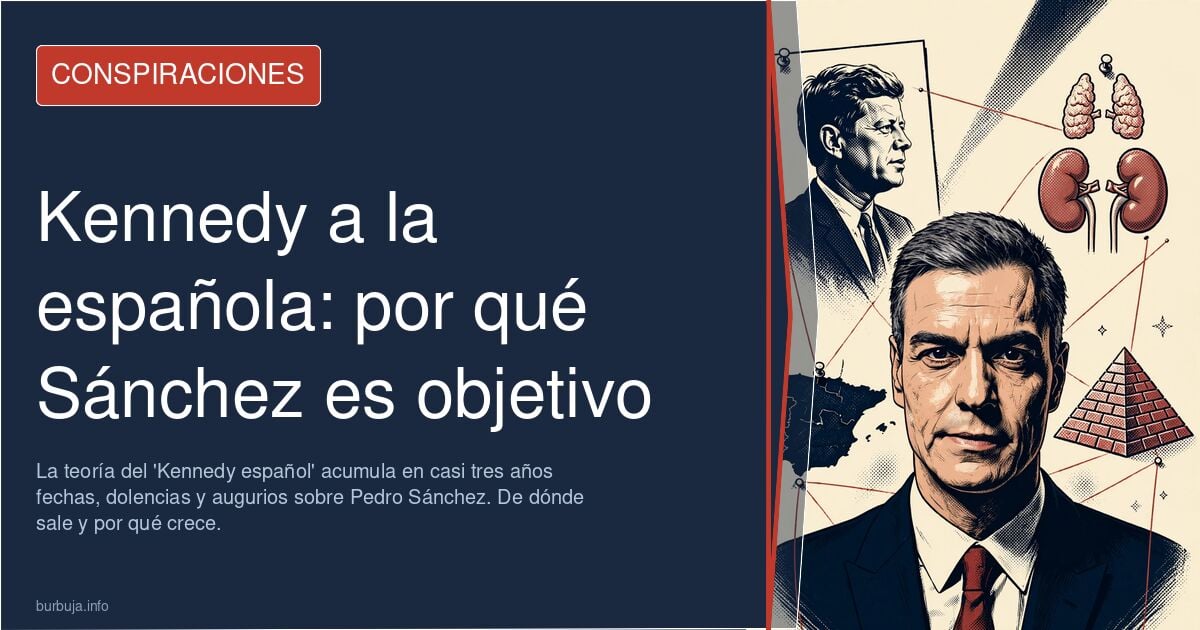
The 'Spanish Kennedy': how numerology points at Sánchez
One November night —a month with gunpowder on the calendar since 1963— someone wondered whether Pedro Sánchez could be "our Kennedy". The idea sounded like a dinner-table joke. It wasn't. Over nearly three years it has kept adding layers: rhyming dates, shared ailments and a narrative about power that, according to this current, resets itself through sacrifice. What began as a passing fancy is now an archive with its own accounting. And its stated aim is to make you see coming what it announces.
Numerology as method: 22-N and 30-D
The framework rests on calendar coincidences. John F. Kennedy was assassinated on 22 November 1963. Sánchez's investiture also fell in November. Add 30 December —the date of Prim's death, another assassination— and the result, for anyone who sees the world this way, stops being a coincidence. The argument about "Spain's vice of assassination" ties that suspicion to a supposed national tradition running from Prim to Carrero Blanco.
Some add The Economist's 2025 cover, showing a car apparently under attack. Some project 2027 as a mirror of 1973: 27 years to 2000 and another 27 to that date. The full calculation, with all the chained coincidences, only adds up if you accept the conclusion in advance.
Addison's disease as 'proof'
The most cited leap goes through the medical route. According to the narrative, Sánchez suffers from Addison's disease, a rare endocrine disorder, and the other president said to have had it would be Abraham Lincoln, whose end is also well known. "I don't believe in coincidences," sums up one of the most repeated messages. The inference leaps through the air: two presidents, one illness, one destiny. It ignores a textbook detail —correlating two data points explains nothing— but it holds up as a headline.
From prophecy to wish, and the prophecy that twists
The striking twist comes from within the narrative itself. Those who have spent years announcing a specific date declare themselves disgusted when others voice it as a wish. The American mirror slips into the conversation: recent episodes of political violence are read as confirmation that "things are moving forward", whatever the protagonist's colour. After the visit to Paiporta —on 3 November— a new milestone was set: fourteen months later, on 3 January. Nothing peine. The date was moved. It is impossible to verify the data that would settle the matter, because the point of the matter is precisely that nothing ever does.
The counter-theory deserves its own paragraph, and it is the most uncomfortable one: that the elite floods social media with absurd conspiracies so that, when a real one appears, nobody believes it. Under that logic, every failed prophecy would be proof of its own usefulness. The machine does not stop for being wrong. The narrative keeps adding layers —a release linked to the macro-mafia, the trains, one headline after another— while the calendar passes without proving it right. Nearly three years on, not a single prediction has hit the mark. Far from switching it off, that is its fuel. It goes out when you stop looking.
Disclaimer: This article analyses theories circulating on social media about unverified events. It does not endorse any hypothesis or prediction about real people.
Summary of a discussion on Burbuja.info - Foro de economía, actualidad y política., translated from Spanish and reviewed before publication. Read the full discussion (80 replies).
More summaries
-
Is Reality a Control System? Energy Farming and Archontic Management
Analysis of reality as an energy extraction system managed by hierarchical entities, questioning if our existence is a controlled farm designed to harvest fear and conflict.
-
Mel Gibson Falsely Accused of Calling for Ellen DeGeneres' Execution
Mel Gibson and Ellen DeGeneres: a disreputable outlet claims the actor sought the death penalty for the presenter over cannibalism, without any evidence.
-
Why is this "simulated" world so stingy?
Forum users discuss why this reality seems like a cheap simulation, full of incongruities and coincidences that many consider bad design.
-
The secret plan behind words, according to the conspiracy
A list of everyday words redefined as hidden messages: from 'Málaga' to 'Gobierno', a conspiracy theory spreading online.
-
Melchizedek: the priest-king who vanished from the Bible
Melchizedek was king, priest and teacher of Abraham. So why did the Bible erase him? From the Kabbalah to Biglino, the mystery of the being who was never born and never died.
-
Why do the left-wing trash media push Rosalía so hard?
Conspiracy or marketing? We look at why Spanish media promote Rosalía so heavily and the theories that explain it.