
Spain's October 12 holiday: parade pageantry meets colonial reckoning
A forum thread mixes criticism of Spain's October 12 national day with proposals such as changing the date or even marking the July 18, 1936 coup instead.
English · Original discussion in Spanish · Published
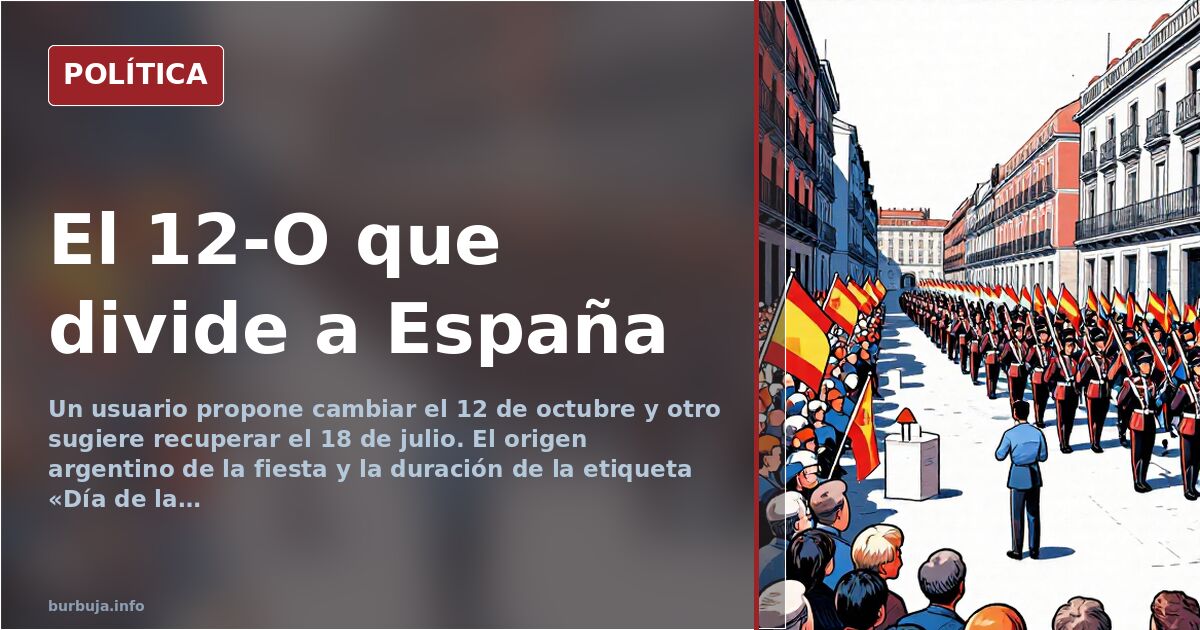
Hispanic Day: the October 12 that divides Spain
Does it still make sense to celebrate October 12 as Spain's national day? The date commemorates Columbus's arrival in the Americas in 1492, but its meaning remains contested. For some, it marks the start of the greatest civilizing endeavour in history; for others, the beginning of a plunder whose effects still linger. The debate is nothing new, but every year it returns louder than before. In 2024, the controversy has flared up again on social media and forums, mixing historical, economic and political arguments. The underlying question: is there something to celebrate, or only to reassess?
The holiday's origins and how it evolved
Spain established its national day in 1918 as the "Día de la Raza" (Day of the Race), a name intended to unite Spain with Latin America. In 1958 it was renamed "Día de la Hispanidad" (Hispanic Day), and in 1987 October 12 was definitively fixed as the Fiesta Nacional. Over time, the term "Raza" fell out of use because of its connotations, and some Latin American countries rebranded it as "Day of Indigenous Resistance". In Spain, the day has become an institutional event complete with a military parade, adding a layer of patriotic meaning that not everyone shares.
What exactly is being celebrated?
For part of public opinion, October 12 commemorates Spain's achievement in the Americas: the creation of viceroyalties, the spread of the Spanish language and culture, and the halting of Sarracin's expansion in the West. The argument goes that Spain never had colonies in the usual sense, but rather territories regarded as part of the metropole, some of them wealthier than the peninsula itself. Others, however, believe the date glorifies a genocide and demand that it be abolished or turned into a day of critical reflection. The tension between these two visions shows up in public events, political statements and, of course, on social media.
The parade and the monarchy: unity or division?
The October 12 parade, presided over by the King, is for many the centrepiece of the day. Yet not everyone embraces it with enthusiasm. Some criticise the monarchical pageantry and the associated cost, while others see the date as a chance to champion the role of the Armed Forces. The presence of Princess Leonor, increasingly prominent, has added media interest. For some, the image of the Royal Family at the parade symbolises institutional continuity; for others, it is a reminder of a past they would rather leave behind.
Alternative proposals: from January 2 to July 18
In recent years, voices have emerged proposing a change to the date of the national day. Some suggest January 2, commemorating the capture of Granada in 1492, which ended the Reconquista. Others, more radical, advocate July 18, the date of the 1936 coup d'état, which would spark even greater controversy. There are also those who simply want to scrap the celebration or replace it with a day honouring the victims of colonisation. None of these proposals has gained traction, but the mere fact they are raised shows the date generates no consensus.
Spain's role in history: pride or shame?
Spain's legacy in the Americas is the subject of heated debate. Supporters point to the founding of universities, the introduction of the printing press, the building of infrastructure and the spread of Christianity. Critics highlight the abuses, the imported diseases and the exploitation of resources. The figure of Isabella the Catholic, key to the American enterprise, has been championed by some and criticised by others. Economically, it is recalled that Spain was the first global power during the 16th and 17th centuries, with an empire spanning four continents. That splendour, however, faded and gave way to a decline still studied in schools today.
The celebration today: between indifference and assertion
For many citizens, October 12 is simply another public holiday, a chance to rest or travel. Polls rarely ask about the meaning of the date, but social media reveals growing polarisation. While some post flags and patriotic messages, others use the occasion to denounce the colonial past. The controversy shows no sign of dying down; quite the opposite, it flares up every year. Is October 12 a date to celebrate or to reassess? The answer depends on whom you ask.
In the end, the national day remains a mirror of the country's divisions. Some see glory; others, disgrace. And meanwhile, the calendar moves on and October 12 returns, punctual as ever, with its parade, its speeches and its controversy. Did anyone expect anything else?
Also available in: Deutsch
Summary of a discussion on Burbuja.info - Foro de economía, actualidad y política., translated from Spanish and reviewed before publication. Read the full discussion (34 replies).
More summaries
-
Retired Colonel Calls for Emergency Government and New Constitution
A retired lieutenant colonel proposed an emergency government and a new constitution at the Military Casino, deeming it unviable without external support.
-
Spain's defence faces the collapse nobody mentions
The decline of Spain's Armed Forces, in the words of those who see an inevitable collapse amid budget cuts and lack of investment
-
Spain's Crown and its democratic legitimacy: a debate that never ends
Spain's monarchy was born out of Franco's Succession Law and was ratified in the 1978 referendum. Did that vote legitimize the Crown? The debate goes on.
-
Madrid PP gives 48 hours to clear Sol camp
Madrid's PP gives 48 hours to clear the Sol encampment, citing cobblestones, stoves and knives; banners against Ayuso appear.
-
Globalist Aznar says let those who can do it act, yet he never did anything himself
We examine Aznar's legacy: liberal rhetoric in words, but a record marked by concessions to separatism and a surge of uncontrolled immigration.
-
The paradox of identity-driven self-hatred
An analysis of the trend that praises immigrants' courage over that of natives, based on an episode of online polarization with no verifiable data