
Spain's Ministerio de Vivienda launches an ad many read as mocking people who share a flat
Spain's Ministerio de Vivienda (housing ministry) launches a housing-access campaign that many read as mocking people who share a flat.
English · Original discussion in Spanish · Published
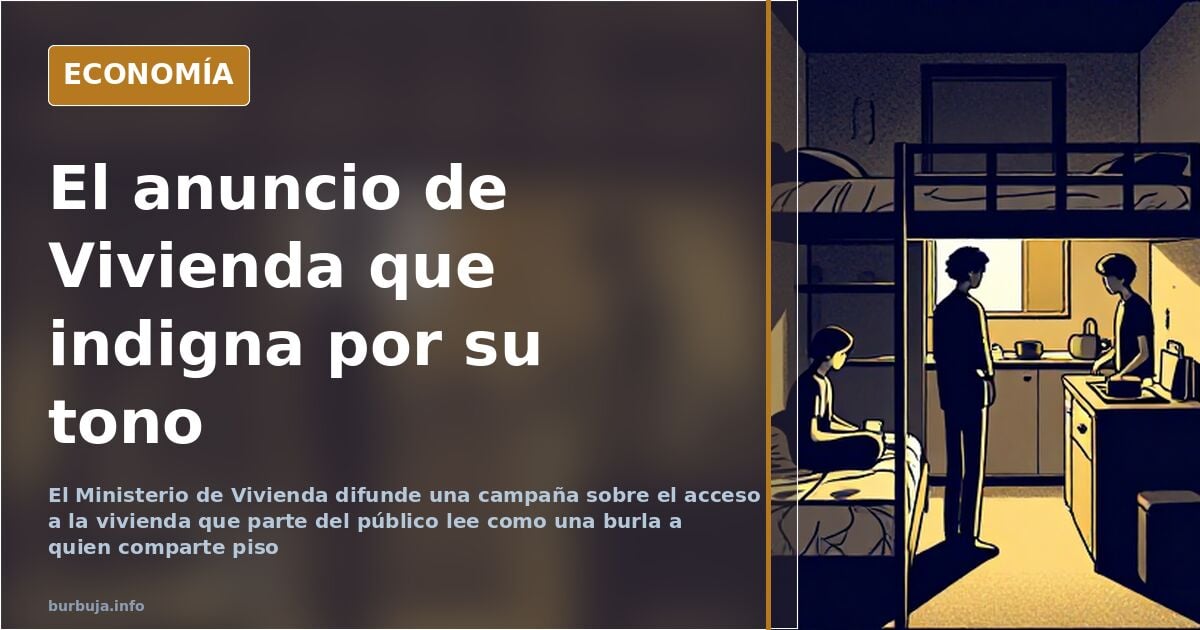
The Ministerio de Vivienda ad that ridicules people still sharing a flat at 40
The illuminated billboard that opens the campaign reads «Marzo 2055». No one has clarified whether that is a date, a promise or a joke. The Ministerio de Vivienda (Spain's housing ministry) has released an ad about access to housing that has landed like a bombshell: much of the public has read it not as an institutional message but as a mockery of people who already live in shared flats. The scene is everyday: a pensioner splitting the rent and a thirty-something in the same flat. What is being debated is not the scene. It is who provoked it.
What the Ministerio de Vivienda ad says and why it has caused outrage
The department headed by Isabel Rodríguez has launched a piece that, in the view of its critics, laughs at the problem instead of tackling it. The tone has been described as mocking, and that is the core of the anger: it is not the existence of a campaign, it is the gesture. Some point out that, stripped of its institutional stamp, the piece would read just like a party video against the previous government.
The outrage does not stop at aesthetics. The argument is that the ad treats as an acceptable horizon something that, for an average family, is a life failure: living in shared rented accommodation in your forties. And that it does so, moreover, with a smile. The underlying complaint is fundamental: the State would be certifying as normal what until recently was exceptional.
Housing has gone from not being a problem to being the number-one problem
The most repeated argument among critics is not that there is a crisis, but that the crisis is recent and by design: they maintain that before this parliamentary term housing was just another concern and that today it appears as the first topic in any conversation among anyone looking for a roof. The price has stopped being a barrier and become a wall: buying is unattainable and rent eats your paycheck.
On the table is a list of supposed culprits that is repeated with few variations: legal reforms that, according to this analysis, have made renting more expensive, along with licences and requirements; the scarcity of developable land; the tax burden across the entire construction chain. None of it is solved by an ad. All of it gets worse while the ad airs.
There are even those who add a more uncomfortable suspicion: that part of the system has no interest in freeing up land, because already-built housing is the main asset of many fortunes. It is an unproven hypothesis, but it explains why it is repeated so often.
The Congreso’s rejection of taxing home purchases by foreigners
While the campaign was being rolled out, the Congreso (Spain's lower house) dismissed a Vox motion that sought to introduce a deterrent tax regime for foreigners interested in buying homes in Spain, with the stated aim of giving Spanish citizens preference in access to social housing and other housing aid. The proposal was defeated.
The issue has peine the dispute over the role of foreign demand. Some argue that purchases by non-residents push prices up and drive out long-time neighbours; others respond that the problem is structural and that little is built and it is expensive regardless of who signs the deed. A leader of the proposing party went so far as to attribute the rise in housing prices to South American immigration. It is a political thesis, not a settled fact.
Other layers of discontent creep into that clash: the distribution of public housing, who gets access to aid and with how long a period of residence. The perception of grievance among those who have lived their whole lives in the same neighbourhood fuels a debate that is no longer only economic.
The constitutional right to housing and who pays for it
The constitutional text recognises the right to decent housing, but does not oblige the State to pay for it. The distinction has been repeated ad nauseam: there is a mandate for public authorities to remove obstacles, not a duty to hand over the keys. Half the debate is fought over that boundary.
The nuance matters because the reproach is not only inaction. It is the direction of the action. If the mandate is to facilitate access, the criticism is that the rules approved have done the opposite: made land more expensive, complicated development and taxed the operation down to the last link. And the uncomfortable question remains: is a flat shared with strangers decent housing?
Salaries of «1.000 euros and little more» and a shopping basket 60% more expensive: the figures that keep recurring
In the thread, unsourced figures are repeated: the salary of a growing part of the population would be stuck at «1.000 euros and little more», food would have accumulated rises of more than 60% and cars would have doubled in price, according to the calculations wielded by several participants. Housing is not viewed in that picture: it is viewed in the one played out every month with the payslip in front of you.
Hence the diagnosis repeated by several participants: it is not that flats are expensive in absolute terms, it is that wages have been devalued. Inflation would have done the job the bubble failed to do, leaving an entire generation out of the market without the need for a prior crash.
With that picture, the ad becomes the least important thing and the most annoying. The illuminated billboard is still there, with its date: Marzo 2055. By then the campaign will have expired. The question is whether the problem will too.
The illuminated billboard that opens the campaign reads «Marzo 2055». No one has clarified whether that is a date, a promise or a joke. The Ministerio de Vivienda (Spain's housing ministry) has released an ad about access to housing that has landed like a bombshell: much of the public has read it not as an institutional message but as a mockery of people who already live in shared flats. The scene is everyday: a pensioner splitting the rent and a thirty-something in the same flat. What is being debated is not the scene. It is who provoked it.
What the Ministerio de Vivienda ad says and why it has caused outrage
The department headed by Isabel Rodríguez has launched a piece that, in the view of its critics, laughs at the problem instead of tackling it. The tone has been described as mocking, and that is the core of the anger: it is not the existence of a campaign, it is the gesture. Some point out that, stripped of its institutional stamp, the piece would read just like a party video against the previous government.
The outrage does not stop at aesthetics. The argument is that the ad treats as an acceptable horizon something that, for an average family, is a life failure: living in shared rented accommodation in your forties. And that it does so, moreover, with a smile. The underlying complaint is fundamental: the State would be certifying as normal what until recently was exceptional.
Housing has gone from not being a problem to being the number-one problem
The most repeated argument among critics is not that there is a crisis, but that the crisis is recent and by design: they maintain that before this parliamentary term housing was just another concern and that today it appears as the first topic in any conversation among anyone looking for a roof. The price has stopped being a barrier and become a wall: buying is unattainable and rent eats your paycheck.
On the table is a list of supposed culprits that is repeated with few variations: legal reforms that, according to this analysis, have made renting more expensive, along with licences and requirements; the scarcity of developable land; the tax burden across the entire construction chain. None of it is solved by an ad. All of it gets worse while the ad airs.
There are even those who add a more uncomfortable suspicion: that part of the system has no interest in freeing up land, because already-built housing is the main asset of many fortunes. It is an unproven hypothesis, but it explains why it is repeated so often.
The Congreso’s rejection of taxing home purchases by foreigners
While the campaign was being rolled out, the Congreso (Spain's lower house) dismissed a Vox motion that sought to introduce a deterrent tax regime for foreigners interested in buying homes in Spain, with the stated aim of giving Spanish citizens preference in access to social housing and other housing aid. The proposal was defeated.
The issue has peine the dispute over the role of foreign demand. Some argue that purchases by non-residents push prices up and drive out long-time neighbours; others respond that the problem is structural and that little is built and it is expensive regardless of who signs the deed. A leader of the proposing party went so far as to attribute the rise in housing prices to South American immigration. It is a political thesis, not a settled fact.
Other layers of discontent creep into that clash: the distribution of public housing, who gets access to aid and with how long a period of residence. The perception of grievance among those who have lived their whole lives in the same neighbourhood fuels a debate that is no longer only economic.
The constitutional right to housing and who pays for it
The constitutional text recognises the right to decent housing, but does not oblige the State to pay for it. The distinction has been repeated ad nauseam: there is a mandate for public authorities to remove obstacles, not a duty to hand over the keys. Half the debate is fought over that boundary.
The nuance matters because the reproach is not only inaction. It is the direction of the action. If the mandate is to facilitate access, the criticism is that the rules approved have done the opposite: made land more expensive, complicated development and taxed the operation down to the last link. And the uncomfortable question remains: is a flat shared with strangers decent housing?
Salaries of «1.000 euros and little more» and a shopping basket 60% more expensive: the figures that keep recurring
In the thread, unsourced figures are repeated: the salary of a growing part of the population would be stuck at «1.000 euros and little more», food would have accumulated rises of more than 60% and cars would have doubled in price, according to the calculations wielded by several participants. Housing is not viewed in that picture: it is viewed in the one played out every month with the payslip in front of you.
Hence the diagnosis repeated by several participants: it is not that flats are expensive in absolute terms, it is that wages have been devalued. Inflation would have done the job the bubble failed to do, leaving an entire generation out of the market without the need for a prior crash.
With that picture, the ad becomes the least important thing and the most annoying. The illuminated billboard is still there, with its date: Marzo 2055. By then the campaign will have expired. The question is whether the problem will too.
Summary of a discussion on Burbuja.info - Foro de economía, actualidad y política., translated from Spanish and reviewed before publication. Read the full discussion (216 replies).
More summaries
-
Colau Demands Abolition of Housing Ministry and Expulsion of Vulture Funds
Ada Colau calls to abolish the Ministry of Housing, which she deems “fake,” and demands the expulsion of vulture funds from Spain.
-
Euthanasia in Old Age: Autonomy vs. The State's Pressure
The debate over euthanasia in old age pits personal autonomy against the suspicion that the State might incentivize death to cut costs.
-
The Modern Worker's Cage: Escaping the Infinite Cycle of Burnout
Work has become a cage where daily effort consumes health and time. Discover why we push ourselves so hard and how to break the cycle.
-
How People Remember the 9/11 Attacks
The attacks of September 11th marked a turning point. Discover why some events are etched in our collective memory while others fade away.
-
Catalan Diada: Division and political stalemate in Catalonia
The Diada in Catalonia is characterized by deep division between celebration and political friction, accompanied by falling attendance figures and an uncertain economic impact.
-
Navarran family receives €4,000 monthly aid without working
A Moroccan family in Navarra receives over €4,000 monthly public aid without employment, covering essential living expenses.