
Spain's Minimum Wage Rises 110%, Engineer Salaries Just 29%
Spain's minimum wage has surged 110% since 2005, while senior engineer salaries rose only 29%, significantly compressing the wage scale.
English · Original discussion in Spanish · Published
Engineer salary now just 1.8 times the minimum wage
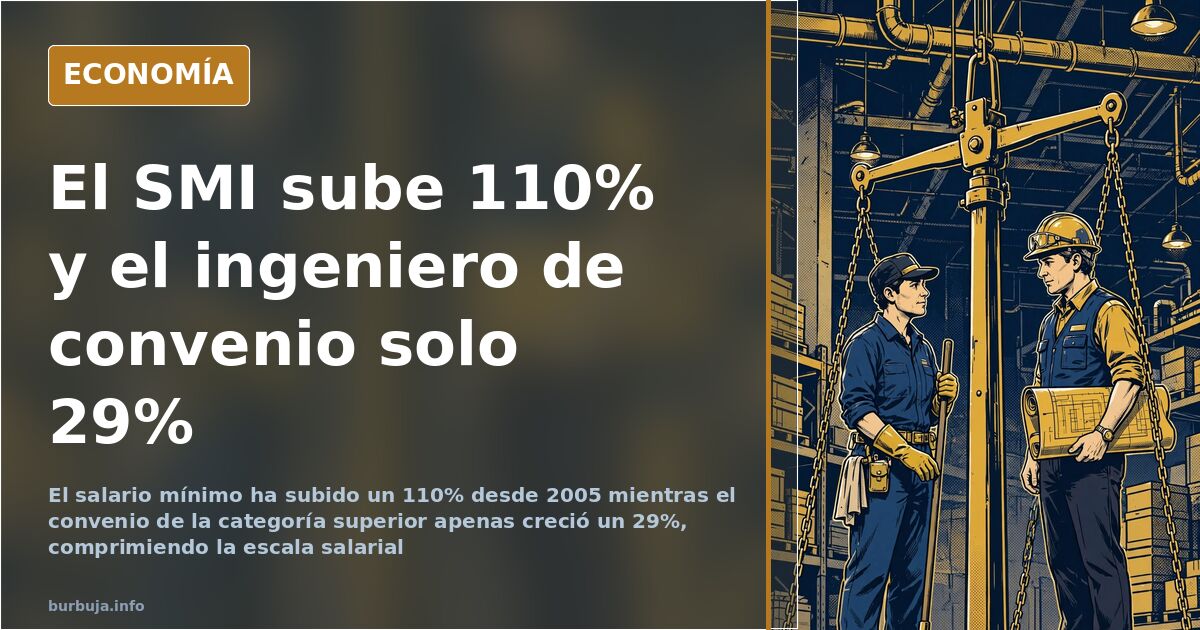
According to data provided by a participant regarding their own sectoral agreement, in 2005 a graduate or senior engineer covered by the collective agreement earned triple the minimum wage. Eighteen years later, that same profile barely exceeds it by 1.8 times. No one's paycheck has decreased; rather, one of the two benchmarks moved much faster than the other. In the highest category of that agreement, the salary went from €21,700 gross annually in 2005 to €28,000 currently, a 29% increase. The minimum wage, over the same period, rose from €513 to €1,080 gross per month in 14 payments: a 110% increase. With inflation during the period at 45%, the result is a wage scale that has been halved.
How the wage scale has compressed in Spain
The effect isn't seen in falling salaries, but in shortening distances. In 2005, the gap between the top-tier agreement and the SMI (Salario Mínimo Interprofesional) was three to one in gross terms; currently, it is 1.8 to one in gross and 1.5 to one in net terms, because lower tax brackets pay less tax and social security contributions. Those who already earned well haven't seen their paychecks grow at the rate they expected, but they have seen those previously far below catch up.
This case is not isolated. An industrial maintenance technician describes salaries of €21,000 gross in 2003, a drop to €16,000 in 2011—when there were about twenty candidates waiting for someone to resign—and a recovery to €26,000 over five years. Offers for this profile remain anchored at €21,000. "Depending on the sector, they haven't changed AT ALL in 20 years."
The inflation thesis: raising the SMI without productivity gains
Here lies the core of the matter. The argument opening the discussion claims that legally raising the minimum wage without an equivalent increase in productivity does not create wealth: it merely shifts price labels. The example is domestic. The minimum goes from €500 to €1,000, but since available wealth remains constant, what cost €500 ends up costing €800. The person at the bottom improves. The one earning €1,500 still earns €1,500 and pays €800 for the same goods. The scale compresses, and the middle class pays the bill.
Objections come from two fronts. First: inflation is rampant across Europe, and Spain's SMI is a speck in that picture. Second, more uncomfortable for the liberal narrative: the classic critique of raising the minimum was always unemployment, rarely inflation. And appealing to the free market to set wages clashes with the fact that, in this reading, there is no free market when there are oligopolies in means of production and monopolies in currency and financing.
Should the minimum wage depend on the province?
Disagreement becomes geographic. An identical SMI in Lugo and Madrid clashes with the reality that housing—the largest expense for any worker by far—is not paid equally in both places. One participant argues that a couple with two minimum wages lives relatively comfortably in Lugo and doubts the same occurs in Madrid, where the budget is tight. Some advocate linking the minimum to the provincial or even municipal price index, noting that in the United States the mechanism exists: there are municipalities with their own higher minimums compared to neighboring towns with lower prices.
Against this weighs a practical argument: in Spain, it is common to live far from work, and adjusting the minimum to the place of residence does not solve the problem for commuters. Regarding the US, interpretations differ: one holds that people live far from work due to urban center degradation, while another counters that it is financial necessity, not preference, that pushes people to the suburbs.
Can you be middle class with €40,000 and a mortgage?
The conversation shifts to where the middle class stands. A criterion gains traction: middle class is defined as those who have no debt or could liquidate it with their liquidity. Earning €40,000 a year while carrying a €200,000 mortgage does not fit that definition, however good the figure sounds. Life stage matters: those €40,000 are reached, if lucky, around age 28, when assets are still zero.
The wall is housing. With that salary, a protected apartment of €150,000 in a capital like Zaragoza is out of reach due to income limits, and the free market pushes the deal to €200,000. The scale compresses from above, and real estate stretches from below.
Public salary and the complaint of producers
Another current, very present, argues that the incentive system is inverted and that those who contribute least earn the most. Recurring examples include vocational training teachers working nine months a year with fourteen payments of €1,900 net, or freely appointed positions in town halls, provincial councils, and regional governments with salaries of two or three thousand euros. Against this image, the counter-argument is that the private sector pays so poorly that the public sector only seems expensive by comparison: the greater the responsibility and qualifications required, the more perversos the proportional salary. On the other end, non-contributory pensions and aid anchored at €500 do not move at the same pace as the minimum wage.
With a compressed scale, stagnant high salaries, and prices that don't fall, who really pays the bill for raising the minimum wage?
According to data provided by a participant regarding their own sectoral agreement, in 2005 a graduate or senior engineer covered by the collective agreement earned triple the minimum wage. Eighteen years later, that same profile barely exceeds it by 1.8 times. No one's paycheck has decreased; rather, one of the two benchmarks moved much faster than the other. In the highest category of that agreement, the salary went from €21,700 gross annually in 2005 to €28,000 currently, a 29% increase. The minimum wage, over the same period, rose from €513 to €1,080 gross per month in 14 payments: a 110% increase. With inflation during the period at 45%, the result is a wage scale that has been halved.
How the wage scale has compressed in Spain
The effect isn't seen in falling salaries, but in shortening distances. In 2005, the gap between the top-tier agreement and the SMI (Salario Mínimo Interprofesional) was three to one in gross terms; currently, it is 1.8 to one in gross and 1.5 to one in net terms, because lower tax brackets pay less tax and social security contributions. Those who already earned well haven't seen their paychecks grow at the rate they expected, but they have seen those previously far below catch up.
This case is not isolated. An industrial maintenance technician describes salaries of €21,000 gross in 2003, a drop to €16,000 in 2011—when there were about twenty candidates waiting for someone to resign—and a recovery to €26,000 over five years. Offers for this profile remain anchored at €21,000. "Depending on the sector, they haven't changed AT ALL in 20 years."
The inflation thesis: raising the SMI without productivity gains
Here lies the core of the matter. The argument opening the discussion claims that legally raising the minimum wage without an equivalent increase in productivity does not create wealth: it merely shifts price labels. The example is domestic. The minimum goes from €500 to €1,000, but since available wealth remains constant, what cost €500 ends up costing €800. The person at the bottom improves. The one earning €1,500 still earns €1,500 and pays €800 for the same goods. The scale compresses, and the middle class pays the bill.
Objections come from two fronts. First: inflation is rampant across Europe, and Spain's SMI is a speck in that picture. Second, more uncomfortable for the liberal narrative: the classic critique of raising the minimum was always unemployment, rarely inflation. And appealing to the free market to set wages clashes with the fact that, in this reading, there is no free market when there are oligopolies in means of production and monopolies in currency and financing.
Should the minimum wage depend on the province?
Disagreement becomes geographic. An identical SMI in Lugo and Madrid clashes with the reality that housing—the largest expense for any worker by far—is not paid equally in both places. One participant argues that a couple with two minimum wages lives relatively comfortably in Lugo and doubts the same occurs in Madrid, where the budget is tight. Some advocate linking the minimum to the provincial or even municipal price index, noting that in the United States the mechanism exists: there are municipalities with their own higher minimums compared to neighboring towns with lower prices.
Against this weighs a practical argument: in Spain, it is common to live far from work, and adjusting the minimum to the place of residence does not solve the problem for commuters. Regarding the US, interpretations differ: one holds that people live far from work due to urban center degradation, while another counters that it is financial necessity, not preference, that pushes people to the suburbs.
Can you be middle class with €40,000 and a mortgage?
The conversation shifts to where the middle class stands. A criterion gains traction: middle class is defined as those who have no debt or could liquidate it with their liquidity. Earning €40,000 a year while carrying a €200,000 mortgage does not fit that definition, however good the figure sounds. Life stage matters: those €40,000 are reached, if lucky, around age 28, when assets are still zero.
The wall is housing. With that salary, a protected apartment of €150,000 in a capital like Zaragoza is out of reach due to income limits, and the free market pushes the deal to €200,000. The scale compresses from above, and real estate stretches from below.
Public salary and the complaint of producers
Another current, very present, argues that the incentive system is inverted and that those who contribute least earn the most. Recurring examples include vocational training teachers working nine months a year with fourteen payments of €1,900 net, or freely appointed positions in town halls, provincial councils, and regional governments with salaries of two or three thousand euros. Against this image, the counter-argument is that the private sector pays so poorly that the public sector only seems expensive by comparison: the greater the responsibility and qualifications required, the more perversos the proportional salary. On the other end, non-contributory pensions and aid anchored at €500 do not move at the same pace as the minimum wage.
With a compressed scale, stagnant high salaries, and prices that don't fall, who really pays the bill for raising the minimum wage?
Summary of a discussion on Burbuja.info - Foro de economía, actualidad y política., translated from Spanish and reviewed before publication. Read the full discussion (143 replies).
More summaries
-
The Middle Class Collapse Hidden from Official Statistics
Housing prices rise several times faster than wages, and new cars require 80% financing. Is the middle class gone in Spain?
-
Income vs wealth: Social class is more than a salary
Social class in Spain is defined not by salary but by wealth and fixed expenses. We analyze how income alone is insufficient to classify reality.
-
Foreign tenants: over half in Spain, 70% in three regions
More than 5.2 million tenants in Spain were born abroad. In Madrid, Valencia and Murcia the share reaches 70%. Data and analysis of...
-
Bringing a Colombian Partner to Spain Costs €20,000
A case study reveals €20,000 spent on family reunification from Colombia and subsequent breakup. No official data measures the real cost.
-
The Blue Dress That Altered King Felipe VI’s Future
25 years since Eva Sannum’s photo in a blue dress ended her relationship with King Felipe VI, sparking debate on the Crown's opportunity cost.
-
Lloret de Mar: Viral photo sparks debate on tourist saturation
A count of 470 people in a Lloret de Mar photo fuels tourism debate, though telephoto lenses and beach slopes skew the perception of overcrowding.