
Spain's middle class is quietly disappearing
Salaries of €1,500–€2,000 no longer cover decent rent. Analysis of the 'poor class' and a 40% loss in purchasing power.
English · Original discussion in Spanish · Published
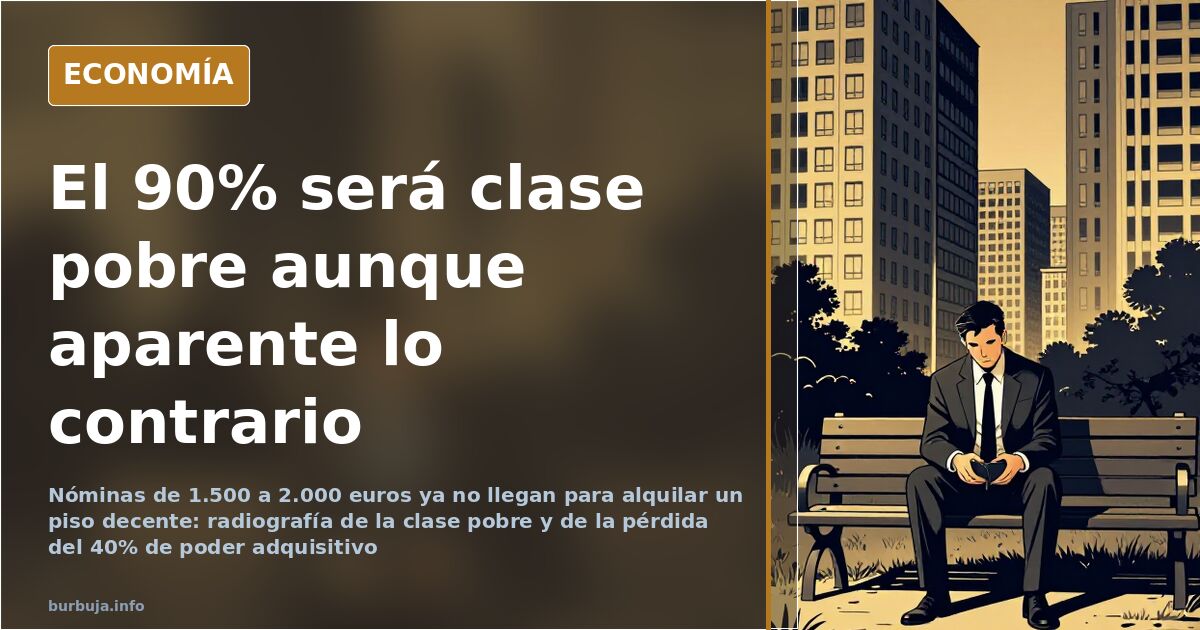
90% will be the poor class, but pretending not to be
Cooking oil at €15 per liter. Civil servant salaries stuck between €1,500 and €2,000 that don't cover decent rent. Cumulative inflation has reportedly eroded 40% of purchasing power in just a few years. These three figures lead to a conclusion rarely questioned aloud: the middle class is dissolving, doing so with full terraces, phones on, and unhappy faces.
What defines the 'poor class' in Spain?
The bar has moved, and not upward. A permanent government job, long synonymous with stability, no longer guarantees much: those passing civil service exams earning between €1,500 and €2,000 remain part of the poor class, especially in major cities. In Málaga, Alicante, or Valencia, where property prices have gone, as the saying goes, to the moon, such salaries fall short even for modest rents.
This leads to the most cited projection: within a few years, 90% of the population will be the poor class, though appearing otherwise. It is not official data, but a trend estimate. Its strength lies not in arithmetic, but in the recognizability of the scenario it describes.
Working only for rent and food
Daily life descriptions are bitter: people work to pay for cramped housing and food, resulting in visible frustration. Behind this lies a labor market where temporary contracts and precariousness are no longer exceptions. Career paths, once resembling ladders, have become wheels spinning without ascent.
The cost is measured in decisions no longer made. It is argued that 80% cannot afford children, not due to lack of desire, but because rent, food, and taxes consume salaries before month-end. Low birth rates shift from demographic data to economic symptom.
The country that appears prosperous: busy terraces, empty accounts
Contrasts appear in any neighborhood. Franchise cafés filled with people spending five euros on coffee while salaries barely suffice. Clothes are renewed, phones upgraded, terraces busy; what doesn’t renew is savings capacity. This gap between appearance and reality may define the new poor class.
A more uncomfortable reading: appearances deceive others but also serve as anesthesia. Maintaining the facade costs money and time, leaving less room to question why finances don’t add up.
Why do streets look grayer and more tired?
Explanations vary. One points to schedules: endless shifts, screens until late, and chronic sleep deprivation. Another cites political saturation: daily scandals and unacceptable behavior across media exhaust public sarracena. When everything feels urgent, nothing matters, affecting collective mood.
A third view attributes weariness to continuous migrant arrivals and competition for housing and jobs. This claim lacks supporting data in discussions, coexisting with purely economic diagnoses explaining similar distress without invoking migration.
Emigration as Plan B
The classic exit—leaving—reappears with nuance. Those who worked abroad note differences beyond salary, particularly in daily organization: crossing into France or Germany reveals improvements, if only through better working hours. This comparison serves as an unflattering mirror.
Notably, this escape valve has been open for years without massive outflows. Those leaving rarely consider returning for economic reasons.
Aesthetic judgment as social thermometer
Some focus on others’ appearances—clothes, tattoos, gestures, bodies—as diagnostic tools. Read objectively, these judgments reveal more about their authors than recipients. Baroja described Madrid’s misery over a century ago in La busca with similar bluntness and humor, when incomes were lower and the middle class wasn’t discussed.
Physical appearance is the cheapest way to explain distress rooted in duller causes: wages, rents, schedules, and taxes.
Is Spain becoming poorer, or simply more aware of its impoverishment? Analysis stalls here. Some blame economic policy, others housing and wages, while some argue crowds walk tiredly due to years of insufficient sleep. No one closes the circle.
Cooking oil at €15 per liter. Civil servant salaries stuck between €1,500 and €2,000 that don't cover decent rent. Cumulative inflation has reportedly eroded 40% of purchasing power in just a few years. These three figures lead to a conclusion rarely questioned aloud: the middle class is dissolving, doing so with full terraces, phones on, and unhappy faces.
What defines the 'poor class' in Spain?
The bar has moved, and not upward. A permanent government job, long synonymous with stability, no longer guarantees much: those passing civil service exams earning between €1,500 and €2,000 remain part of the poor class, especially in major cities. In Málaga, Alicante, or Valencia, where property prices have gone, as the saying goes, to the moon, such salaries fall short even for modest rents.
This leads to the most cited projection: within a few years, 90% of the population will be the poor class, though appearing otherwise. It is not official data, but a trend estimate. Its strength lies not in arithmetic, but in the recognizability of the scenario it describes.
Working only for rent and food
Daily life descriptions are bitter: people work to pay for cramped housing and food, resulting in visible frustration. Behind this lies a labor market where temporary contracts and precariousness are no longer exceptions. Career paths, once resembling ladders, have become wheels spinning without ascent.
The cost is measured in decisions no longer made. It is argued that 80% cannot afford children, not due to lack of desire, but because rent, food, and taxes consume salaries before month-end. Low birth rates shift from demographic data to economic symptom.
The country that appears prosperous: busy terraces, empty accounts
Contrasts appear in any neighborhood. Franchise cafés filled with people spending five euros on coffee while salaries barely suffice. Clothes are renewed, phones upgraded, terraces busy; what doesn’t renew is savings capacity. This gap between appearance and reality may define the new poor class.
A more uncomfortable reading: appearances deceive others but also serve as anesthesia. Maintaining the facade costs money and time, leaving less room to question why finances don’t add up.
Why do streets look grayer and more tired?
Explanations vary. One points to schedules: endless shifts, screens until late, and chronic sleep deprivation. Another cites political saturation: daily scandals and unacceptable behavior across media exhaust public sarracena. When everything feels urgent, nothing matters, affecting collective mood.
A third view attributes weariness to continuous migrant arrivals and competition for housing and jobs. This claim lacks supporting data in discussions, coexisting with purely economic diagnoses explaining similar distress without invoking migration.
Emigration as Plan B
The classic exit—leaving—reappears with nuance. Those who worked abroad note differences beyond salary, particularly in daily organization: crossing into France or Germany reveals improvements, if only through better working hours. This comparison serves as an unflattering mirror.
Notably, this escape valve has been open for years without massive outflows. Those leaving rarely consider returning for economic reasons.
Aesthetic judgment as social thermometer
Some focus on others’ appearances—clothes, tattoos, gestures, bodies—as diagnostic tools. Read objectively, these judgments reveal more about their authors than recipients. Baroja described Madrid’s misery over a century ago in La busca with similar bluntness and humor, when incomes were lower and the middle class wasn’t discussed.
Physical appearance is the cheapest way to explain distress rooted in duller causes: wages, rents, schedules, and taxes.
Is Spain becoming poorer, or simply more aware of its impoverishment? Analysis stalls here. Some blame economic policy, others housing and wages, while some argue crowds walk tiredly due to years of insufficient sleep. No one closes the circle.
Also available in: Deutsch
Summary of a discussion on Burbuja.info - Foro de economía, actualidad y política., translated from Spanish and reviewed before publication. Read the full discussion (193 replies).
More summaries
-
Former Middle-Class Friends Now Poor, Fear Same Fate
Middle-class impoverishment accelerates in Spain. Data and testimonies on lost purchasing power.
-
Sol Campout: Elite Spokespeople and Suspicions of Manipulation
Spokespeople for the Sol campout against the housing crisis reportedly attended United World College and Comillas, according to disseminated data.
-
Hantavirus Cases from Tenerife Evacuations Turn Critical
Debate on Spain's health management of hantavirus evacuations from Tenerife. Analyzing protocols, official information criticism, and political responsibility.
-
Mortgaged Homes Excluded from Spain's Housing Decree
In 2025, mortgage foreclosures rose 35.6% to 31,416. Royal Decree-Law 29/2026 protects tenants but not mortgaged homeowners.
-
Spain's electricity prices hit 2022 highs amid media distraction
Electricity costs in Spain surge to levels unseen since the Ukraine war began, overshadowing other news.
-
Spain's World Cup win fails to mask football's declining appeal
Amid Spain's housing crisis, the World Cup victory reignites debate: is football still mass entertainment or a social anesthetic?