
Spain's middle class has normalized being poor
Spain's middle class has normalized poverty: housing, wages and pensions. An analysis of the structural precarity that defines the new reality.
English · Original discussion in Spanish · Published
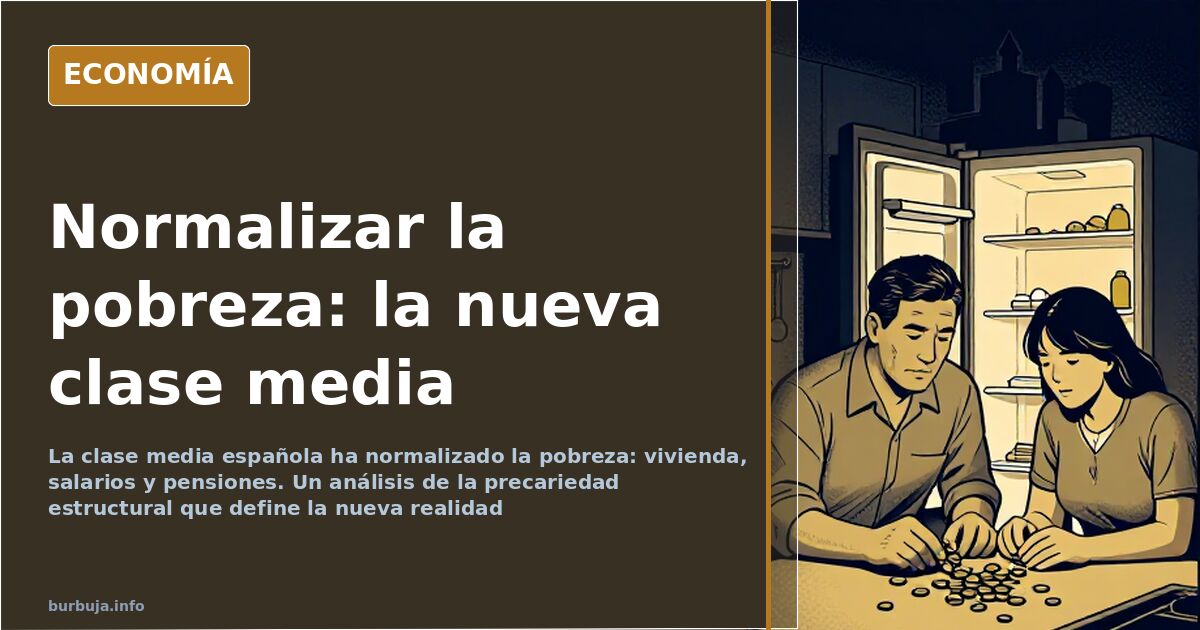
Spain's middle class has normalized poverty
The claim is blunt: we have normalized being poor. But reality is more nuanced: it is not that we have accepted it, it is that we have been pushed into it while the gap with the elite widens. An economist summed it up starkly: society has come to accept that living paycheck to paycheck is the norm.
The mirage of the middle class
The generational comparison is devastating. Our parents, on a single salary, owned their home, had a vacation apartment and a car. Their grandchildren need two salaries to pay rent and still consider themselves middle class. The truth is that the real middle class has disappeared: what remains are poor workers with delusions of wealth. The example of the eight-bedroom flat, turned into a barracks to rent to eight precarious tenants at 400 euros each, is the perfect picture of a model that squeezes the productive class while the political and union caste lives in its bubble.
The future that awaits us
The data are stubborn: pensions paid with debt, a collapsed health system, education turned into indoctrination and businesses suffocated by taxes. If the official scenario plays out, Spain will have Polish wages, Swiss prices and third-world services, with the elite shielded from it all. But history rarely trinc the official script. The question is how much society will endure before the house of cards collapses.
Also available in: Deutsch
Summary of a discussion on Burbuja.info - Foro de economía, actualidad y política., translated from Spanish and reviewed before publication. Read the full discussion (18 replies).
More summaries
-
The Middle Class Collapse Hidden from Official Statistics
Housing prices rise several times faster than wages, and new cars require 80% financing. Is the middle class gone in Spain?
-
Spain's middle class can no longer afford housing or a car
OECD statistics fail to capture the decline of the middle class in Spain: no homes or new cars, while car registrations rise by 3.7%.
-
The average worker can no longer afford housing or a new car
The OECD measures the middle class by income, but fails to capture that housing and a new car have slipped out of reach of the average worker. Data and...
-
46% of Spanish Voters Receive Public Funds, Analysis Finds
A journalistic analysis claims 46% of Spain's electoral census receives pensions, aid, or public employment. This figure constrains any potential reform.
-
Spain's migration dilemma: caught between Europe and the labour market
Spain stands alone in the EU against Meloni's deportation camps, yet its economy needs 1.5 million migrant workers. The contradiction is hard to ignore.
-
Ousman Umar's story hits cinemas amid criticism and questions
Five years of travel, an NGO in Ghana and plenty of unanswered questions. Ousman Umar's film reopens the debate on the cost of immigration and how these organisations are funded.