
Spain's MEI pension levy rises to 0.7% in 2024
The Intergenerational Equity Mechanism (MEI) contribution increases to 0.7% of gross wages in Spain, adding €3.702 billion to the Social Security Reserve Fund.
English · Original discussion in Spanish · Published
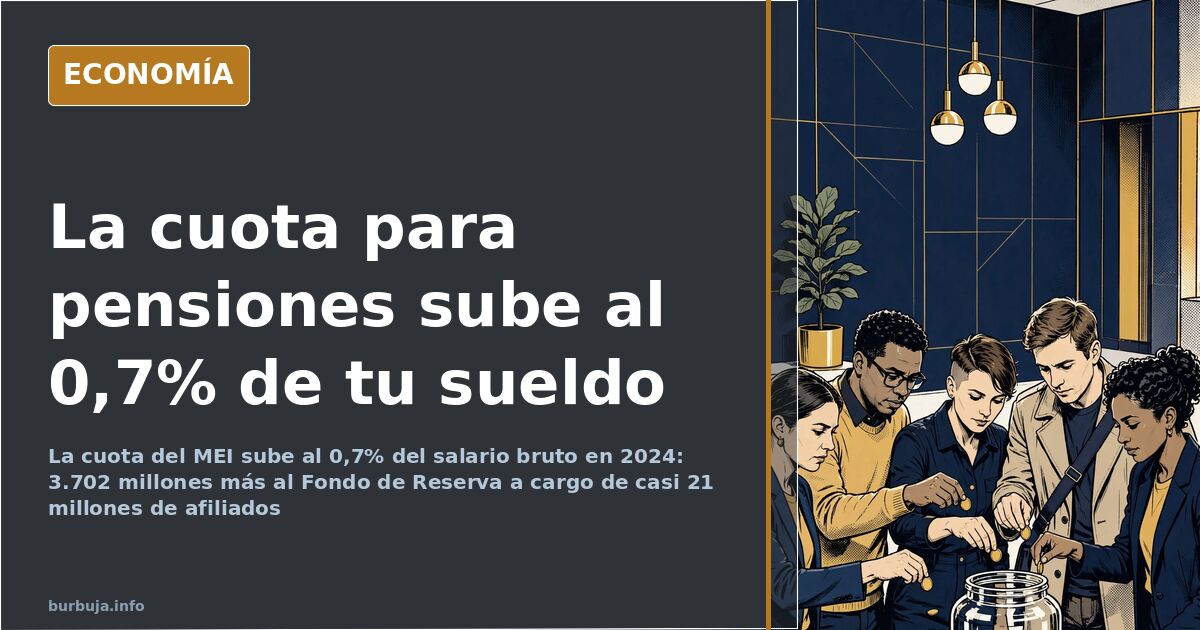
MEI takes another 0.7% of salaries for the pension fund
How much will be deducted from your paycheck next year and why? The official answer is simple: a 0.7% of gross salary to boost the reserve meant to sustain pensions. The Intergenerational Equity Mechanism (MEI), the name given to this new contribution, started in January this year and will rise to that percentage in 2024. With it, the Social Security Reserve Fund will receive €3.702 billion. Those who feel it on their payslips are the nearly 21 million contributors supporting the system. There is no surprise: the deduction is already applied.
What is the MEI and how much does it increase in 2024
The MEI is not a new tax with its own box: it is an additional social security contribution. It falls under common contingencies on the payslip, is calculated on each employee's gross salary, and is split between the worker's share and the employer's share. One contributor confirms seeing an additional 0.10% in that section on their receipt, before the hike reaches its definitive level next year.
The recipient has a name: the Reserve Fund, the cushion this new contribution aims to fill with current money. Fill, not shield. The mechanism does not change a comma of the formula that will decide how much each retiree receives tomorrow. It only changes who pays today. And who pays today is, literally, anyone with a salary.
Why do only workers pay it?
The most repeated objection is not the percentage, but the scope. Some argue that in Spain only those who work pay it, young people and those who will have nothing more than subsistence pensions, while a large part of the group already receiving benefits is excluded from the burden. The comparison with France comes up again and again: according to circulating calculations, there the equivalent mechanism ranges between 6% and 10%, taxes labor and capital income, and includes retirees. "In France, if I'm not mistaken, it's a tax of between 6% and 10% for everyone, including retirees. Labor and capital income," summarizes one of the circulating calculations.
The detail matters more than it seems. If the levy only reaches salaries, the system rests on a base that narrows every year, the same one already bearing ordinary contributions and suffering from precariousness. Others point out that in France the equivalent rate is already around 9% and the idea is to raise it little by little, like the frog in the pot.
Does filling the Reserve Fund help?
Here skepticism is widespread. "The absurdity is that everyone knows the pension system is going to blow up and any measure only delays the inevitable, yet they continue to destroy the economy just to prolong a few years the institutional monstrosity that is pensions," argues one of the most supported messages in the debate. The complaint is not just about the money: it is because the structure is not touched. With a fuller piggy bank, the underlying problem would remain.
There is a harsher version of the same argument: if more comes in every year and the balance sheet does not improve, the problem is not revenue. And a version closer to the receipt: raising the minimum wage while the levy eats part of the increase leaves the improvement on one line of the payslip, the top one, and the deduction on another, the bottom one. Another current points out that the discussion is not about how much comes in, but what it is spent on, pointing to budget items and territorial transfers as the real hole. Without figures to back it up, it is a suspicion, not a diagnosis.
From Switzerland to Argentina: the cited examples
The conversation jumps from country to country as soon as salaries are mentioned. "Greetings from Zurich, where you pay 20% income tax on 100k and 30% on 200k," summarizes a message that has become a reference. The underlying idea is that there are systems with much higher rates where, even so, the taxpayer feels their money stays closer to home. Others look to Argentina and Milei hoping that an adjustment serves as an example; and some warn that the path, for now, goes through more debt and greater long-term ruin.
At the heart of almost all positions lurks the same uncomfortable calculation, summarized in one of the most supported messages: the contribution of those earning €20,000 a year is raised to support pensions of €30,000. And some go further, adding that these retirees also accumulate real estate assets valued at billions. The principle of intergenerational equity that gives the mechanism its name works, given what we see, as its best refutation.
With these elements, the only thing that grows with the reform is the certainty that the 2024 payslip will come with another line. Meanwhile, the piggy bank still has no door at the bottom.
How much will be deducted from your paycheck next year and why? The official answer is simple: a 0.7% of gross salary to boost the reserve meant to sustain pensions. The Intergenerational Equity Mechanism (MEI), the name given to this new contribution, started in January this year and will rise to that percentage in 2024. With it, the Social Security Reserve Fund will receive €3.702 billion. Those who feel it on their payslips are the nearly 21 million contributors supporting the system. There is no surprise: the deduction is already applied.
What is the MEI and how much does it increase in 2024
The MEI is not a new tax with its own box: it is an additional social security contribution. It falls under common contingencies on the payslip, is calculated on each employee's gross salary, and is split between the worker's share and the employer's share. One contributor confirms seeing an additional 0.10% in that section on their receipt, before the hike reaches its definitive level next year.
The recipient has a name: the Reserve Fund, the cushion this new contribution aims to fill with current money. Fill, not shield. The mechanism does not change a comma of the formula that will decide how much each retiree receives tomorrow. It only changes who pays today. And who pays today is, literally, anyone with a salary.
Why do only workers pay it?
The most repeated objection is not the percentage, but the scope. Some argue that in Spain only those who work pay it, young people and those who will have nothing more than subsistence pensions, while a large part of the group already receiving benefits is excluded from the burden. The comparison with France comes up again and again: according to circulating calculations, there the equivalent mechanism ranges between 6% and 10%, taxes labor and capital income, and includes retirees. "In France, if I'm not mistaken, it's a tax of between 6% and 10% for everyone, including retirees. Labor and capital income," summarizes one of the circulating calculations.
The detail matters more than it seems. If the levy only reaches salaries, the system rests on a base that narrows every year, the same one already bearing ordinary contributions and suffering from precariousness. Others point out that in France the equivalent rate is already around 9% and the idea is to raise it little by little, like the frog in the pot.
Does filling the Reserve Fund help?
Here skepticism is widespread. "The absurdity is that everyone knows the pension system is going to blow up and any measure only delays the inevitable, yet they continue to destroy the economy just to prolong a few years the institutional monstrosity that is pensions," argues one of the most supported messages in the debate. The complaint is not just about the money: it is because the structure is not touched. With a fuller piggy bank, the underlying problem would remain.
There is a harsher version of the same argument: if more comes in every year and the balance sheet does not improve, the problem is not revenue. And a version closer to the receipt: raising the minimum wage while the levy eats part of the increase leaves the improvement on one line of the payslip, the top one, and the deduction on another, the bottom one. Another current points out that the discussion is not about how much comes in, but what it is spent on, pointing to budget items and territorial transfers as the real hole. Without figures to back it up, it is a suspicion, not a diagnosis.
From Switzerland to Argentina: the cited examples
The conversation jumps from country to country as soon as salaries are mentioned. "Greetings from Zurich, where you pay 20% income tax on 100k and 30% on 200k," summarizes a message that has become a reference. The underlying idea is that there are systems with much higher rates where, even so, the taxpayer feels their money stays closer to home. Others look to Argentina and Milei hoping that an adjustment serves as an example; and some warn that the path, for now, goes through more debt and greater long-term ruin.
At the heart of almost all positions lurks the same uncomfortable calculation, summarized in one of the most supported messages: the contribution of those earning €20,000 a year is raised to support pensions of €30,000. And some go further, adding that these retirees also accumulate real estate assets valued at billions. The principle of intergenerational equity that gives the mechanism its name works, given what we see, as its best refutation.
With these elements, the only thing that grows with the reform is the certainty that the 2024 payslip will come with another line. Meanwhile, the piggy bank still has no door at the bottom.
Also available in: Deutsch
Summary of a discussion on Burbuja.info - Foro de economía, actualidad y política., translated from Spanish and reviewed before publication. Read the full discussion (142 replies).
More summaries
-
Machines paying into Social Security: what's being proposed
A forum user puts gross operating surplus at 8%: the proposal for machines to contribute divides between redistribution and capital flight
-
Muface: Bal estimates 1.5 million civil servants affected
Edmundo Bal says 1.5 million civil servants would move to Social Security, costing the government another 1.5 million votes.
-
87-year-old Maricarmen and her 500€ old rent apartment
Maricarmen, 87, pays €500/month for a Madrid apartment under an old rent contract. Police cleared the street during her fourth eviction attempt.
-
Spanish man in Philippines lives on €400 with young fiancée
A Spanish content creator with diabetes moves to the Philippines, aiming for a low-cost life and marriage despite lacking health insurance.
-
Marc Giró's 1998 TV3 Clip Reignites Debate on Persona
A 1998 clip of Marc Giró on Catalan channel TV3 shows a subdued collaborator, sparking debate over whether his flamboyant persona is authentic or constructed.
-
Spain rental listings on Idealista drop 9.5% in 12 days
Rental inventory on Spain's leading portal Idealista fell 9.5% in just 12 days, with Barcelona seeing an 83% decline in long-term offers.