
Spain's Marriage Tax: No Divorce for Lack of Sex
Lack of sex isn't grounds for divorce in Spain, where splitting up costs more than staying married and paying the bills.
English · Original discussion in Spanish · Published
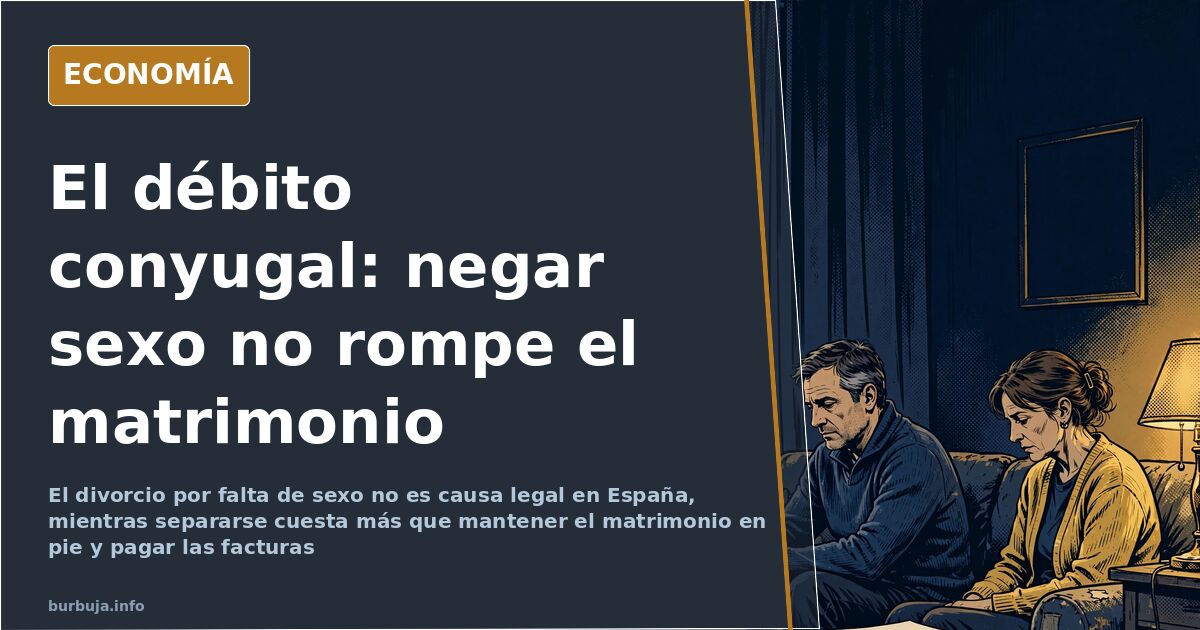
Sens, mortgage, and child support: the bill that blocks divorce
A worker has been hearing the same complaint at the office for months: his colleague says his vvife won't have sens, that he always has to take the initiative, and that when they do, it's once a month. The question he drops — whether that's enough to file for divorce — has accumulated 355 responses over 855 days and remains open. It's not a lack of opinions, but because the issue has two layers that are rarely viewed together: the legal and the financial.
The second is what truly decides.
Can you file for divorce if your partner refuses sens?
There is a term for what is being discussed here: marital debt. In systems with causal or fault-based divorce, persistently refusing to maintain relations — without a justified excuse, such as illness or postpartum recovery — is interpreted as a breach of marital duties. This allows one to seek separation and assign blame to the other party. The reasoning is summarized in a phrase circulating in the conversation: 'if one wants, the other must.'
In Spain, things are different. This criterion has not existed in civil legislation, except during the era when canon law de facto applied. The current model does not assign blame, and without blame, there is no associated economic compensation. Translated: the grievance has no door through which to enter. No one has yet found a way to fit desire inside a contract.
The bill: splitting up costs more than holding on
Here the analysis becomes accounting-based, and the conclusion is uncomfortable. A divorce carries child support, a mortgage, and alimony, and the asymmetry pointed out is difficult to refute: one party can refuse sensual relations, but the payment of obligations does not stop because of that. A calculation circulating in the conversation holds that maintaining the marriage and resolving the physical aspect outside costs less than separating. The complete breakdown, item by item, is the material that has attracted the most attention to the matter.
Some take it to the extreme and describe marriage as a partnership where one party chooses for stability and the other for continuous sensual access. When the first fails, it is said, the reproach is immediate; when the second fails, there is no legal consequence. It is a harsh way to put it, and also the most repeated.
The initial question adds a nuance that no one resolves: if there are young children, the exit becomes even more complicated. The cost is not just child support, but the complete reorganization of a life.
Does libido drop with age or rise?
The versions contradict each other without either providing proof. One school of thought holds that female desire declines after a certain age and that this is natural, and that expecting otherwise after forty is a statistical exception. Another claims the exact opposite: that a woman's libido increases with age, unlike men's, and relies on studies dating back to the seventies. Between the two, the only certainty is that the material contains no verifiable data to settle the matter.
The range handled by the narratives is broad, and the sample is small: once a month, two or three times a year, or entire seasons without anything. Building statistics from that would be an abuse.
What does appear is personal experience. A case of 18 years of marriage and nearly twenty of relationship asserts that the vvife takes the initiative, and presents it as the best decision of her life. Opposite to this, another account speaks of relations two or three times a year, with divorce planned and discarded due to the inability to afford the cost.
Sens as a bargaining chip
Much of the conversation assumes a transactional framework. One view defends that sens is an end in itself for men, while attributing to women the use of it as a means to achieve other things. The rebuttal is direct: if someone ceases to be desirable because they no longer take care of themselves or are not present for their partner, sens for sens's sake is uninteresting. This is where the argument gets tangled, because each party describes their own ideal market.
There are also those who warn that without long cohabitation, none of this is understood, and those who believe the real problem is having paired with someone they did not desire. The lack of one's own desire then becomes an inconvenience endured with more or less resignation as long as the comfort lasts.
With those threads, the initial question has no clean exit. The law does not recognize the cause, the economy punishes the exit, and the frequencies discussed range from once a month to twice a year. No one has yet put a price on desire, and those who have tried have ended up talking about mortgages.
A worker has been hearing the same complaint at the office for months: his colleague says his vvife won't have sens, that he always has to take the initiative, and that when they do, it's once a month. The question he drops — whether that's enough to file for divorce — has accumulated 355 responses over 855 days and remains open. It's not a lack of opinions, but because the issue has two layers that are rarely viewed together: the legal and the financial.
The second is what truly decides.
Can you file for divorce if your partner refuses sens?
There is a term for what is being discussed here: marital debt. In systems with causal or fault-based divorce, persistently refusing to maintain relations — without a justified excuse, such as illness or postpartum recovery — is interpreted as a breach of marital duties. This allows one to seek separation and assign blame to the other party. The reasoning is summarized in a phrase circulating in the conversation: 'if one wants, the other must.'
In Spain, things are different. This criterion has not existed in civil legislation, except during the era when canon law de facto applied. The current model does not assign blame, and without blame, there is no associated economic compensation. Translated: the grievance has no door through which to enter. No one has yet found a way to fit desire inside a contract.
The bill: splitting up costs more than holding on
Here the analysis becomes accounting-based, and the conclusion is uncomfortable. A divorce carries child support, a mortgage, and alimony, and the asymmetry pointed out is difficult to refute: one party can refuse sensual relations, but the payment of obligations does not stop because of that. A calculation circulating in the conversation holds that maintaining the marriage and resolving the physical aspect outside costs less than separating. The complete breakdown, item by item, is the material that has attracted the most attention to the matter.
Some take it to the extreme and describe marriage as a partnership where one party chooses for stability and the other for continuous sensual access. When the first fails, it is said, the reproach is immediate; when the second fails, there is no legal consequence. It is a harsh way to put it, and also the most repeated.
The initial question adds a nuance that no one resolves: if there are young children, the exit becomes even more complicated. The cost is not just child support, but the complete reorganization of a life.
Does libido drop with age or rise?
The versions contradict each other without either providing proof. One school of thought holds that female desire declines after a certain age and that this is natural, and that expecting otherwise after forty is a statistical exception. Another claims the exact opposite: that a woman's libido increases with age, unlike men's, and relies on studies dating back to the seventies. Between the two, the only certainty is that the material contains no verifiable data to settle the matter.
The range handled by the narratives is broad, and the sample is small: once a month, two or three times a year, or entire seasons without anything. Building statistics from that would be an abuse.
What does appear is personal experience. A case of 18 years of marriage and nearly twenty of relationship asserts that the vvife takes the initiative, and presents it as the best decision of her life. Opposite to this, another account speaks of relations two or three times a year, with divorce planned and discarded due to the inability to afford the cost.
Sens as a bargaining chip
Much of the conversation assumes a transactional framework. One view defends that sens is an end in itself for men, while attributing to women the use of it as a means to achieve other things. The rebuttal is direct: if someone ceases to be desirable because they no longer take care of themselves or are not present for their partner, sens for sens's sake is uninteresting. This is where the argument gets tangled, because each party describes their own ideal market.
There are also those who warn that without long cohabitation, none of this is understood, and those who believe the real problem is having paired with someone they did not desire. The lack of one's own desire then becomes an inconvenience endured with more or less resignation as long as the comfort lasts.
With those threads, the initial question has no clean exit. The law does not recognize the cause, the economy punishes the exit, and the frequencies discussed range from once a month to twice a year. No one has yet put a price on desire, and those who have tried have ended up talking about mortgages.
Also available in: Deutsch
Summary of a discussion on Burbuja.info - Foro de economía, actualidad y política., translated from Spanish and reviewed before publication. Read the full discussion (355 replies).
More summaries
-
Spanish court orders Mexican surrogate to pay child support
A Spanish court has ordered a Mexican surrogate mother to pay child support for the child she carried for a Spanish father, highlighting legal contradictions.
-
Spanish retiree claims 1,000 euros monthly pension is entirely spent on groceries
A Spanish pensioner states he spends all 1,000 euros on food. We analyze the figures, inflation, and the pension debate.
-
Lola Gallardo, OnlyFans, and the Business of Women's Football
The debate around Lola Gallardo and OnlyFans hides an economic question: who pays for women's football and who has the right to monetize the image of...
-
Ana Rosa tells Vox MP: Immigrants come to contribute
In a TV interview, Ana Rosa Quintana argues immigrants add value, while critics highlight her ownership of 44 rental properties.
-
Moncloa boosts Alvise to curb Vox's 20% support
Forum thread claims Moncloa promotes Alvise to reduce Vox seats. One million votes might yield no MPs but could shift several.
-
Spain's Parasite Debate: Cultural Shock or Marketing?
Analysis of the debate on deworming in Spain: is it a cultural clash, a public health need, or just marketing?