
Spain's Low Wages: Why Your Paycheck Isn't Rising
A forum user argues that household savings are below 8% of GDP and that unemployed people over 45 now make up 57% of the total.
English · Original discussion in Spanish · Published
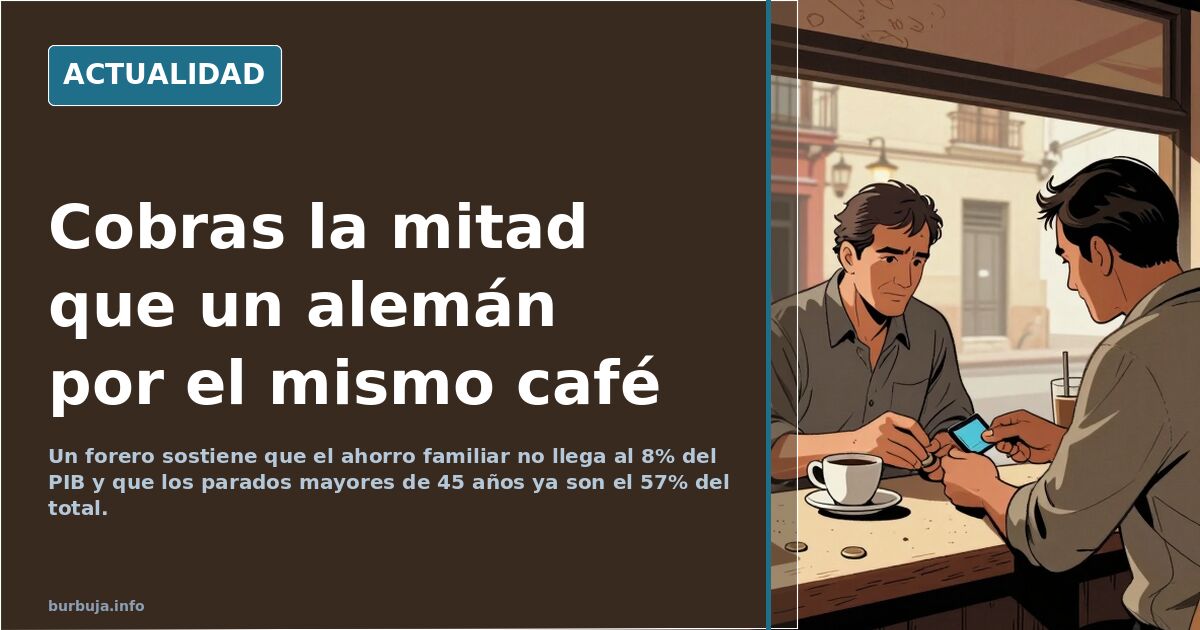
Why wages in Spain are so low: a diagnosis that doesn't add up
Why do you earn half as much as a German for the same job, pay the same price for coffee, yet are told Spain is a cheap country? The short answer is that it isn't. Purchasing power for basic goods has collapsed, and the narrative attributing wage moderation to tourist competitiveness no longer holds: a coffee or a hotel night already costs the same or more in Spain than in Germany, while average salaries remain far lower. According to one forum user, this results in household savings barely reaching 8% of GDP and a middle class living hand-to-mouth.
The competing diagnosis in the debate: lack of companies, not willingness
One of the most repeated arguments points to a productive structure problem: there is a shortage of companies. Low wages would be the consequence of scarce capital allocated to the workforce, worsened by levies, fees, regulations, and taxes. The Spanish business fabric is overwhelmingly composed of SMEs (small and medium-sized enterprises) and freelancers, limiting the capacity to pay high salaries. In parallel, it is argued that the country undervalues skilled workers: generic university degrees are prioritized over specialized CNC and CAD/CAM machinists, a profile highly valued in Germany.
The most repeated calculation on the other side concerns total labor costs. An employee earning 1,400 euros net costs the company significantly more, with the difference taken by the State via income tax (IRPF) and social security contributions. Hence the proposal, launched by employers' associations, to pay the gross amount directly to the worker so they see the real cost of their employment and deal with the tax authorities themselves. Unions and the Government opposed this, according to circulating accounts.
Why is there such structural unemployment in Spain?
Because there is little job supply for high demand. This is the most common explanation: with high unemployment, workers cannot choose, and companies push wages down to collective agreement minimums, or resort to contracts with fewer hours than worked or unpaid overtime. Lack of savings and capitalization, excess savings poured into real estate, regulatory complexity, and the scarcity of large companies fuel this structural unemployment. The result is that wage negotiations always happen from a position of weakness.
There is a data point that worsens the picture and often misses headlines: unemployed people over 45 exceed 57% of the total, the highest level in the series. That means the bulk of unemployment is neither youth-related nor cyclical: it consists of experienced people expelled from the market who are never rehired. This reserve army puts downward pressure on any salary.
Migration pressure on low wages
Part of the analysis claims that the massive influx of foreign workers has acted as wage dumping in low-skilled sectors, while simultaneously increasing public service spending. Another current rejects this reading, noting that newcomers are barred from public sector jobs and that there are positions the native population no longer fills. Disagreement is total, and one should not confuse social tension with a proven causal relationship.
What clearly emerges is the complaint about distribution: it is argued that any non-contributor has more right to receive public services than someone who has been paying for years, something that, according to this thesis, did not even happen in Soviet socialism. The discussion shifts to spending: it cannot be that more is spent on job creation than on healthcare or education.
The printer, the euro, and the 'cheap country' narrative
The monetary thesis has its own faction. Since 1971, with the end of the gold standard, money ceased to be a scarce good and began to be distributed based on proximity to the central bank's printing press. Those close to it protect themselves; those receiving a paycheck do not. Real wages are not the bills you receive, but the pasta, shoes, and shirts you buy with them. If you were paid in kind, your salary would hold; paid in depreciating currency, you buy less each month.
Added to this is the euro. Spain marketed itself for decades as a cheap country, accepting low wages in exchange for contained prices. After joining the single currency, prices converged with France and Germany, but wages did not. The tourism model, which requires remaining competitive on price, acts as a ceiling: the day a coffee here costs the same as in Munich, the bargain ends. Except that day has already arrived, and the salary hasn't.
With these elements, the most honest conclusion is that the problem does not have one cause, but five that reinforce each other. Meanwhile, the country continues debating whether the blame lies with employers, immigrants, or politicians. Convenient, especially for all three.
Why do you earn half as much as a German for the same job, pay the same price for coffee, yet are told Spain is a cheap country? The short answer is that it isn't. Purchasing power for basic goods has collapsed, and the narrative attributing wage moderation to tourist competitiveness no longer holds: a coffee or a hotel night already costs the same or more in Spain than in Germany, while average salaries remain far lower. According to one forum user, this results in household savings barely reaching 8% of GDP and a middle class living hand-to-mouth.
The competing diagnosis in the debate: lack of companies, not willingness
One of the most repeated arguments points to a productive structure problem: there is a shortage of companies. Low wages would be the consequence of scarce capital allocated to the workforce, worsened by levies, fees, regulations, and taxes. The Spanish business fabric is overwhelmingly composed of SMEs (small and medium-sized enterprises) and freelancers, limiting the capacity to pay high salaries. In parallel, it is argued that the country undervalues skilled workers: generic university degrees are prioritized over specialized CNC and CAD/CAM machinists, a profile highly valued in Germany.
The most repeated calculation on the other side concerns total labor costs. An employee earning 1,400 euros net costs the company significantly more, with the difference taken by the State via income tax (IRPF) and social security contributions. Hence the proposal, launched by employers' associations, to pay the gross amount directly to the worker so they see the real cost of their employment and deal with the tax authorities themselves. Unions and the Government opposed this, according to circulating accounts.
Why is there such structural unemployment in Spain?
Because there is little job supply for high demand. This is the most common explanation: with high unemployment, workers cannot choose, and companies push wages down to collective agreement minimums, or resort to contracts with fewer hours than worked or unpaid overtime. Lack of savings and capitalization, excess savings poured into real estate, regulatory complexity, and the scarcity of large companies fuel this structural unemployment. The result is that wage negotiations always happen from a position of weakness.
There is a data point that worsens the picture and often misses headlines: unemployed people over 45 exceed 57% of the total, the highest level in the series. That means the bulk of unemployment is neither youth-related nor cyclical: it consists of experienced people expelled from the market who are never rehired. This reserve army puts downward pressure on any salary.
Migration pressure on low wages
Part of the analysis claims that the massive influx of foreign workers has acted as wage dumping in low-skilled sectors, while simultaneously increasing public service spending. Another current rejects this reading, noting that newcomers are barred from public sector jobs and that there are positions the native population no longer fills. Disagreement is total, and one should not confuse social tension with a proven causal relationship.
What clearly emerges is the complaint about distribution: it is argued that any non-contributor has more right to receive public services than someone who has been paying for years, something that, according to this thesis, did not even happen in Soviet socialism. The discussion shifts to spending: it cannot be that more is spent on job creation than on healthcare or education.
The printer, the euro, and the 'cheap country' narrative
The monetary thesis has its own faction. Since 1971, with the end of the gold standard, money ceased to be a scarce good and began to be distributed based on proximity to the central bank's printing press. Those close to it protect themselves; those receiving a paycheck do not. Real wages are not the bills you receive, but the pasta, shoes, and shirts you buy with them. If you were paid in kind, your salary would hold; paid in depreciating currency, you buy less each month.
Added to this is the euro. Spain marketed itself for decades as a cheap country, accepting low wages in exchange for contained prices. After joining the single currency, prices converged with France and Germany, but wages did not. The tourism model, which requires remaining competitive on price, acts as a ceiling: the day a coffee here costs the same as in Munich, the bargain ends. Except that day has already arrived, and the salary hasn't.
With these elements, the most honest conclusion is that the problem does not have one cause, but five that reinforce each other. Meanwhile, the country continues debating whether the blame lies with employers, immigrants, or politicians. Convenient, especially for all three.
Summary of a discussion on Burbuja.info - Foro de economía, actualidad y política., translated from Spanish and reviewed before publication. Read the full discussion (144 replies).
More summaries
-
Why Spain Pays Bar Staff Wages While Europe Holidays
Spain relies on tourism but pays wages that don't allow for travel. Productivity, housing, and myths about the peseta or oil are examined.
-
Moving to France: minimum wage and housing at 800 euros
France's net minimum wage is around €1,250, not the €2,000 some claim; cheap housing in the Jura, but taxes and debt raise red flags.
-
Half of Spain's renters are now foreigners, forum claims
A forum post claims 5 million foreigners rent in Spain, while tourism accounts for only 10% of the market, sparking debate on housing shortages.
-
Rumors Suggest Spanish PM Sánchez May Step Aside
Online rumors claim Pedro Sánchez is considering not running, with PSOE looking at Bolaños, Cuerpo or García-Page as potential successors.
-
Woman dies falling from Lugo Wall while teens mock her
A woman died falling from the Lugo Wall in Spain as teenagers filmed and laughed. Analysis of legal liability and physical rescue feasibility.
-
Ayuso: Madrid celebrates Hispanic Day with US as guest
Madrid's leader Isabel Díaz Ayuso marks Hispanic Day in Spain, highlighting the US as guest nation and asserting a shared cultural power.