
Spain's Loneliness Economy Outpaces Real Estate
Living alone in Spain drives up costs and boosts spending on pets, therapy, and solo leisure. The loneliness market now generates billions.
English · Original discussion in Spanish · Published
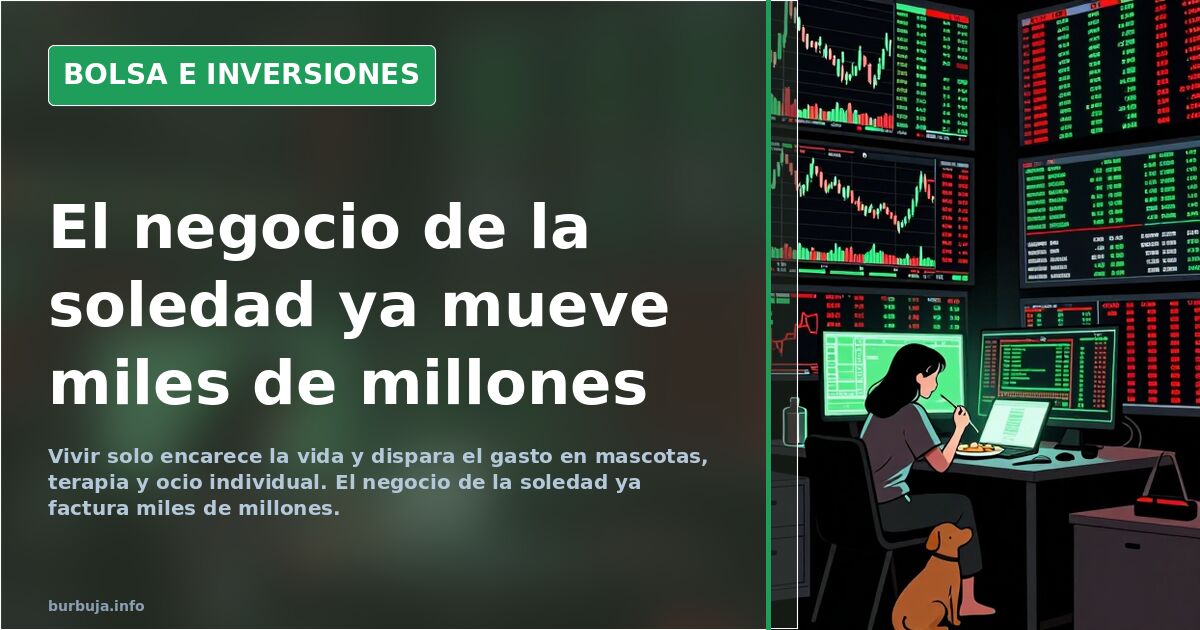
Loneliness Now Moves More Money Than Bricks
The business of loneliness is not a prophecy: it is an invoice already being paid. While housing prices and the cost of raising children push part of the population out of partnered life, an entire market—pets, psychologists, content platforms, individual leisure—has been built on that absence. The question running through investment forums is not whether the phenomenon is real, but who will monetize it and at what margin.
Some argue that the big business is not loneliness itself, but the emotional management of loneliness: dating apps, therapies, companionship subscriptions, assistance robots. Counter to this is the argument that unwanted loneliness is primarily a public health problem and a social cost, not a clean investment opportunity. The line separating business from problem is exactly where analysis stalls.
The Real Cost of Living Alone
The first data point ordering the debate is economic: living alone is more expensive than living with company. Those without a partner bear rent, utilities, food, and leisure costs alone, without sharing the burden. This reduces savings capacity and, by extension, the ability to buy a home or start a family. The consequence is not just sentimental: it is a loss of economic efficiency pushing more people to rely on the State or extended family.
The second data point is market-driven: companies have already detected this pocket. Spending on pets, psychological treatments, content subscriptions, and individual experiences grows as the number of single-person households increases. It is no coincidence that leisure, mental health, and consumer technology sectors are reorienting their offerings toward clients who live alone and want to feel accompanied without commitment.
Why Has Loneliness Become a Business?
Because loneliness has ceased to be a stage and has become a permanent state for a growing part of the adult population. When stable partnership becomes harder to sustain—due to cost, expectations, or simple wear—the market fills the gap. And it does so with products that do not require reciprocity: a pet does not argue, a subscription does not disappoint, a digital assistant does not get tired.
The debate over whether this is good or bad is secondary for the investor. What matters is that there is structural demand and supply covering it. The discussion on surrogacy, egg donation, or assisted reproduction falls into the same logic: services allowing parenthood without a partner, with clear economic costs and an expanding market. Ethical objections exist but have not stopped revenue generation.
The State as Partner Substitute
Part of the analysis argues that the true provider of loneliness is the State: pensions, aid, healthcare, and social services cover what family once did. This safety net allows living alone without falling into misery but also disincentivizes forming traditional households. The result is a fragile balance: more people alone, more public spending, and more pressure on accounts.
The objection is evident: the State does not provide company, only coverage. And coverage does not eliminate unwanted loneliness, which remains a leading cause of psychological suffering. That is where private businesses enter: psychologists, companionship platforms, digital communities. The market does not solve the problem; it monetizes it.
Technology as Emotional Substitute
Artificial intelligence appears in the debate as the next leap. Assistants capable of maintaining conversation, remembering preferences, and simulating empathy are around the corner. For those living alone who cannot find a partner, this may be a practical solution; for the market, it is a business line with high margins and low marginal costs. The question is not if it will arrive, but how long normalization will take.
Skepticism also has its place: AI does not replace a person if you know it is AI. The illusion works only while unbroken. This limits the business to those accepting simulation as sufficient, a segment that can be huge or residual depending on whom you ask. The data is not settled.
With these elements, loneliness is not a trend: it is a demographic and economic structure. The business exists, grows, and diversifies. What is unclear is whether the society sustaining it can afford it long-term. There, analysis runs out of answers.
The business of loneliness is not a prophecy: it is an invoice already being paid. While housing prices and the cost of raising children push part of the population out of partnered life, an entire market—pets, psychologists, content platforms, individual leisure—has been built on that absence. The question running through investment forums is not whether the phenomenon is real, but who will monetize it and at what margin.
Some argue that the big business is not loneliness itself, but the emotional management of loneliness: dating apps, therapies, companionship subscriptions, assistance robots. Counter to this is the argument that unwanted loneliness is primarily a public health problem and a social cost, not a clean investment opportunity. The line separating business from problem is exactly where analysis stalls.
The Real Cost of Living Alone
The first data point ordering the debate is economic: living alone is more expensive than living with company. Those without a partner bear rent, utilities, food, and leisure costs alone, without sharing the burden. This reduces savings capacity and, by extension, the ability to buy a home or start a family. The consequence is not just sentimental: it is a loss of economic efficiency pushing more people to rely on the State or extended family.
The second data point is market-driven: companies have already detected this pocket. Spending on pets, psychological treatments, content subscriptions, and individual experiences grows as the number of single-person households increases. It is no coincidence that leisure, mental health, and consumer technology sectors are reorienting their offerings toward clients who live alone and want to feel accompanied without commitment.
Why Has Loneliness Become a Business?
Because loneliness has ceased to be a stage and has become a permanent state for a growing part of the adult population. When stable partnership becomes harder to sustain—due to cost, expectations, or simple wear—the market fills the gap. And it does so with products that do not require reciprocity: a pet does not argue, a subscription does not disappoint, a digital assistant does not get tired.
The debate over whether this is good or bad is secondary for the investor. What matters is that there is structural demand and supply covering it. The discussion on surrogacy, egg donation, or assisted reproduction falls into the same logic: services allowing parenthood without a partner, with clear economic costs and an expanding market. Ethical objections exist but have not stopped revenue generation.
The State as Partner Substitute
Part of the analysis argues that the true provider of loneliness is the State: pensions, aid, healthcare, and social services cover what family once did. This safety net allows living alone without falling into misery but also disincentivizes forming traditional households. The result is a fragile balance: more people alone, more public spending, and more pressure on accounts.
The objection is evident: the State does not provide company, only coverage. And coverage does not eliminate unwanted loneliness, which remains a leading cause of psychological suffering. That is where private businesses enter: psychologists, companionship platforms, digital communities. The market does not solve the problem; it monetizes it.
Technology as Emotional Substitute
Artificial intelligence appears in the debate as the next leap. Assistants capable of maintaining conversation, remembering preferences, and simulating empathy are around the corner. For those living alone who cannot find a partner, this may be a practical solution; for the market, it is a business line with high margins and low marginal costs. The question is not if it will arrive, but how long normalization will take.
Skepticism also has its place: AI does not replace a person if you know it is AI. The illusion works only while unbroken. This limits the business to those accepting simulation as sufficient, a segment that can be huge or residual depending on whom you ask. The data is not settled.
With these elements, loneliness is not a trend: it is a demographic and economic structure. The business exists, grows, and diversifies. What is unclear is whether the society sustaining it can afford it long-term. There, analysis runs out of answers.
Also available in: Deutsch
Summary of a discussion on Burbuja.info - Foro de economía, actualidad y política., translated from Spanish and reviewed before publication. Read the full discussion (111 replies).
More summaries
-
Ibex Falls in May 2013 as Shorts Take Charge
The Ibex closed May 2013 around 8,200 after key S&P support levels broke. Short sellers celebrated as the market turned.
-
Stock Analysis 2021-2026: The Target Price That Never Arrives
Six years of stock analysis without a single price figure: from Microsoft and Inditex to Pernod Ricard, with quarterly results and criticism for errors.
-
Hotel101 sells rooms in Valdebebas for €208,800
Hotel101 sells rooms in Valdebebas for €208,800 plus VAT with monthly income distribution and doubts about what happens if the operator goes bankrupt
-
Precious metals forum devolves into bans and accusations
A thread on gold and silver investment turns into mass blocking and mutual accusations among users, with no verified evidence.
-
S&P 500 Golden Cross Signals Buy with 78% Historical Success
The S&P 500 golden cross above 4,100 points has a 78% success rate since 1950, averaging 13% returns.
-
Intel shares hit 11-year low after 27% plunge
Intel stock fell 27%, hitting an 11-year low with a P/E of 8 vs AMD's 35. Markets split between bottom-fishers and knife-catchers.