
Spain’s Interior Ministry strips ex-ministers Iglesias, Montero, Belarra, and Garzón of police escorts
Spain’s Interior Ministry withdraws police protection from four former Unidas Podemos ministers, sparking accusations of political violence from Irene Montero.
English · Original discussion in Spanish · Published
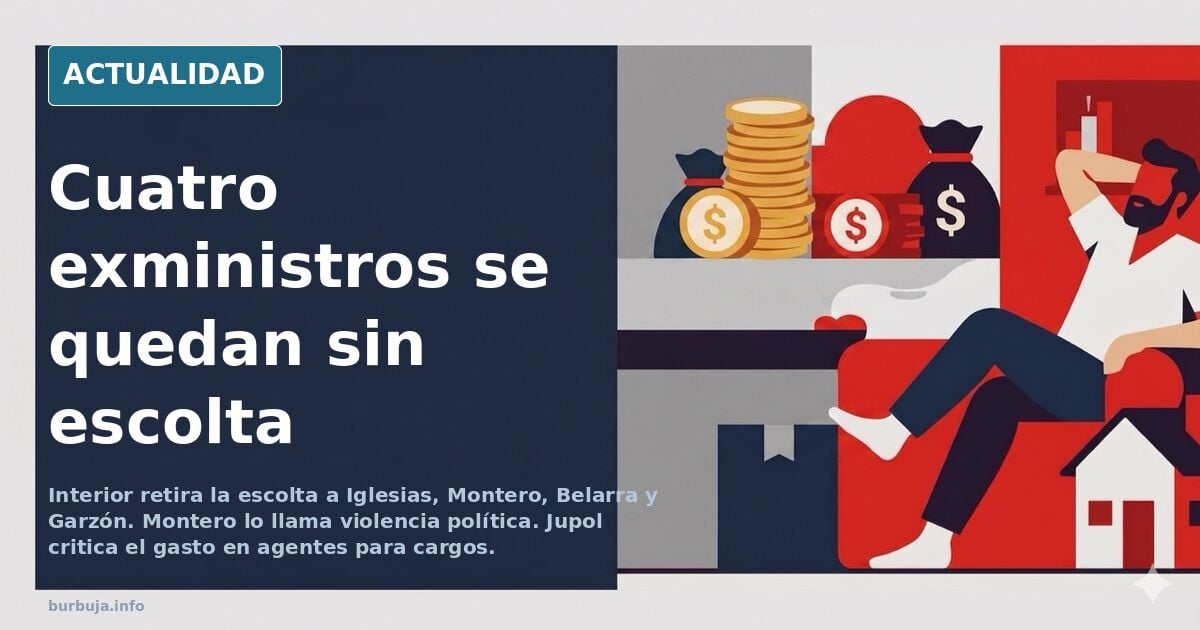
Spain’s Interior Ministry strips police protection from four former Unidas Podemos ministers
The Ministry has revoked state security details for four former coalition government officials: Pablo Iglesias, Irene Montero, Ione Belarra, and Alberto Garzón. All four held ministerial portfolios between 2020 and 2023 and were assigned escorts based on their institutional responsibilities. The decision shifts what is technically an administrative security matter into the realm of political conflict, highlighted by the fact that all four belong to the Unidas Podemos political space.
The public response has been mixed. Iglesias frames the move as political persecution, while Montero demands explanations, characterizing it as sustained political violence against feminist women in public life, citing threats she receives. Belarra labels the measure as political violence, whereas Garzón maintains a low profile, reserving criticism for private channels. A common, rarely voiced concern is the conviction that security guarantees no longer apply equally regardless of a recipient’s political trajectory.
What does it cost to maintain escorts for former public officials?
The largest National Police union, Jupol, provided figures for the debate, criticizing the allocation of agents to political figures while a single officer handles more than one hundred victims of gender-based violence with active protection orders. This data is significant: it involves finite human resources assigned according to criteria the Marlaska department has shielded by invoking the Official Secrets Act.
The underlying question is whether a former minister retains lifelong state protection or if it expires when their term ends. The debate notes that the law reserves lifelong escorts for former prime ministers and former interior ministers, without detailing internal protocols for others. The problem lies here: when criteria are not explained, any decision appears arbitrary.
The Montero case: MEP with her own security budget
Irene Montero is a Member of the European Parliament, a detail that changes the calculation. As a parliamentarian in Brussels, she has her own budget to cover her security, as noted in the debate. She ceased to be Minister of Equality in November 2023. Nearly three years later, the question remains why Spain’s Interior Ministry continued paying for escorts for someone no longer holding an executive position.
Some argue the measure is late, while others see it as a political decision disguised as administrative austerity. Montero has warned she will not retreat from public space despite threats. Her demand for explanations arrives amid tension over the criteria Interior uses to decide which former high-ranking officials retain escorts and which lose them.
The uncomfortable comparison: former prime ministers and interior ministers
The debate cited that the law reserves lifelong escorts for former prime ministers and former interior ministers. Outside this, protection is discretionary. In 2009, José María Aznar and Felipe González together had 51 assigned agents, according to published data. The current number for the four living former presidents is not detailed, but the contrast with the four former Unidas Podemos ministers is evident.
Zapatero, it was noted, retains his acompañante. Iglesias, Montero, Belarra, and Garzón do not. This asymmetry fuels suspicion that the criteria are not merely administrative. When security becomes political currency, everyone loses: those left without protection and those suspecting the decision stems from other motives.
The core debate: who pays for whose security?
The withdrawal of escorts has peine a broader discussion on who is entitled to taxpayer-funded security. Jupol raised the issue bluntly: agents dedicated to political figures while there are insufficient staff for victims of gender-based violence. The argument has merit. It also has a counterargument: if a former minister suffers an assassination attempt, the political and human cost is incalculable.
The issue is not binary. It is not about choosing between protecting Montero or a victim of gender-based violence. It is about allocating resources with transparent criteria. And explaining why some do and others do not. Interior does not do this, invoking official secrets. The vacuum is filled by politics.
What the numbers say and what they don’t
Concrete data is scarce. We know four former high-ranking officials are affected. We know Montero has a European security budget. We know that in 2009, Aznar and González totaled 51 escorts. We know one officer handles more than one hundred victims with protection orders. This builds the narrative, but it is insufficient to evaluate the decision.
What is missing is the criteria. How many agents Interior frees up with this measure. How much each acompañante costs. What risk assessment backs the withdrawal. Without this data, any conclusion is merely an opinion disguised as analysis.
Interior’s decision leaves four former ministers without escorts and an unanswered question: whether security is a right or a privilege granted and withdrawn depending on who governs. Montero will retain European protection. The other three will not. And while the criteria remain classified, the suspicion that politics outweighs risk remains justified.
The Ministry has revoked state security details for four former coalition government officials: Pablo Iglesias, Irene Montero, Ione Belarra, and Alberto Garzón. All four held ministerial portfolios between 2020 and 2023 and were assigned escorts based on their institutional responsibilities. The decision shifts what is technically an administrative security matter into the realm of political conflict, highlighted by the fact that all four belong to the Unidas Podemos political space.
The public response has been mixed. Iglesias frames the move as political persecution, while Montero demands explanations, characterizing it as sustained political violence against feminist women in public life, citing threats she receives. Belarra labels the measure as political violence, whereas Garzón maintains a low profile, reserving criticism for private channels. A common, rarely voiced concern is the conviction that security guarantees no longer apply equally regardless of a recipient’s political trajectory.
What does it cost to maintain escorts for former public officials?
The largest National Police union, Jupol, provided figures for the debate, criticizing the allocation of agents to political figures while a single officer handles more than one hundred victims of gender-based violence with active protection orders. This data is significant: it involves finite human resources assigned according to criteria the Marlaska department has shielded by invoking the Official Secrets Act.
The underlying question is whether a former minister retains lifelong state protection or if it expires when their term ends. The debate notes that the law reserves lifelong escorts for former prime ministers and former interior ministers, without detailing internal protocols for others. The problem lies here: when criteria are not explained, any decision appears arbitrary.
The Montero case: MEP with her own security budget
Irene Montero is a Member of the European Parliament, a detail that changes the calculation. As a parliamentarian in Brussels, she has her own budget to cover her security, as noted in the debate. She ceased to be Minister of Equality in November 2023. Nearly three years later, the question remains why Spain’s Interior Ministry continued paying for escorts for someone no longer holding an executive position.
Some argue the measure is late, while others see it as a political decision disguised as administrative austerity. Montero has warned she will not retreat from public space despite threats. Her demand for explanations arrives amid tension over the criteria Interior uses to decide which former high-ranking officials retain escorts and which lose them.
The uncomfortable comparison: former prime ministers and interior ministers
The debate cited that the law reserves lifelong escorts for former prime ministers and former interior ministers. Outside this, protection is discretionary. In 2009, José María Aznar and Felipe González together had 51 assigned agents, according to published data. The current number for the four living former presidents is not detailed, but the contrast with the four former Unidas Podemos ministers is evident.
Zapatero, it was noted, retains his acompañante. Iglesias, Montero, Belarra, and Garzón do not. This asymmetry fuels suspicion that the criteria are not merely administrative. When security becomes political currency, everyone loses: those left without protection and those suspecting the decision stems from other motives.
The core debate: who pays for whose security?
The withdrawal of escorts has peine a broader discussion on who is entitled to taxpayer-funded security. Jupol raised the issue bluntly: agents dedicated to political figures while there are insufficient staff for victims of gender-based violence. The argument has merit. It also has a counterargument: if a former minister suffers an assassination attempt, the political and human cost is incalculable.
The issue is not binary. It is not about choosing between protecting Montero or a victim of gender-based violence. It is about allocating resources with transparent criteria. And explaining why some do and others do not. Interior does not do this, invoking official secrets. The vacuum is filled by politics.
What the numbers say and what they don’t
Concrete data is scarce. We know four former high-ranking officials are affected. We know Montero has a European security budget. We know that in 2009, Aznar and González totaled 51 escorts. We know one officer handles more than one hundred victims with protection orders. This builds the narrative, but it is insufficient to evaluate the decision.
What is missing is the criteria. How many agents Interior frees up with this measure. How much each acompañante costs. What risk assessment backs the withdrawal. Without this data, any conclusion is merely an opinion disguised as analysis.
Interior’s decision leaves four former ministers without escorts and an unanswered question: whether security is a right or a privilege granted and withdrawn depending on who governs. Montero will retain European protection. The other three will not. And while the criteria remain classified, the suspicion that politics outweighs risk remains justified.
Summary of a discussion on Burbuja.info - Foro de economía, actualidad y política., translated from Spanish and reviewed before publication. Read the full discussion (76 replies).
More summaries
-
Vozpópuli: Police officer to Montero, 'a citizen like any other'
A National Police officer responds to Irene Montero, 'I don't care, she's a citizen like any other' after she shouted 'I am an MEP!'
-
Christians Lawyers Sue Doctor Who Processed Noelia's Euthanasia
Christians Lawyers sue the physician who processed Noelia’s euthanasia for conflict of interests. The Prosecutor's Office seeks to dismiss the case.
-
Street prayers in Japan fuel migration debate
A video of street prayers in Japan is shared as a pork boycott. The prayer direction and location do not match the claim.
-
Spanish User Quits Online Debate Over 'Hate Speech' Prosecution Fears
A Spanish forum user claims he is leaving public debate due to fear of the 'hate speech' unit, highlighting a climate of self-censorship on social media.
-
Banning Social Media for Minors: Why Age Verification Fails
Banning social media for minors requires verifying each user’s age, but the internet identifies connections, not people: an IP address has no ID number.
-
Debate on Using the Center Lane on Highways
A forum discusses whether driving in the center lane without overtaking is bad practice or a defensive strategy against merges and trucks.