
Spain's Interior Ministry proposes MiDNI voting amid JEC approval claims
Interior introduces MiDNI QR codes for polling stations; reports claim the Central Electoral Board lifted a suspension and spent €7 million on readers.
English · Original discussion in Spanish · Published
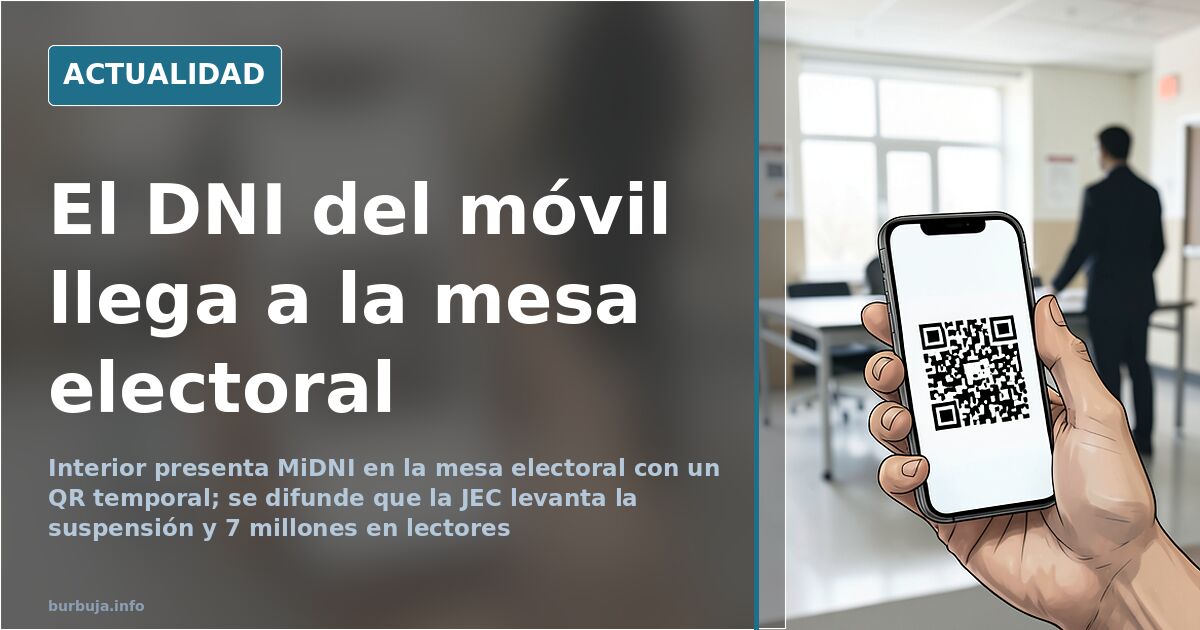
Mobile ID arrives at polling stations: QR codes, €7 million, and suspicions
A temporary QR code on a smartphone to verify identity at the ballot box. This is what the Ministry of the Interior presents as a natural extension of MiDNI (the Spanish digital ID app): if the digital DNI has the same legal validity as the physical one, it can also be used in elections. The spark for the controversy was another element: the Junta Electoral Central (Central Electoral Board) reportedly lifted the suspension on using MiDNI for voting, according to a message attributing the decision to Iustitia Europa ahead of the November 29 vote.
What Interior says about the MiDNI QR code
The official approach is simple to state but complex to execute. Users generate a temporary QR code that allows secure data verification and identity confirmation. It trinc the same logic as the physical DNI, but on screen. The lingering question is not whether the code identifies the user, but who reads it and with what device at each polling station.
Here lies the first practical gap: Will a mobile phone or reader be provided to all polling stations? Without a terminal, the QR code is just an image. With a terminal, verification depends on connectivity and software that no one has detailed in this discussion.
The JEC, Iustitia Europa, and €7 million in QR readers
The twist that centered the controversy is the decision by the Central Electoral Board. According to circulating messages, the JEC responded to Iustitia Europa by lifting the suspension, noting that the Government had already committed more than €7 million in QR readers while the suspension was still in effect. The order of events tells the whole story: spending first, authorization second.
The suspicion arising from this timeline is electoral fraud. To be precise: there is no proof of fraud in the material, only the temporal coincidence between a multimillion-euro investment and a subsequent authorization. Those looking for intent will see intent; those looking for administrative clumsiness will see that too.
Reader failure as the perfect alibi
The most worrying scenario is not the voter with a legitimate QR code, but errors attributed to the machine. If someone detects that people from another municipality voted in a specific precinct, it is always possible to blame a reader malfunction. The traceability of physical voting—the ballot paper, the envelope, the census—is replaced by faith in a device.
This adds to doubts about biometric verification: does the holder's photo appear in the app? Is it checked that the person presenting the code is who they claim to be? Without a photo and cross-checking, the QR code verifies a number, not a person.
Other fronts: 'Grandchildren Law' and public funds
The conversation does not stop at QR codes. It intersects with other information: the relocation to Spain of individuals naturalized under the Ley de Nietos (Grandchildren Law), funded with public money, according to a report by Vozpópuli. The chain of reasoning is direct: new voters, same calendar, same elections. And a non-trivial question: Where was this in any electoral manifesto?
The core issue is institutional design. Digitizing identification at the polling station is not neutral: it changes who controls the process, what can be audited, and what can be challenged. A temporary QR code expires; a recount does not.
The uncomfortable question remains: if the system fails on November 29, who is responsible—the reader, the Ministry, or the polling board?
Also available in: Deutsch
Summary of a discussion on Burbuja.info - Foro de economía, actualidad y política., translated from Spanish and reviewed before publication. Read the full discussion (22 replies).
More summaries
-
HODIO: Spain's Interior Ministry plan to monitor social media
HODIO, the Spanish Interior Ministry's tool for monitoring online hate, draws criticism: censorship, subsidies and precedents in Venezuela and Argentina.
-
Spain's Interior Ministry blocks Under-20 match in Ceuta over security
Spain's Interior Ministry has asked the Football Federation not to hold the Under-20 team's match in Ceuta, saying it cannot guarantee security, according to accounts of the case.
-
Spain's Transport Ministry spent €70,000 cataloguing Óscar Puente's nicknames
Spain's Transport Ministry paid nearly €70,000 to catalogue the nicknames Óscar Puente receives on X. The spending reopens the debate over priorities and public money.
-
Small Plane Crashes in Venezuela, Carrying Witnesses to the Zapatero Case
The small plane that crashed in Venezuela carried two witnesses to the Zapatero case. Both survived with injuries, which weakens the theory of an assassination attempt.
-
Chinese business-politics wisdom doesn't apply in West
Viral claim cites Chinese wisdom to separate business and politics. We explain why this fails in Western systems.
-
China and US sentences reveal Western media double standard
Joshua Wong sentenced to 10 years in China; David Rivera got 10 years in the US. Unequal media coverage fuels criticism of Western narratives.