
Spain's IMV to rise 14% in 2027 to €836 monthly
Spain's Minimum Vital Income (IMV) will increase by 14% in 2027, raising the single adult allowance from €733.60 to approximately €836 per month.
English · Original discussion in Spanish · Published
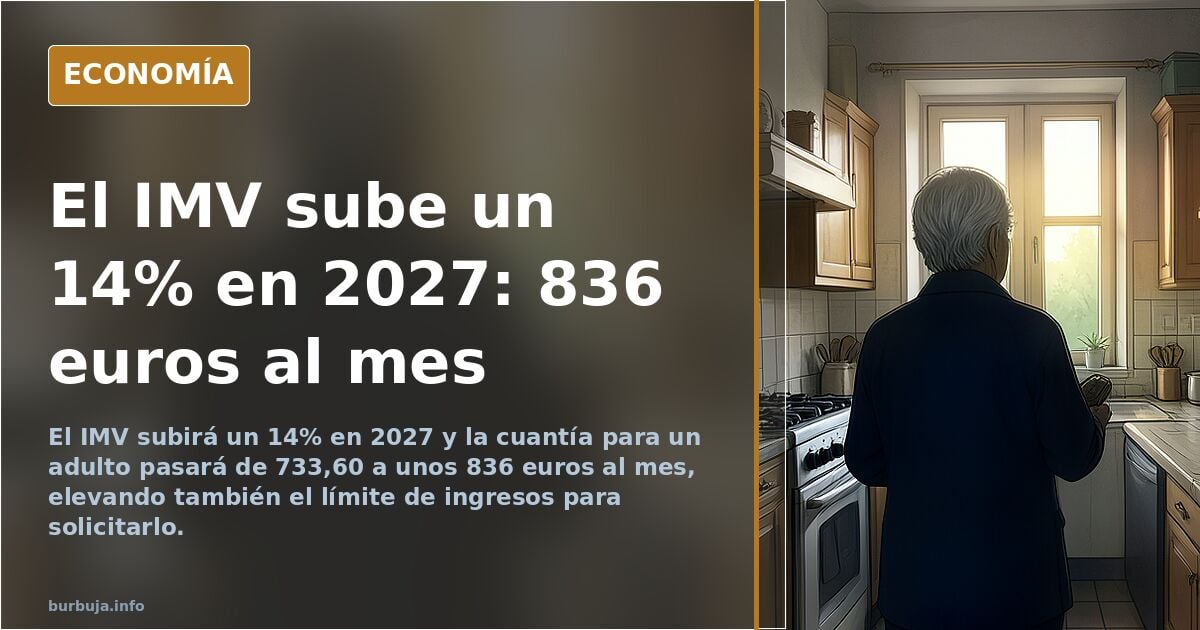
Spain's IMV set to rise 14% in 2027, reaching nearly €836 a month
A single adult receiving Spain's Minimum Vital Income (Ingreso Mínimo Vital or IMV) currently gets €733.60 per month. In 2027, if the legal link between this benefit and non-contributory pensions holds, that figure will approach €836. This represents an increase of about one hundred euros. While a 14% rise sounds like a rescue on paper, in practice it remains a modest boost for those struggling with the aid.
The mechanism is straightforward: the law mandates that non-contributory pensions reach 75% of the poverty threshold, and the IMV is tied to them. Hence the percentage. The amount for a single adult will only move from €733.60 to around €836 per month, and the income limit to apply for the aid will rise accordingly. This means more people can qualify, and existing recipients will receive slightly more. It is neither a revolution nor a miracle.
How much does the Minimum Vital Income rise in 2027?
The increase is around 14%, based on the legal linkage of the benefit to non-contributory pensions. For a single adult, the jump goes from €733.60 to approximately €836 monthly. The income threshold for applying rises in the same proportion, expanding the pool of potential beneficiaries. The exact figure depends on how the 75% of the poverty threshold mandated by law for non-contributory pensions is implemented.
The news itself allows for two interpretations. First: the aid is updated and maintains its purchasing power relative to the legal reference. Second: one hundred euros a month does not change anyone's life, especially when the baseline discussed remains below the very threshold the law aims to combat.
The uncomfortable comparison: IMV versus pension
The most circulated figure in public discourse is the comparison with pensions. With the rise, the IMV for a single adult approaches what a retiree receives as a minimum pension. The irony lies in the contrast: some see this convergence as a sign that the system rewards inactivity and penalizes contributions. The argument has merit but needs context: the IMV is a welfare benefit for those without income, not deferred salary like a contributory pension.
Even so, the picture is unsettling. A country raising non-contributory aid while contributory pensions depend on years worked sends an ambiguous message about effort. That message, more than the figure itself, fuels discontent.
Who pays for the increase and how are criteria applied?
The million-dollar question is not how much it rises, but where the money comes from. Financing the IMV depends on the General State Budgets, involving deficit, public debt, and potentially European funds. There is no magic line item. Every additional euro of the benefit is a euro diverted from elsewhere or added to liabilities.
The second front concerns criteria. The aid targets those proving income below the threshold, but verifying this condition is a recognized weakness among both supporters and critics. Expanding the income limit for application adds legitimate beneficiaries and complicates control. Debates over fraud loom over any welfare benefit, and this is no exception.
The underlying debate: assistance versus contribution
In the background lies a discussion older than the benefit itself: whether aid should be universal or conditioned on a contribution history. Some argue the IMV should function as indefinite unemployment, reserved for those who have contributed a minimum number of years to Social Security, which would reduce the scope and, according to this thesis, fraud. Opposing this is the argument that poverty knows nothing of contributions and demanding work history excludes precisely those who need it most.
Neither position is cost-free. The first prioritizes contribution; the second, need. The problem is that the current system mixes both logics without resolving either, and the 14% rise does not clarify the direction: it merely updates the amount.
Ultimately, the disorienting figure is not the 14%, but the €836. With this floor, the IMV remains below the average rent in much of the country. The increase is real. The solution is not.
Also available in: Deutsch
Summary of a discussion on Burbuja.info - Foro de economía, actualidad y política., translated from Spanish and reviewed before publication. Read the full discussion (15 replies).
More summaries
-
Spain's minimum income benefit to rise 14% in 2027, tied to non-contributory pensions
Spain's IMV minimum income will rise almost 14% in 2027 due to its legal link to non-contributory pensions: from 733.60 to 836 euros per month for a single person.
-
Spain's Social Security demands €39,000 from IMV recipient
A woman received the Minimum Vital Income for four years despite ineligibility. Spain's Social Security now demands retroactive repayment of €39,000.
-
Forum Cites Social Security Data: Girona Leads at 41.2%
Forum cites August 2026 Social Security data: Girona, 41.2%; Teruel, 40.4%; Basque Country, 28.8%.
-
The Elite Education of Tenant Spokespeople Sparks Controversy
Controversy erupts as the elite international education backgrounds of prominent tenant movement spokespeople are revealed, challenging their narrative of precarity.
-
Moncloa and the Narrative: False Flag Theory Circulates Online
Forum debate ranges from alleged election fraud to false flag attacks, highlighting deep distrust of Moncloa's official narrative.
-
Trump warns Europe: close borders or face extinction
On October 19, 2026, Trump warned that Europe must close its borders and expel threats to its identity or risk disappearing.