
Spain's Immigration Dilemma: Balancing Pensions and Wages
Spain faces a demographic crisis with a median age over 44. Immigration sustains pensions but pressures wages, housing, and public services.
English · Original discussion in Spanish · Published
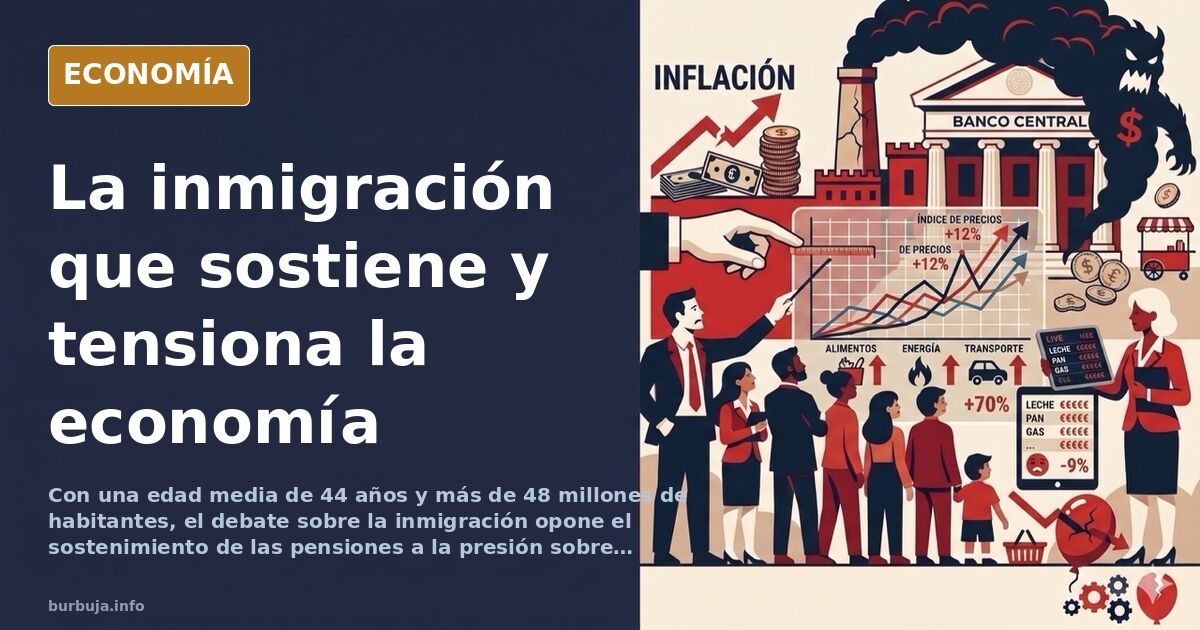
Aging population highlights Spain's economic immigration dilemma
Can Spain afford to forgo immigration without its economy collapsing? This question has circulated quietly for years but is now open: with a population median age above 44 and negative natural growth, the country faces a demographic problem no natality policy has solved. Immigration appears as the piece that sustains—or disrupts—everything else. Depending on the variable measured, the result changes completely.
Is immigration essential to sustain pensions?
Yes, according to the view defending young population entry: without new contributors, the public pension system is depleted as larger cohorts retire than enter the labor market. The argument relies on a simple fact: Spain now exceeds 48 million inhabitants, and this growth is largely due to foreign residents. Without them, the country would shrink alongside its aging.
The objection has merit. Some argue that linking pension sustainability to permanent migration is a pyramid scheme: if each generation needs more entrants than the previous, the model only delays the problem. The alternative calculation involves boosting native natality and reforming the system, though these paths yield slow, partial results.
Impact on wages and employment
The most debated front is labor. Some analysis argues that abundant labor supply pushes down wages in labor-intensive sectors—construction, hospitality, agriculture, care—and forces local workers to compete in worse conditions. The idea of labor dumping reappears: more workers, same jobs, prices adjusting downward.
Against this weighs a hard-to-rebut argument. Three decades ago, without current migration flows, crops were harvested, buildings erected, and bars served tables. Workers willing to do so existed. This suggests the problem is not just labor supply, but the structure of sectors dependent on low labor costs for profitability. Detailed sector-by-sector calculations paint a more uncomfortable picture than the easy headline suggests.
Housing and public services under pressure
The second major focus is public spending and housing. It is argued that rapid population growth strains services like healthcare and pushes up rental prices, especially where supply does not grow at the same pace. Multiple families sharing an apartment where one lived before is a recurring image in the hardest residential market segments.
The nuance matters: this pressure depends not on who arrives, but on how many arrive and the country's capacity to absorb them. The lack of affordable housing and long healthcare waiting lists have causes predating any migration wave, but increased demand makes them much more visible.
The Japanese model: aging without opening borders
Opposed to the immigration path is the example of Japan, a country aging at accelerated rates with very restrictive migration policies. Its supporters cite it as proof that population decline does not necessarily lead to collapse, but to a readjustment: when circumstances improve, population can grow again.
Critics respond that this readjustment has costs: lower potential growth, more pressure on services in already depopulated areas, and increasing fiscal burden on a narrowing base. There is no free solution, only different ways to distribute the cost.
Security and coexistence: what data says and what it doesn't
The third axis is security. References are made to gangs, mostly linked to score-settling between groups and centered on nightlife venues. It is important not to generalize: known incidents affect internal disputes between groups, not the general population, and the link between nationality and crime is not supported by aggregate data.
Where a real phenomenon exists is in perception. A rapid population increase in specific neighborhoods alters daily coexistence and fuels rejection, even if crime figures do not match that sense to the same extent. And rejection, once installed, is rarely measured with a ruler.
The narrative that anticipated the data
Many participants in these discussions argue that the warning came years in advance, and that half of Spain was slow to see it because it lived with its back to the problem. South American immigration entered through Barajas during Aznar's governments and accelerated afterward. The repeated fact is striking: one in three children born in Spain is the child of foreigners.
This is the real terrain of the debate: not whether they arrive, but how long it will take the rest of the country to notice what reception areas already notice.
With these figures, a reasonable conclusion would be a state pact on population. What exists, instead, is a discussion that each generation believes it discovers for the first time. And that, if the demographic calculation does not fail, the next generation will inherit without anyone having left instructions.
Can Spain afford to forgo immigration without its economy collapsing? This question has circulated quietly for years but is now open: with a population median age above 44 and negative natural growth, the country faces a demographic problem no natality policy has solved. Immigration appears as the piece that sustains—or disrupts—everything else. Depending on the variable measured, the result changes completely.
Is immigration essential to sustain pensions?
Yes, according to the view defending young population entry: without new contributors, the public pension system is depleted as larger cohorts retire than enter the labor market. The argument relies on a simple fact: Spain now exceeds 48 million inhabitants, and this growth is largely due to foreign residents. Without them, the country would shrink alongside its aging.
The objection has merit. Some argue that linking pension sustainability to permanent migration is a pyramid scheme: if each generation needs more entrants than the previous, the model only delays the problem. The alternative calculation involves boosting native natality and reforming the system, though these paths yield slow, partial results.
Impact on wages and employment
The most debated front is labor. Some analysis argues that abundant labor supply pushes down wages in labor-intensive sectors—construction, hospitality, agriculture, care—and forces local workers to compete in worse conditions. The idea of labor dumping reappears: more workers, same jobs, prices adjusting downward.
Against this weighs a hard-to-rebut argument. Three decades ago, without current migration flows, crops were harvested, buildings erected, and bars served tables. Workers willing to do so existed. This suggests the problem is not just labor supply, but the structure of sectors dependent on low labor costs for profitability. Detailed sector-by-sector calculations paint a more uncomfortable picture than the easy headline suggests.
Housing and public services under pressure
The second major focus is public spending and housing. It is argued that rapid population growth strains services like healthcare and pushes up rental prices, especially where supply does not grow at the same pace. Multiple families sharing an apartment where one lived before is a recurring image in the hardest residential market segments.
The nuance matters: this pressure depends not on who arrives, but on how many arrive and the country's capacity to absorb them. The lack of affordable housing and long healthcare waiting lists have causes predating any migration wave, but increased demand makes them much more visible.
The Japanese model: aging without opening borders
Opposed to the immigration path is the example of Japan, a country aging at accelerated rates with very restrictive migration policies. Its supporters cite it as proof that population decline does not necessarily lead to collapse, but to a readjustment: when circumstances improve, population can grow again.
Critics respond that this readjustment has costs: lower potential growth, more pressure on services in already depopulated areas, and increasing fiscal burden on a narrowing base. There is no free solution, only different ways to distribute the cost.
Security and coexistence: what data says and what it doesn't
The third axis is security. References are made to gangs, mostly linked to score-settling between groups and centered on nightlife venues. It is important not to generalize: known incidents affect internal disputes between groups, not the general population, and the link between nationality and crime is not supported by aggregate data.
Where a real phenomenon exists is in perception. A rapid population increase in specific neighborhoods alters daily coexistence and fuels rejection, even if crime figures do not match that sense to the same extent. And rejection, once installed, is rarely measured with a ruler.
The narrative that anticipated the data
Many participants in these discussions argue that the warning came years in advance, and that half of Spain was slow to see it because it lived with its back to the problem. South American immigration entered through Barajas during Aznar's governments and accelerated afterward. The repeated fact is striking: one in three children born in Spain is the child of foreigners.
This is the real terrain of the debate: not whether they arrive, but how long it will take the rest of the country to notice what reception areas already notice.
With these figures, a reasonable conclusion would be a state pact on population. What exists, instead, is a discussion that each generation believes it discovers for the first time. And that, if the demographic calculation does not fail, the next generation will inherit without anyone having left instructions.
Also available in: Deutsch
Summary of a discussion on Burbuja.info - Foro de economía, actualidad y política., translated from Spanish and reviewed before publication. Read the full discussion (305 replies).
More summaries
-
Morocco Signs 'Historic Deal' with US and Israel, Exchanging Embassies in Jerusalem to Celebrate Abraham Accords
Morocco and Israel agree to exchange ambassadors and restore direct flights, consolidating the Abraham Accords. The move seeks to boost economic and security cooperation.
-
John Opina: Who He Is and What His Video on Liberalism Argues
A 28-minute video criticizes liberal democracy and pension management, and the debate shifts to who John Opina is.
-
Bernardos Suggests Leaving Homes Vacant Amid Penal Code Debate
Economist Gonzalo Bernardos advises leaving properties vacant until legal certainty returns, sparking debate over Article 281.1 of the Spanish Penal Code.
-
Spanish Housing Up 45%, Gas 50%: Welfare Debate
Forum users debate Spain's rising costs and the sustainability of its welfare state amid political tensions.
-
Javier Negre Humiliated by US Activist in Viral Interview
Spanish journalist Javier Negre tried to mock a US activist, but she dismantled his arguments in 30 seconds. The video he posted went viral.
-
Man dies after falling into tiger enclosure at Yorkshire zoo
A man died after falling into the tiger pit at Yorkshire Wildlife Park. Police are investigating the circumstances of the fall.