
Spain's 'I'm a Civil Servant' Viral Phrase Offers No Legal Shield
A viral video shows a woman claiming civil servant status during a police intervention in Spain, sparking debate on public employment privileges.
English · Original discussion in Spanish · Published
"Don't touch me, I'm a civil servant": Anatomy of a meme
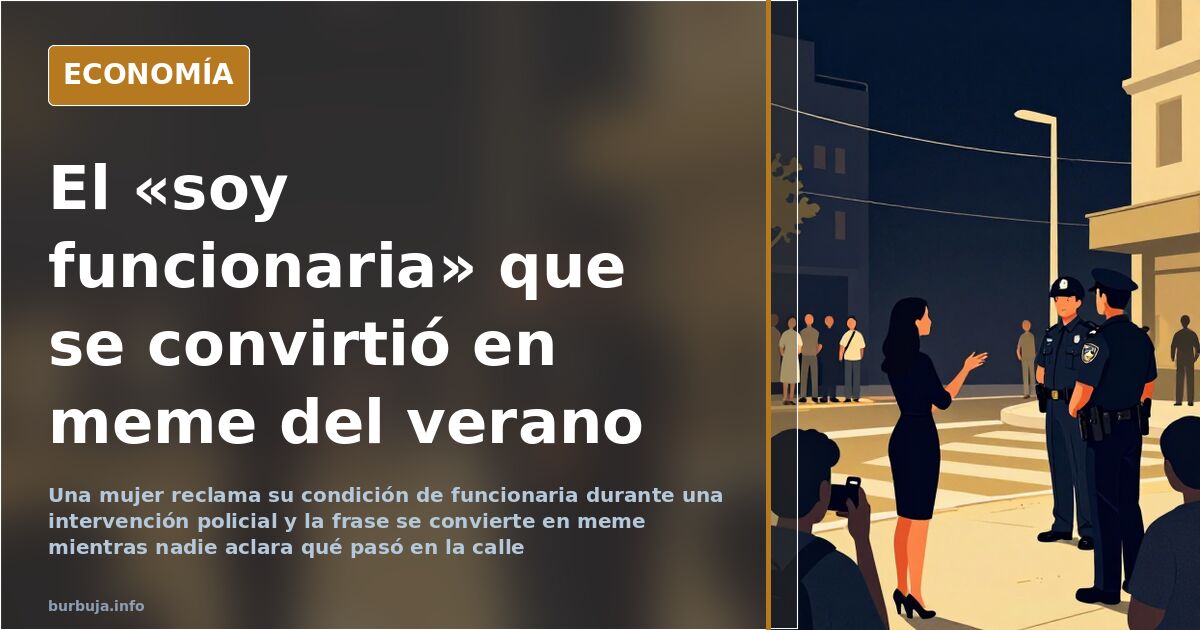
No one has yet proven that being a civil servant prevents an officer from grabbing your arm. It doesn't matter. The phrase has become the summer hit, turning a confusing police intervention into an uncomfortable mirror: a society loudly debating whether public employment offers protection or just second-hand embarrassment. In the circulating scene, a woman repeats "EHHHHH, EHHHHHH" and "don't touch me, I'm a civil servant" while two Local Police officers struggle with a man who, according to witnesses, appears disoriented. The recording lasts less than the controversy, which is saying a lot.
What is seen in the "I'm a civil servant" video
Little and much at once. A scuffle, two uniformed officers, a woman invoking her job status as if it were a bulletproof vest, and a man being restrained. There is debate over the use of batons, immobilization techniques, and who controlled the situation, but no account clarifies the starting point: neither prior warnings, nor the motive, nor the actual state of the person involved. In this vacuum, the conversation becomes creative. A line-by-line breakdown—who says what and in what order—is more useful than any hasty headline.
One circulating hypothesis is that the man is a relative of the woman and suffers from untreated issues. None of this is confirmed; the video only supports the sound. Another part of the commentary reinforces the kinship theory and leaves a phrase that sums up half the issue: "I don't understand police procedures, but instead of helping, they seem to aggravate the problem."
Where does the accompanying "EHHHHH" come from?
The sound isn't new. Before the video popularized it, that "EHHHHH, EHHHHH" had been installed in the collective imagination for years: it was a Televisión Española (TVE) transition sting, a filler that became normalized as the soundtrack for booing. The coincidence between the start of the scene and the old TV cue did more for virality than any detail of the intervention. Someone adds, as a bonus, that the officers didn't get burned out of the fight because the man was wearing flip-flops.
Why did "I'm a civil servant" become a meme?
Because it touches an old nerve. The phrase activates the suspicion that there exists a caste with permanent positions and a conviction of being above the average citizen. It is no accident that the repertoire also includes a "don't touch me, I'm A1" (top-tier administrative grade), recited like a magic password. The jump to a joke was immediate: "I'm Charo, a civil servant" as a key to deactivate an officer.
Some read the episode as a symptom of a labor aristocracy that knows it is untouchable. What the recording fixes is the gesture: the woman invokes no right, she invokes her paycheck.
Does saying "I'm a civil servant" help with police?
No. In all material surrounding the scene, no norm, regulation, or instruction granting a public employee a shield against identification or arrest appears. Civil servant status grants no privilege before the law, and common sense in the comments repeats this ad nauseam. Another thing is what each person believes they have: the expression "don't touch me" anticipates that whoever says it expects different treatment. If immunity doesn't exist, where does the confidence with which it is claimed come from?
The labor detail is grayer than the joke suggests. Public employment regimes have peculiarities that feed the sense of shielding—stability, internal discipline, seniority—but none turn a civil servant into a citizen with a special ID card. The gap between law and perception is exactly the space where all reactions generated by the video fit.
Police action under scrutiny
The second front is the officers themselves. They are criticized for lack of technique—"none of the three know how to stand their ground," summarizes one comment, adding that those who should protect you don't know how to protect themselves—and accused of going straight to physical struggle. Another segment reopens the comparison with the United States and its use-of-force doctrine; the trench response is always the same: what matters what they do there?
No one disputes an uncomfortable nuance: the action is judged by the video, without a file, without the officers' version, and without injury reports. And an anecdote someone rescues from their military service—that certain minor infractions were resolved with a blind eye—reminds us that discretion has always existed. The difference is that now it is recorded and shared.
The man, the part not in the joke
Underneath the meme is a person restrained in the middle of the street, with a mental state no one has confirmed and many assume. It is the least fun part and the one neither side wants to acknowledge: if there was a health issue, the video doesn't solve it, it exposes it. It is worth remembering before laughing again at the phrase.
Closing
With what is on the table, it is likely the matter will remain memes, t-shirts, and some file no one will see. If an official version appears, the focus will shift. If it doesn't, the phrase will continue doing the video's work: dividing people into two groups, those who have a position and those who pay for it.
No one has yet proven that being a civil servant prevents an officer from grabbing your arm. It doesn't matter. The phrase has become the summer hit, turning a confusing police intervention into an uncomfortable mirror: a society loudly debating whether public employment offers protection or just second-hand embarrassment. In the circulating scene, a woman repeats "EHHHHH, EHHHHHH" and "don't touch me, I'm a civil servant" while two Local Police officers struggle with a man who, according to witnesses, appears disoriented. The recording lasts less than the controversy, which is saying a lot.
What is seen in the "I'm a civil servant" video
Little and much at once. A scuffle, two uniformed officers, a woman invoking her job status as if it were a bulletproof vest, and a man being restrained. There is debate over the use of batons, immobilization techniques, and who controlled the situation, but no account clarifies the starting point: neither prior warnings, nor the motive, nor the actual state of the person involved. In this vacuum, the conversation becomes creative. A line-by-line breakdown—who says what and in what order—is more useful than any hasty headline.
One circulating hypothesis is that the man is a relative of the woman and suffers from untreated issues. None of this is confirmed; the video only supports the sound. Another part of the commentary reinforces the kinship theory and leaves a phrase that sums up half the issue: "I don't understand police procedures, but instead of helping, they seem to aggravate the problem."
Where does the accompanying "EHHHHH" come from?
The sound isn't new. Before the video popularized it, that "EHHHHH, EHHHHH" had been installed in the collective imagination for years: it was a Televisión Española (TVE) transition sting, a filler that became normalized as the soundtrack for booing. The coincidence between the start of the scene and the old TV cue did more for virality than any detail of the intervention. Someone adds, as a bonus, that the officers didn't get burned out of the fight because the man was wearing flip-flops.
Why did "I'm a civil servant" become a meme?
Because it touches an old nerve. The phrase activates the suspicion that there exists a caste with permanent positions and a conviction of being above the average citizen. It is no accident that the repertoire also includes a "don't touch me, I'm A1" (top-tier administrative grade), recited like a magic password. The jump to a joke was immediate: "I'm Charo, a civil servant" as a key to deactivate an officer.
Some read the episode as a symptom of a labor aristocracy that knows it is untouchable. What the recording fixes is the gesture: the woman invokes no right, she invokes her paycheck.
Does saying "I'm a civil servant" help with police?
No. In all material surrounding the scene, no norm, regulation, or instruction granting a public employee a shield against identification or arrest appears. Civil servant status grants no privilege before the law, and common sense in the comments repeats this ad nauseam. Another thing is what each person believes they have: the expression "don't touch me" anticipates that whoever says it expects different treatment. If immunity doesn't exist, where does the confidence with which it is claimed come from?
The labor detail is grayer than the joke suggests. Public employment regimes have peculiarities that feed the sense of shielding—stability, internal discipline, seniority—but none turn a civil servant into a citizen with a special ID card. The gap between law and perception is exactly the space where all reactions generated by the video fit.
Police action under scrutiny
The second front is the officers themselves. They are criticized for lack of technique—"none of the three know how to stand their ground," summarizes one comment, adding that those who should protect you don't know how to protect themselves—and accused of going straight to physical struggle. Another segment reopens the comparison with the United States and its use-of-force doctrine; the trench response is always the same: what matters what they do there?
No one disputes an uncomfortable nuance: the action is judged by the video, without a file, without the officers' version, and without injury reports. And an anecdote someone rescues from their military service—that certain minor infractions were resolved with a blind eye—reminds us that discretion has always existed. The difference is that now it is recorded and shared.
The man, the part not in the joke
Underneath the meme is a person restrained in the middle of the street, with a mental state no one has confirmed and many assume. It is the least fun part and the one neither side wants to acknowledge: if there was a health issue, the video doesn't solve it, it exposes it. It is worth remembering before laughing again at the phrase.
Closing
With what is on the table, it is likely the matter will remain memes, t-shirts, and some file no one will see. If an official version appears, the focus will shift. If it doesn't, the phrase will continue doing the video's work: dividing people into two groups, those who have a position and those who pay for it.
Summary of a discussion on Burbuja.info - Foro de economía, actualidad y política., translated from Spanish and reviewed before publication. Read the full discussion (193 replies).
More summaries
-
Un, dos, tres: Pradera and Cortez knew more than today's graduates
The 'Un, dos, tres' clip of Pradera and Cortez reciting classics reignites debate over EGB (old Spanish primary) vs ESO (current secondary)
-
37-year-old police chief in Yeles, Spain, dies by suicide
The death of a 37-year-old police chief in Yeles raises questions about workplace pressure, firearm access, and the lack of official data.
-
Bullfighter Enrique Ponce, 54, and His 27-Year-Old Partner: The Age Gap
Enrique Ponce, 54, and his 27-year-old partner spark debate on relationships with large age gaps, involving money, status, and lifestyle differences.
-
Ayuso Cites Mari Carmen to Blame Sánchez, Omits Criticism of Her Own Administration
Madrid leader Ayuso used a eviction case to attack PM Sánchez but ignored the victim's criticism of her own administration and Mayor Almeida.
-
Ayuso Urges Against Mail-In Voting Citing Fraud Risk
Madrid's Ayuso warns of potential electoral fraud via mail-in ballots without evidence, sparking debate during the pre-campaign period.
-
Spain's new rental law: Five exceptions to landlord compensation
Royal Decree-Law 27/2026 mandates 12-month compensation for non-renewal in Spain, with five specific exceptions. It takes effect immediately.