
Spain’s hunters halve in 50 years; collapse expected by 2050
Hunting loses half its participants in 50 years; recruitment drops 89%. Only 6,000 new enthusiasts in the last decade.
English · Original discussion in Spanish · Published
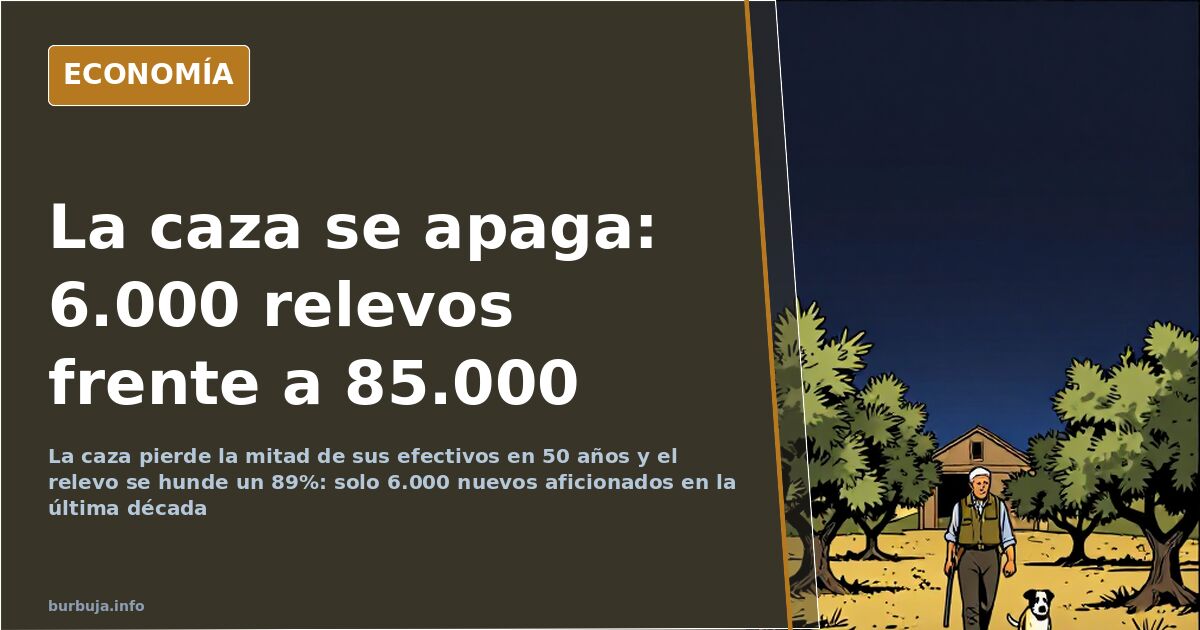
Spain loses half its hunters and the replacement no longer arrives
In the 1970s, nearly 85,000 new hunters joined per decade. In the last one, barely 6,000. This gap paints a picture of a group fading faster than it renews: hunting activity has dropped 45% over half a century and 26% in the last 15 years. Documented by a study published in the journal People and Nature and disseminated by El Confidencial, it projects an uncomfortable scenario: if nothing changes, by 2050 hunting will have declined 70%, and the proportion of enthusiasts over 60 will rise from 40% to 61%.
The work is authored by José Daniel Anadón, a scientist at the Pyrenean Institute of Ecology (IPE-CSIC). Its basis is nearly 600,000 hunters from six autonomous communities —Andalusia, Murcia, Castilla-La Mancha, Madrid, Aragon and Navarre— and Portugal, a set representing nearly 60% of the population and the peninsula’s surface. The authors warn that Galicia, Asturias and Castile and León are excluded from the calculation, and they are the oldest areas. Translated: the global figure may be even worse.
What the study says about the decline of hunting in Spain
The work does not describe a dip. It describes a demographic collapse due to lack of recruitment. Young people’s entry has fallen 89% over half a century, and the result is that the most numerous age bracket is now between 61 and 70. The decline, moreover, has been constant over the last 50 years: there are no good exercises to offset the bad ones.
The explanation has historical roots. Hunting was a subsistence activity in an agrarian society and, with emigration to cities in the 1960s, became leisure. That generation kept hunting. The next one did not. For a teenager to take up the hobby requires something as simple and as difficult as his father taking him to the countryside from childhood, and in the urban environment hunting is just one more option competing with other forms of leisure or contact with nature. No one wins that fight by inertia.
Why there is no longer generational replacement in hunting?
Because hunting lives from the countryside. Participation in hunting activities is up to eight times higher in small towns than in large ones: the more the municipality empties, the fewer shotguns. The decline of hunting is, to a large extent, the decline of the rural world counted with another metric.
The demographic drip feeds itself. And some argue, without it being provable, that those trying to enter find a very closed circle, with family cliques and old hierarchies, where it is not always easy to get into the woods without a sponsor vouching for you.
The cost of hunting: from popular pastime to expensive sport
The complaint repeats itself among those participating in the debate: hunting used to be within everyone’s reach and today is extremely expensive. Add fuel, car depreciation, club fees, administrative charges and ammunition, and it becomes a leisure activity competing in price with many others.
Regulation adds to this. In Catalonia, according to a participant’s account, a particularly restrictive and bureaucratic hunting law led enthusiasts to a sort of gun strike for months. That same version includes wild boars wandering the streets and opening trash bags in municipalities with door-to-door collection.
Wild boars, rabbits and parrots: the pests that, according to the sector, arrive without hunters
The list brandished by hunting’s defenders is long: rabbits, hares, wild boars, parrots, silurus, American crayfish and blue crayfish. Species that, in their view, behave as pests and pressure crops, infrastructure and native wildlife.
The best involuntary laboratory is the National Parks, where commercial and sporting hunting has been prohibited since 2020. There management begins to complicate: the excess of ungulates such as deer and wild boars is causing havoc on other animal species and even on vegetation. The article asks whether, if hunters do not contribute to regulating those populations, this is the future awaiting the entire peninsula.
Do you really need to hunt to maintain the balance of the countryside?
There is no closed answer: the impact of hunting on ecosystems is the subject of debate among scientists themselves. It is clear that the old pursuit of animals for self-consumption or to eliminate livestock predators no longer exists. What there is, in Anadón’s words, is sporting hunting whose effect is difficult to evaluate. And that doubt is the mother of all trench wars.
One current holds that the wolf can assume much of that role: it preys selectively, attacks the weakest specimens first and controls populations slowly, without needing drives. The opposing view answers that packs expand slowly, that there are already attacks on goats and livestock, and that, until that balance arrives, someone will have to remove specimens. Who? The proposal points to forest rangers, that is, to assuming it with public money.
Hunting as a rural business
The debate is not only ecological, it is economic. Hunting has a significant economic impact in rural areas with strong hunting tradition, with Castilla-La Mancha as a recurrent example. Around 2.2% of the population of the Iberian Peninsula hunts, one of the most important groups in Europe.
There is a business line the sector claims as an alternative: hand-held hunting, that done on foot, with dogs and in silence, the one most like a sport and the most marketable as prestigious hunting tourism. It requires, however, large tracts of land.
And a detail the sector cites: thousands of ungulates are bred each year on farms because the sector demands them. According to that argument, the disappearance of hunting does not imply the disappearance of demand for meat or trophies; it implies that it will be sought by another route, probably less controlled.
Can you sustain a countryside with no one paying to manage it? It is one of the questions hovering over the debate when the private enthusiast seems condemned to extinction by age and by price.
In the 1970s, nearly 85,000 new hunters joined per decade. In the last one, barely 6,000. This gap paints a picture of a group fading faster than it renews: hunting activity has dropped 45% over half a century and 26% in the last 15 years. Documented by a study published in the journal People and Nature and disseminated by El Confidencial, it projects an uncomfortable scenario: if nothing changes, by 2050 hunting will have declined 70%, and the proportion of enthusiasts over 60 will rise from 40% to 61%.
The work is authored by José Daniel Anadón, a scientist at the Pyrenean Institute of Ecology (IPE-CSIC). Its basis is nearly 600,000 hunters from six autonomous communities —Andalusia, Murcia, Castilla-La Mancha, Madrid, Aragon and Navarre— and Portugal, a set representing nearly 60% of the population and the peninsula’s surface. The authors warn that Galicia, Asturias and Castile and León are excluded from the calculation, and they are the oldest areas. Translated: the global figure may be even worse.
What the study says about the decline of hunting in Spain
The work does not describe a dip. It describes a demographic collapse due to lack of recruitment. Young people’s entry has fallen 89% over half a century, and the result is that the most numerous age bracket is now between 61 and 70. The decline, moreover, has been constant over the last 50 years: there are no good exercises to offset the bad ones.
The explanation has historical roots. Hunting was a subsistence activity in an agrarian society and, with emigration to cities in the 1960s, became leisure. That generation kept hunting. The next one did not. For a teenager to take up the hobby requires something as simple and as difficult as his father taking him to the countryside from childhood, and in the urban environment hunting is just one more option competing with other forms of leisure or contact with nature. No one wins that fight by inertia.
Why there is no longer generational replacement in hunting?
Because hunting lives from the countryside. Participation in hunting activities is up to eight times higher in small towns than in large ones: the more the municipality empties, the fewer shotguns. The decline of hunting is, to a large extent, the decline of the rural world counted with another metric.
The demographic drip feeds itself. And some argue, without it being provable, that those trying to enter find a very closed circle, with family cliques and old hierarchies, where it is not always easy to get into the woods without a sponsor vouching for you.
The cost of hunting: from popular pastime to expensive sport
The complaint repeats itself among those participating in the debate: hunting used to be within everyone’s reach and today is extremely expensive. Add fuel, car depreciation, club fees, administrative charges and ammunition, and it becomes a leisure activity competing in price with many others.
Regulation adds to this. In Catalonia, according to a participant’s account, a particularly restrictive and bureaucratic hunting law led enthusiasts to a sort of gun strike for months. That same version includes wild boars wandering the streets and opening trash bags in municipalities with door-to-door collection.
Wild boars, rabbits and parrots: the pests that, according to the sector, arrive without hunters
The list brandished by hunting’s defenders is long: rabbits, hares, wild boars, parrots, silurus, American crayfish and blue crayfish. Species that, in their view, behave as pests and pressure crops, infrastructure and native wildlife.
The best involuntary laboratory is the National Parks, where commercial and sporting hunting has been prohibited since 2020. There management begins to complicate: the excess of ungulates such as deer and wild boars is causing havoc on other animal species and even on vegetation. The article asks whether, if hunters do not contribute to regulating those populations, this is the future awaiting the entire peninsula.
Do you really need to hunt to maintain the balance of the countryside?
There is no closed answer: the impact of hunting on ecosystems is the subject of debate among scientists themselves. It is clear that the old pursuit of animals for self-consumption or to eliminate livestock predators no longer exists. What there is, in Anadón’s words, is sporting hunting whose effect is difficult to evaluate. And that doubt is the mother of all trench wars.
One current holds that the wolf can assume much of that role: it preys selectively, attacks the weakest specimens first and controls populations slowly, without needing drives. The opposing view answers that packs expand slowly, that there are already attacks on goats and livestock, and that, until that balance arrives, someone will have to remove specimens. Who? The proposal points to forest rangers, that is, to assuming it with public money.
Hunting as a rural business
The debate is not only ecological, it is economic. Hunting has a significant economic impact in rural areas with strong hunting tradition, with Castilla-La Mancha as a recurrent example. Around 2.2% of the population of the Iberian Peninsula hunts, one of the most important groups in Europe.
There is a business line the sector claims as an alternative: hand-held hunting, that done on foot, with dogs and in silence, the one most like a sport and the most marketable as prestigious hunting tourism. It requires, however, large tracts of land.
And a detail the sector cites: thousands of ungulates are bred each year on farms because the sector demands them. According to that argument, the disappearance of hunting does not imply the disappearance of demand for meat or trophies; it implies that it will be sought by another route, probably less controlled.
Can you sustain a countryside with no one paying to manage it? It is one of the questions hovering over the debate when the private enthusiast seems condemned to extinction by age and by price.
Summary of a discussion on Burbuja.info - Foro de economía, actualidad y política., translated from Spanish and reviewed before publication. Read the full discussion (257 replies).
More summaries
-
El Confidencial: CERA Vote Residency Was Not Verified
Report published by El Confidencial: Consulates requested residency papers very recently and described no material proof of connection.
-
Fiscal Scandal Involving Government Insider Sparks Resignation Calls
Investigation into fake Costa Rican companies used by a close associate of the PSOE. Could this trigger a presidential crisis?
-
Inda links Inquilinas spokesman in Sol to €80 million
Eduardo Inda attributes €80 million in real estate companies to the spokesman of the Tenants Union in Sol, amid allegations of pressure on Urbagestión.
-
Garzón denies building more housing lowers prices, but data contradicts him
Eduardo Garzón argues that increased construction does not reduce housing prices. However, supply and demand data in Spain suggest otherwise.
-
Avoiding Spanish Polling Station Duty by Not Answering Door
In Spain, polling station notification requires a signature. Without it, there is no summons. The lottery runs from October 31 to November 4.
-
Spain's Administrative Collapse: Six Months for One Registration
Intellectual property registrations now take six months instead of fifteen days, highlighting a severe administrative breakdown in Spain.