
Spain's household savings rate drops to 11.8%
Economist Santiago Niño Becerra warns that inflation is eroding Spanish savings, which have fallen to 11.8% from 25% in late 2020.
English · Original discussion in Spanish · Published
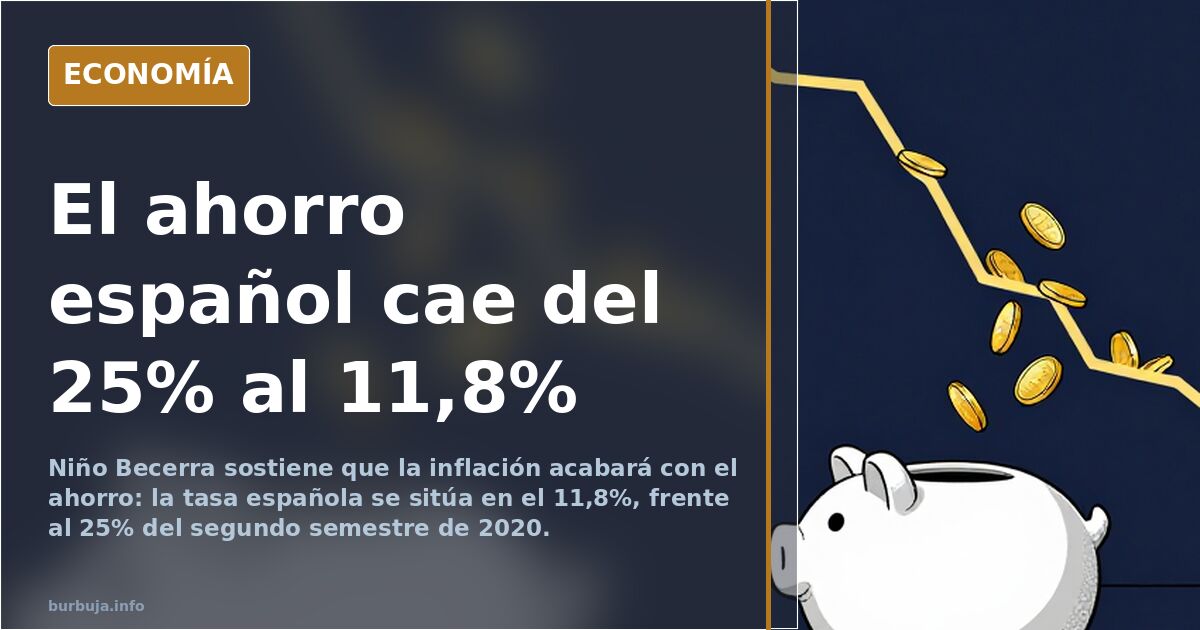
Niño Becerra: Spain's savings plunge to 11.8%
Spanish household savings are hemorrhaging. This is the thesis of economist Santiago Niño Becerra, who argues that if inflation does not subside and purchasing power does not recover, savings will "eventually disappear" due to a "negative redistribution of income." He published this view on X, backing it with charts from El Economista. His conclusion: rising grocery prices have forced households to dip into their reserves to maintain their standard of living.
The figure underpinning this argument is 11.8%. This is the current average savings rate for Spaniards, adjusted for inflation. In the eurozone between 2015 and 2019, this rate hovered around 12.6%. The alarming data point is different: in the second half of 2020, Spanish savings reached 25%, thirteen points higher than today.
Where is the flaw in the analysis?
Comparing today's savings with those of 2020 is misleading. That semester was anything but normal: with economic activity semi-paralyzed and consumption restricted, households accumulated money they could not spend. Using that peak as a baseline to project a downward trend toward disaster is, according to several commentators, a deceptive exercise.
A more common objection goes further: the data itself supports the opposite interpretation. If savings are lower now than in 2020 but align with the eurozone average of the past decade, the diagnosis is not apocalyptic but rather a return to normalcy after an exceptional pause. Serious analyses, critics argue, do not project trends by comparing atypical periods with the present.
What few dispute is the bottom line. Grocery prices have risen while wages have not kept pace. In other words, people are buying less with the same amount of money.
Ten years predicting catastrophe
There is a credibility issue that weighs more than any chart. Critics accuse him of having predicted an economic cataclysm since 2010—making the 2008 crisis look trivial—that has yet to materialize. Some also recall his failed predictions regarding Catalan independence. None came true, according to these critics.
This track record fuels a cynical reading: each warning serves as a showcase for a book. The fact that the interview appeared in a sports outlet rather than another publication's economy section is seen as a mass-reach marketing operation. Savers who have heard for a decade that the world is ending have learned to discount the noise.
License plates as a consumer thermometer
A simple exercise helps measure real sentiment: tracking license plate issuance rates. The series 1111BBB was registered on September 19, 2000. Between 1111FBB and 1111GBB, 617 days passed; between 1111HBB (December 2010) and 1111JBB (November 2014), 1,416 days elapsed—the longest interval in the series. Plate 02**MKJ arrived on September 15, 2023.
The interpretation of this table is that number series were exhausted faster during boom years and have stretched out since the K series. What drives the market, proponents argue, is leasing and rental cars, not private buyers changing vehicles every four years. The vehicle fleet is aging because purchases are being postponed.
Gold, fiat currency, and wealth
The discussion quickly turned to a classic topic: gold. One camp defends it as a safe haven; the counterargument is that metal does not fill gas tanks or pay for groceries, and those who accumulate it still depend on circulating banknotes. One participant issued a warning: Spain allegedly has laws allowing asset seizure in times of need.
On the other side, there is defense of the idea that wealth should not be touched for daily subsistence. Savings are not monthly cash flow; they are what remains afterward. From this arises another complaint: discussing seizing homes from those who own none while leaving untouched the properties of those who own five.
From steak to cheap processed meat
If any consensus emerges, it is the most austere one. The dominant recommendation is to forget about steaks and embrace cheap processed meats and canned goods as a retirement plan. It sounds like a joke, but it describes a real strategy for adjusting household spending.
Some look beyond personal finances. If savers suffer from inflation, critics argue, a country owing around 150% of its GDP suffers even more. Public debt cannot be paid off with slices of ham.
Niño Becerra will likely be right eventually. This happens when someone repeats the same prophecy for fifteen years: sooner or later, something fits. The useful question is not whether savings are shrinking—they are—but how much of the diagnosis responds to data versus the habit of selling the end of the world.
Spanish household savings are hemorrhaging. This is the thesis of economist Santiago Niño Becerra, who argues that if inflation does not subside and purchasing power does not recover, savings will "eventually disappear" due to a "negative redistribution of income." He published this view on X, backing it with charts from El Economista. His conclusion: rising grocery prices have forced households to dip into their reserves to maintain their standard of living.
The figure underpinning this argument is 11.8%. This is the current average savings rate for Spaniards, adjusted for inflation. In the eurozone between 2015 and 2019, this rate hovered around 12.6%. The alarming data point is different: in the second half of 2020, Spanish savings reached 25%, thirteen points higher than today.
Where is the flaw in the analysis?
Comparing today's savings with those of 2020 is misleading. That semester was anything but normal: with economic activity semi-paralyzed and consumption restricted, households accumulated money they could not spend. Using that peak as a baseline to project a downward trend toward disaster is, according to several commentators, a deceptive exercise.
A more common objection goes further: the data itself supports the opposite interpretation. If savings are lower now than in 2020 but align with the eurozone average of the past decade, the diagnosis is not apocalyptic but rather a return to normalcy after an exceptional pause. Serious analyses, critics argue, do not project trends by comparing atypical periods with the present.
What few dispute is the bottom line. Grocery prices have risen while wages have not kept pace. In other words, people are buying less with the same amount of money.
Ten years predicting catastrophe
There is a credibility issue that weighs more than any chart. Critics accuse him of having predicted an economic cataclysm since 2010—making the 2008 crisis look trivial—that has yet to materialize. Some also recall his failed predictions regarding Catalan independence. None came true, according to these critics.
This track record fuels a cynical reading: each warning serves as a showcase for a book. The fact that the interview appeared in a sports outlet rather than another publication's economy section is seen as a mass-reach marketing operation. Savers who have heard for a decade that the world is ending have learned to discount the noise.
License plates as a consumer thermometer
A simple exercise helps measure real sentiment: tracking license plate issuance rates. The series 1111BBB was registered on September 19, 2000. Between 1111FBB and 1111GBB, 617 days passed; between 1111HBB (December 2010) and 1111JBB (November 2014), 1,416 days elapsed—the longest interval in the series. Plate 02**MKJ arrived on September 15, 2023.
The interpretation of this table is that number series were exhausted faster during boom years and have stretched out since the K series. What drives the market, proponents argue, is leasing and rental cars, not private buyers changing vehicles every four years. The vehicle fleet is aging because purchases are being postponed.
Gold, fiat currency, and wealth
The discussion quickly turned to a classic topic: gold. One camp defends it as a safe haven; the counterargument is that metal does not fill gas tanks or pay for groceries, and those who accumulate it still depend on circulating banknotes. One participant issued a warning: Spain allegedly has laws allowing asset seizure in times of need.
On the other side, there is defense of the idea that wealth should not be touched for daily subsistence. Savings are not monthly cash flow; they are what remains afterward. From this arises another complaint: discussing seizing homes from those who own none while leaving untouched the properties of those who own five.
From steak to cheap processed meat
If any consensus emerges, it is the most austere one. The dominant recommendation is to forget about steaks and embrace cheap processed meats and canned goods as a retirement plan. It sounds like a joke, but it describes a real strategy for adjusting household spending.
Some look beyond personal finances. If savers suffer from inflation, critics argue, a country owing around 150% of its GDP suffers even more. Public debt cannot be paid off with slices of ham.
Niño Becerra will likely be right eventually. This happens when someone repeats the same prophecy for fifteen years: sooner or later, something fits. The useful question is not whether savings are shrinking—they are—but how much of the diagnosis responds to data versus the habit of selling the end of the world.
Also available in: Deutsch
Summary of a discussion on Burbuja.info - Foro de economía, actualidad y política., translated from Spanish and reviewed before publication. Read the full discussion (167 replies).
More summaries
-
Civil Servant Inflation and Purchasing Power Under Scrutiny
Analysis of inflation's impact on public employees' purchasing power. Are civil service salaries protected against rising prices?
-
Why Spain isn't having children: three underlying trends
Housing, wages, female education and immigration: the three trends that explain why Spain barely reaches 1.2 children per woman
-
Spain Audit Finds €2.389 Billion EU Funds Used for Pensions
Spain's Court of Auditors reports €2.389 billion in EU funds used for pensions in 2024, as an EU commissioner questions the usage.
-
Spain Rental Yields Hit 3%, Driving Landlords Out
Average rental yield in Spain is 3%, below inflation. The €500 per €100,000 rule explains why landlords are leaving the market.
-
Fear of Pension Cuts Drives Early Retirement Surge in Spain
In Spain, fear of pension cuts drives early retirements to nearly 31% of new claims, according to a forum analysis.
-
Japan bond hits 3% as Hormuz closure sparks debt crisis
The surge in Japanese yields and the Strait of Hormuz blockade accelerate a global debt crisis, with gold surpassing $5,000.