
Spain's Grey Zone of Alcohol: Normal Drinking Without Addiction
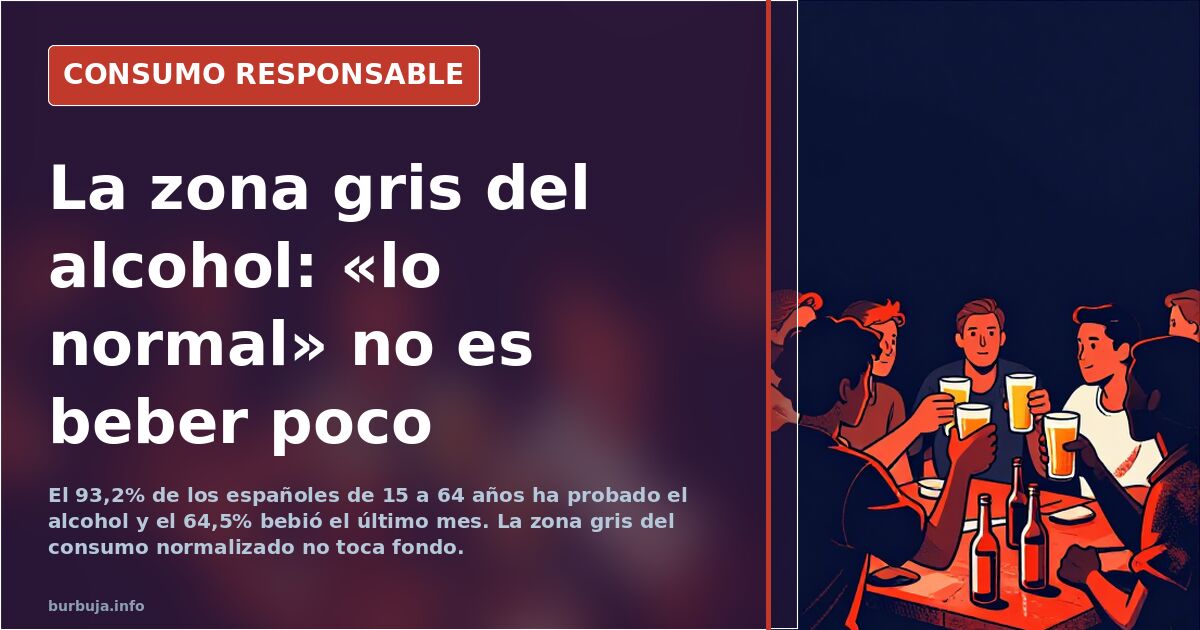
93.2% of Spaniards aged 15-64 have tried alcohol, with 64.5% drinking in the last month. This normalized consumption habit exists in a vast, silent grey area.
English · Original discussion in Spanish · Published
Drinking 'normally': the limbo of those who never hit bottom
For a silent majority, alcohol is not a problem until someone writes it down. In Spain, 93.2% of the population aged 15 to 64 has tried the substance, 64.5% has drunk in the last month, and over 16% has gotten drunk in that period, according to the Survey on Alcohol and Other Drugs (EDADES). The uncomfortable fact is not how much is drunk. It is that almost no one recognizes themselves in the statistics.
The issue took public shape in April 2024, when a report by Patricia Gosálvez described the alcohol 'grey zone': that vast, blurry limbo between who drinks occasionally and who would receive a clinical diagnosis. No bottom, no epiphany, no health scare. Just inertia. And a disconcerting question: what does it miccionan to drink 'normally'?
How much alcohol is 'low-risk', according to Health authorities
Less than any all-you-can-drink bar suggests. Health sets 10 grams of ethanol per day as the ceiling for 'low-risk' consumption for a woman —a small beer, half a glass of wine, half a shot— and double for a man. From there, the health authority warns, 'a significant increase in mortality occurs.' The typical Saturday meal —vermouth, half a bottle of wine, and a gin and tonic after dinner— multiplies that rate almost tenfold.
Does it compensate for being sober the rest of the week? No. 'On the contrary,' stresses Mercè Balcells, psychiatrist and head of the Addictive Behaviors Unit at the Clínic Hospital in Barcelona: weekend binge drinking adds problems due to acute toxicity and accidents, falls, or violence. The bill is not paid from Monday to Thursday.
The social drinker who never stopped drinking
Montse Collado, a 41-year-old coach, has gone almost a year without trying alcohol. She could go weeks without drinking, but when she did, having just one was unthinkable. 'More than dependence, mine was inertia,' she summarizes. She drank like her friends; the WhatsApp group was once called The Sue Ellens, after the Dallas character always with a glass in hand. She never hit bottom because there was no bottom to hit.
The case of Messner, a 49-year-old carpenter from Navarre, is the quiet reverse of the same pattern. Six or seven small beers during the week, split between lunch, dinner, and a card game. Not a fight in his history, two vomits in his entire life. 'You don't get drunk, you don't get sick, it's normal in your circle,' he admits. 'But if you think about it, it's amazing.' He has started by removing the lunch beer.
Why does no one ask how much the patient drinks?
Because the answer makes both sides of the table uncomfortable. The OECD includes increasing surveillance in primary care among its recommended measures, and Health guidelines ask to explore consumption 'at least every two years' in everyone over 14. Practice goes another way: Bob Pop, diagnosed with a neurodegenerative disease at 20, was never asked how much he drank.
The popularizer Oihan Iturbide, a recovered addict and editor of Adicto Books, explains it bluntly. A clinical alcoholic has obvious reasons to quit; someone inhabiting the grey zone is functional and receives no stimulus to change. Around 10% of the population develops an Alcohol Use Disorder, the disease colloquially called alcoholism. The rest drink. There is the knot.
The cultural battle: individual freedom vs. sarracena
The reaction to the report drew two sides that do not discuss data, but who has authority at the table. One current defends consumption as a territory of personal freedom: if one does not bother anyone, they should drink what they please. Another demands eradicating what they consider a vice and recalls that some pay the consequences without having chosen to drink. The health discussion degenerates into a discussion about freedom in minutes.
In the middle appear uncomfortable nuances. There are those who do not drink and do not want to explain: those who do not try alcohol endure the insistence on that 'just one little glass.' And an argument bounces between both sides: if ethanol were such a potent carcinogen, countries with higher consumption should show much higher rates, and the relationship is not so simple. The anecdote of the great-grandfather who drank wine with meals from age 14 and died at 104 always wins at the dinner table.
The morning short beer and the functional alcoholic
There is a step that common language does not distinguish. The couple of red wines in the morning before entering the workplace, the small beer after lunch, and the round after leaving the shift draw a profile that some analyses place openly in dependence: functional alcoholics who perform and socialize without making a scene. The border with the grey zone is a matter of degree, not nature. That is the profile that, according to some forum users, appears in early breathalyzer checks, when agents stop those who have a sol y sombra before clocking in.
Where the conversation stalls
The gap between evidence and custom is not closed with information. Iturbide himself proposes questions to break the ice: have you chosen friends for alcohol?, has it been present in your relationships?, do you stop doing things you like because of the hangover? No one answers them aloud. The grey zone remains there, comfortable, functional, with no bottom to betray it. And with a staggering fact: 39% of men aged 15 to 24 got drunk in the last month. For many, that will continue to be 'normal'.
For a silent majority, alcohol is not a problem until someone writes it down. In Spain, 93.2% of the population aged 15 to 64 has tried the substance, 64.5% has drunk in the last month, and over 16% has gotten drunk in that period, according to the Survey on Alcohol and Other Drugs (EDADES). The uncomfortable fact is not how much is drunk. It is that almost no one recognizes themselves in the statistics.
The issue took public shape in April 2024, when a report by Patricia Gosálvez described the alcohol 'grey zone': that vast, blurry limbo between who drinks occasionally and who would receive a clinical diagnosis. No bottom, no epiphany, no health scare. Just inertia. And a disconcerting question: what does it miccionan to drink 'normally'?
How much alcohol is 'low-risk', according to Health authorities
Less than any all-you-can-drink bar suggests. Health sets 10 grams of ethanol per day as the ceiling for 'low-risk' consumption for a woman —a small beer, half a glass of wine, half a shot— and double for a man. From there, the health authority warns, 'a significant increase in mortality occurs.' The typical Saturday meal —vermouth, half a bottle of wine, and a gin and tonic after dinner— multiplies that rate almost tenfold.
Does it compensate for being sober the rest of the week? No. 'On the contrary,' stresses Mercè Balcells, psychiatrist and head of the Addictive Behaviors Unit at the Clínic Hospital in Barcelona: weekend binge drinking adds problems due to acute toxicity and accidents, falls, or violence. The bill is not paid from Monday to Thursday.
The social drinker who never stopped drinking
Montse Collado, a 41-year-old coach, has gone almost a year without trying alcohol. She could go weeks without drinking, but when she did, having just one was unthinkable. 'More than dependence, mine was inertia,' she summarizes. She drank like her friends; the WhatsApp group was once called The Sue Ellens, after the Dallas character always with a glass in hand. She never hit bottom because there was no bottom to hit.
The case of Messner, a 49-year-old carpenter from Navarre, is the quiet reverse of the same pattern. Six or seven small beers during the week, split between lunch, dinner, and a card game. Not a fight in his history, two vomits in his entire life. 'You don't get drunk, you don't get sick, it's normal in your circle,' he admits. 'But if you think about it, it's amazing.' He has started by removing the lunch beer.
Why does no one ask how much the patient drinks?
Because the answer makes both sides of the table uncomfortable. The OECD includes increasing surveillance in primary care among its recommended measures, and Health guidelines ask to explore consumption 'at least every two years' in everyone over 14. Practice goes another way: Bob Pop, diagnosed with a neurodegenerative disease at 20, was never asked how much he drank.
The popularizer Oihan Iturbide, a recovered addict and editor of Adicto Books, explains it bluntly. A clinical alcoholic has obvious reasons to quit; someone inhabiting the grey zone is functional and receives no stimulus to change. Around 10% of the population develops an Alcohol Use Disorder, the disease colloquially called alcoholism. The rest drink. There is the knot.
The cultural battle: individual freedom vs. sarracena
The reaction to the report drew two sides that do not discuss data, but who has authority at the table. One current defends consumption as a territory of personal freedom: if one does not bother anyone, they should drink what they please. Another demands eradicating what they consider a vice and recalls that some pay the consequences without having chosen to drink. The health discussion degenerates into a discussion about freedom in minutes.
In the middle appear uncomfortable nuances. There are those who do not drink and do not want to explain: those who do not try alcohol endure the insistence on that 'just one little glass.' And an argument bounces between both sides: if ethanol were such a potent carcinogen, countries with higher consumption should show much higher rates, and the relationship is not so simple. The anecdote of the great-grandfather who drank wine with meals from age 14 and died at 104 always wins at the dinner table.
The morning short beer and the functional alcoholic
There is a step that common language does not distinguish. The couple of red wines in the morning before entering the workplace, the small beer after lunch, and the round after leaving the shift draw a profile that some analyses place openly in dependence: functional alcoholics who perform and socialize without making a scene. The border with the grey zone is a matter of degree, not nature. That is the profile that, according to some forum users, appears in early breathalyzer checks, when agents stop those who have a sol y sombra before clocking in.
Where the conversation stalls
The gap between evidence and custom is not closed with information. Iturbide himself proposes questions to break the ice: have you chosen friends for alcohol?, has it been present in your relationships?, do you stop doing things you like because of the hangover? No one answers them aloud. The grey zone remains there, comfortable, functional, with no bottom to betray it. And with a staggering fact: 39% of men aged 15 to 24 got drunk in the last month. For many, that will continue to be 'normal'.
Also available in: Deutsch
Summary of a discussion on Burbuja.info - Foro de economía, actualidad y política., translated from Spanish and reviewed before publication. Read the full discussion (221 replies).
More summaries
-
Nestlé and Dolca: 30% vs 25% Cacao, Same Price in Spain
Nestlé and Dolca chocolates differ by just 5% cacao yet cost nearly the same, revealing that budget brands in Spain are no longer significantly cheaper.
-
Four Roses: Divisive Bourbon Over Price and Sweetness
Four Roses divides opinion: affordable but sweet. Wild Turkey 101 and Maker's Mark emerge as better value alternatives.
-
Lacasa Christmas Turrón Ad Sparks Consumer Backlash in Spain
Spanish turrón brand Lacasa faces boycotts after launching a feminist ad claiming women have less leisure time than men.
-
Driving License No Longer a Rite of Passage for Adults
Many adults live without a driving license as car costs, free public transport, and fear outweigh its symbolic value.
-
Foster's Hollywood in Spain: Shrinking Portions, Rising Prices
Returning customers to Foster's Hollywood in Spain report shrunken portions, industrial bread on €14 burgers, and higher prices.
-
Spanish 1970s Cookies: The Lost Taste of Childhood
Iconic Spanish brands like Cuétara and Fontaneda have changed. Palm oil, mergers, and quality cuts explain the decline of a national staple.